Work record
Epitome of the Philippic History of Pompeius Trogus
JustinEpitome of the Philippic History of Pompeius Trogus by Justin (c. AD 200)The Epitome of the Philippic History of Pompeius Trogus is Justin's abridgment of a vast lost Latin world history written in the age of Augustus.c. AD 200 · Ancient · History · Latin
Read this when you want a short ancient survey of kingdoms, from Assyria to Rome.
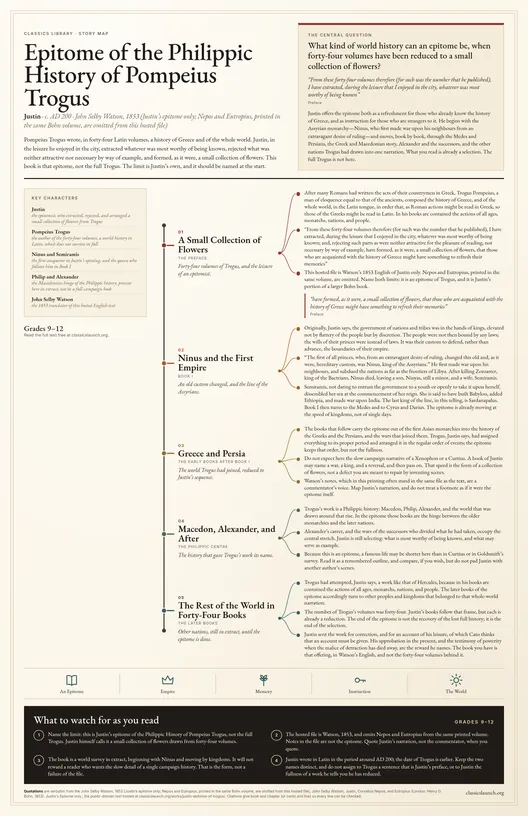 Story mapSee the story mapThe whole book on one page: the story in movements, the characters, and what to watch for. Free to print.
Abstract
Background. A later Roman, otherwise almost unknown, reduced a large Augustan history of the non-Roman world to a manageable abridgment, and that reduced form is now the only path by which the original design can still be read.
Scope. The forty-four books travel from early Asian monarchies through the Greek cities and the Macedonian royal house, then fan out among the courts that rose after the conqueror's death, reaching as far as Carthage, Parthia, Italy, and Spain.
Method. Selection is openly admitted: what is kept is what may please a reader or serve as an example. A reign is often reduced to a few striking deeds and a brief verdict, not to a complete record of campaigns.
Significance. Western schools long used this compact universal history as a first view of many kingdoms, and in 1785 it was chosen as the closing author of an opening course in ancient historians for a young man still in his studies. The book is therefore most useful when read as a treasury of examples, not as a substitute for a full campaign historian of any single reign.
Key figures
- Justin: The epitomist who abridged Trogus
- Pompeius Trogus: Author of the lost Philippic Histories
- Alexander: The central Macedonian figure of the middle books
Summary
The Epitome of the Philippic History of Pompeius Trogus is Justin's abridgment of a vast lost Latin world history written in the age of Augustus. Trogus had told the story of kingdoms from Assyria and Persia through Greece and Macedon to the rise of Rome, with special care for the Macedonian royal house and its successor states. Justin, writing probably in the second or third century AD, says in his preface that he has kept what was most worthy of being known, and has set aside what was neither useful as example nor pleasant to read. The forty-four books of the epitome therefore move quickly: early Asian empires, the affairs of the Greek cities, the rise of Macedon under Philip, the career of Alexander, and the long, often violent, settlement of his empire among the successors. Later books carry the story through the Hellenistic kingdoms, Carthage, Parthia, and the affairs of Italy and Spain, always with an eye to the character of rulers. The work is less a campaign narrative than a school of examples. Ambition, cruelty, filial duty, counsel, and the sudden reverses of royal houses are its usual subjects, and speeches or brief judgments often close a reign. Because Trogus himself is lost, Justin is the only way a modern student can still read that Augustan world history, however shortened. Jefferson placed Justin at the close of the first historical stage he designed for Peter Carr in 1785, after Goldsmith, Herodotus, Thucydides, Xenophon, and Quintus Curtius, as a compact survey of the kingdoms that followed Alexander. The hosted text is the public-domain English of John Selby Watson, taken from his 1853 Bohn volume; only Justin is included here, not the Cornelius Nepos or Eutropius printed with him in that book. A first reading may concentrate on the preface and the Macedonian books, then sample earlier and later reigns as examples, rather than attempting every court in order.
Virtues in this work
- Prudence: Justin repeatedly judges kings by whether they listen to counsel and know the limits of their power.
- Justice: Cruelty, bad faith, and the abuse of subjects are among the vices the epitome holds up for blame.
- Temperance: Ambition that cannot be bounded, and luxury after victory, are treated as the usual ruin of royal houses.
Plot or Argument
- Preface and Books I–VI: Early empires and the Greek cities
Justin explains his abridgment, then moves from Ninus and the Assyrian empire through the Medes and Persians to the Greek states, the Persian wars, and the rivalries that prepared the ground for Macedon.
- Books VII–XII: Philip, Alexander, and the first succession
The epitome now follows the Macedonian house: Philip's rise, Alexander's conquests, his death, and the first struggles among the captains who claimed shares of his empire.
- Books XIII–XLIV: Successor kingdoms to the edge of Rome
The later books survey the Hellenistic kingdoms, Sicily, Carthage, Parthia, and the affairs of Italy and Spain, closing a world history that ends where Roman power is already in view.
Characters
- Justin, Epitomist
The Roman writer who shortened Trogus and who speaks in his own person in the preface.
- Pompeius Trogus, Original historian
The Augustan author of the lost Philippic Histories, whose work Justin preserves only in abridgment.
- Philip of Macedon, King of Macedon
The founder of Macedonian power in Greece, treated at length before the books on his son.
- Alexander, King of Macedon
The conqueror whose career and death organize the central books and whose successors fill many of the later ones.
- Ninus, King of the Assyrians
The first ruler Justin names as changing an old custom of defending, rather than extending, a kingdom's bounds.
Lessons
An abridgment is already a judgment
Justin tells the reader that he has kept what is useful as example or pleasant to read. The epitome is therefore not a neutral shortening. Students should ask, at each reign, why this story survived the cut and what kind of lesson it is meant to supply.
- What does Justin say he has kept, and what has he set aside?
- How would the book feel different if it were only a list of campaigns?
Kingdoms as moral examples
The epitome repeatedly judges rulers by ambition, cruelty, piety toward parents, and the use of counsel. The scale is large, but the unit of interest is often a single house and its virtues or vices.
- Choose one early reign and one Macedonian reign. What moral contrast is Justin drawing?
- Where does a sudden reversal of fortune serve as the real close of a story?
A lost historian, read through another man
Because Trogus is gone, the student meets an Augustan world history only as Justin chose to keep it. That fact is itself a lesson in how historical knowledge is transmitted, shortened, and framed for later readers, including the schoolrooms of Jefferson's day.
- What can we still know of Trogus from this book, and what remains out of reach?
- Why might a short world history have been useful at the end of a first course in ancient historians?
Context
Pompeius Trogus wrote a long Latin history of the non-Roman world, with a special interest in Macedon, in the age of Augustus. Justin later abridged it into forty-four books. The epitome became a standard compact world history in medieval and early modern schools, and it is now the only surviving form of Trogus's work.
Composition
Justin's own date is uncertain, commonly placed in the second or third century AD. The English here is John Selby Watson's 1853 translation for Bohn's Classical Library. This hosting includes only the Justin portion of that volume.
Reception
For centuries Justin was a school text for universal history. Jefferson named him as the last author in the first historical stage of the 1785 plan for Peter Carr, after the Greek historians and Curtius.
Comparisons
- The History of Alexander the Great
Curtius tells Alexander's career at length as a moral and military history; Justin places that career inside a much shorter survey of many kingdoms.
- The Histories
Herodotus is the large Greek beginning of the same world of Asian and Greek kingdoms that Justin later abridges from Trogus; Jefferson set both in one historical course.
- The Grecian History
Goldsmith's 1774 survey was, in Jefferson's plan, the modern first book before the ancient historians; Justin was the last book of that first stage.
Quotes
“I have extracted, during the leisure that I enjoyed in the city, whatever was most worthy of being known; and, rejecting such parts as were neither attractive for the pleasure of reading, nor necessary by way of example, have formed, as it were, a small collection of flowers,”
“The first of all princes, who, from an extravagant desire of ruling, changed this old and, as it were, hereditary custom, was Ninus, king of the Assyrians.”
For Students
A reading companion for classical Christian high school students. See the student guide.
Reading Guide
Watch for
- The preface, in which Justin states his rule for keeping or cutting material.
- The opening books on early Asian kingdoms, where the epitome first shows how it treats a reign as an example.
- The Macedonian books on Philip and Alexander, which form the center of Trogus's original design.
- The later survey of successor kingdoms, where the story becomes many courts instead of one conqueror.
Key terms and names
- Epitome
- A shortened form of a longer work; here, Justin's abridgment of the lost Philippic Histories of Trogus.
- Philippic Histories
- Trogus's original world history, so called because of its special attention to the Macedonian (Philippic) royal house and its aftermath.
- Successors
- The captains and later kings who divided and fought over Alexander's empire after his death.
- Example
- Justin's word for a passage kept because it can teach, not merely because it records what happened.
Seminar Questions
- Comprehension What reason does Justin give in the preface for making an abridgment of Trogus?
- Comprehension Through what major stages does the epitome move from the early Asian kingdoms to the age of Alexander?
- Interpretation How does Justin's portrait of an early king such as Ninus prepare the reader to judge later Macedonian ambition?
- Interpretation In the books after Alexander's death, what kinds of stories does Justin keep, and what does that choice suggest about his aim?
- Big Question If a historian may keep only what is useful as example or pleasant to read, what is at risk of being lost?
- Big Question Can a short world history form a reader's judgment of kings as well as a long campaign narrative can?
Faith Connections
- Daniel 2:37-45 (Scripture)
Daniel's vision of successive kingdoms offers a scriptural way to think about the rise and fall of empires. Students can set that passage beside Justin's survey without treating the epitome as prophecy.
- Proverbs 14:34 (Scripture)
The saying that righteousness exalts a nation, while sin is a reproach to any people, is a just frame for Justin's habit of judging kingdoms by the character of their rulers.
Logic and Rhetoric
Central argument: Justin presents the history of kingdoms as a store of examples, kept from a larger lost work so that later readers may remember what is useful or worth the reading, especially the rise of Macedon and the fates of those who followed Alexander.
Rhetorical device: exemplum. A reign is often told so that a single act of ambition, piety, or cruelty stands for the character of a house, and a brief judgment closes the story.
Debate: Resolved: A short epitome is a better school of political judgment than a long campaign history.
Writing Prompts
Essay: Trace one theme—ambition, filial duty, or the sudden fall of a royal house—from the early books through the Macedonian books, and show how Justin uses it as example.
Comparison with The History of Alexander the Great: Curtius gives a full Latin history of Alexander; Justin gives Alexander a place in a much wider survey of kingdoms. Compare how each writer treats Alexander's death and what follows it.
Creative Prompts
- Essay
Explain Justin's rule of selection in the preface, then test it against one early book and one book on Alexander.
- Dialogue
Write a short exchange in which Justin defends his cuts to a reader who wishes Trogus had been kept in full.
- Classroom
Give students a blank map of the successor kingdoms and have them annotate three courts with a single example Justin wanted remembered.
Further Reading
Verification notes
Primary text checked against the edition identified in fullText. No unverified quotations or page numbers supplied. Recommended grades concern teaching suitability, not a mechanical reading score.
No verification flags recorded.