Story maps · Grades 9–12
Kalevala: A Story Map
The PDF is one tabloid page (11 × 17 in). On letter paper, choose “Fit to page.”
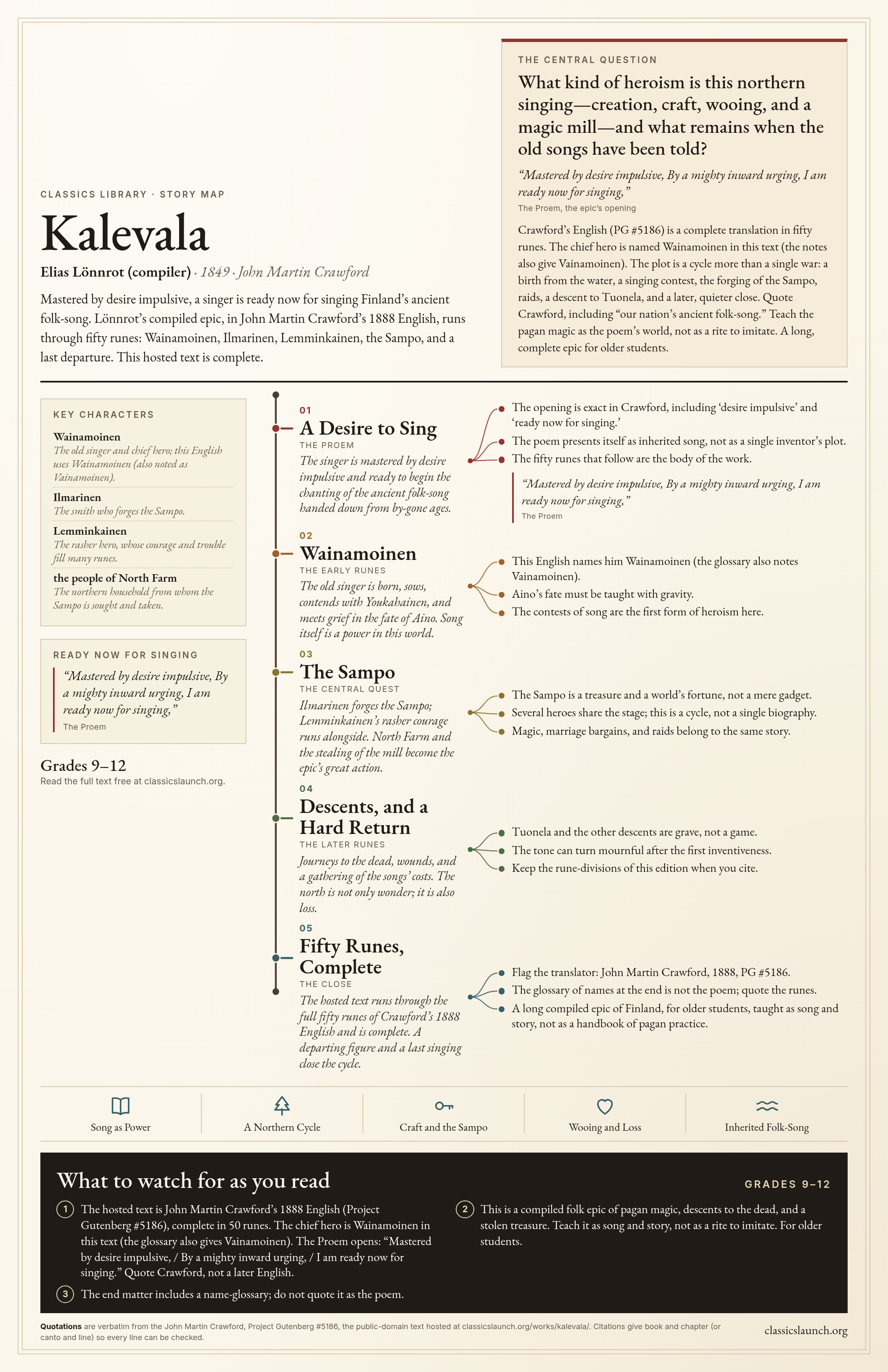
Mastered by desire impulsive, a singer is ready now for singing Finland’s ancient folk-song. Lönnrot’s compiled epic, in John Martin Crawford’s 1888 English, runs through fifty runes: Wainamoinen, Ilmarinen, Lemminkainen, the Sampo, and a last departure. This hosted text is complete.
The central question
What kind of heroism is this northern singing—creation, craft, wooing, and a magic mill—and what remains when the old songs have been told?
“Mastered by desire impulsive, By a mighty inward urging, I am ready now for singing,”
Crawford’s English (PG #5186) is a complete translation in fifty runes. The chief hero is named Wainamoinen in this text (the notes also give Vainamoinen). The plot is a cycle more than a single war: a birth from the water, a singing contest, the forging of the Sampo, raids, a descent to Tuonela, and a later, quieter close. Quote Crawford, including “our nation’s ancient folk-song.” Teach the pagan magic as the poem’s world, not as a rite to imitate. A long, complete epic for older students.
- 01
A Desire to Sing
The Proem
The singer is mastered by desire impulsive and ready to begin the chanting of the ancient folk-song handed down from by-gone ages.
- The opening is exact in Crawford, including ‘desire impulsive’ and ‘ready now for singing.’
- The poem presents itself as inherited song, not as a single inventor’s plot.
- The fifty runes that follow are the body of the work.
“Mastered by desire impulsive, By a mighty inward urging, I am ready now for singing,”
- 02
Wainamoinen
The early runes
The old singer is born, sows, contends with Youkahainen, and meets grief in the fate of Aino. Song itself is a power in this world.
- This English names him Wainamoinen (the glossary also notes Vainamoinen).
- Aino’s fate must be taught with gravity.
- The contests of song are the first form of heroism here.
- 03
The Sampo
The central quest
Ilmarinen forges the Sampo; Lemminkainen’s rasher courage runs alongside. North Farm and the stealing of the mill become the epic’s great action.
- The Sampo is a treasure and a world’s fortune, not a mere gadget.
- Several heroes share the stage; this is a cycle, not a single biography.
- Magic, marriage bargains, and raids belong to the same story.
- 04
Descents, and a Hard Return
The later runes
Journeys to the dead, wounds, and a gathering of the songs’ costs. The north is not only wonder; it is also loss.
- Tuonela and the other descents are grave, not a game.
- The tone can turn mournful after the first inventiveness.
- Keep the rune-divisions of this edition when you cite.
- 05
Fifty Runes, Complete
The close
The hosted text runs through the full fifty runes of Crawford’s 1888 English and is complete. A departing figure and a last singing close the cycle.
- Flag the translator: John Martin Crawford, 1888, PG #5186.
- The glossary of names at the end is not the poem; quote the runes.
- A long compiled epic of Finland, for older students, taught as song and story, not as a handbook of pagan practice.
- Song as Power
- A Northern Cycle
- Craft and the Sampo
- Wooing and Loss
- Inherited Folk-Song
What to watch for as you read
Grades 9–12- The hosted text is John Martin Crawford’s 1888 English (Project Gutenberg #5186), complete in 50 runes. The chief hero is Wainamoinen in this text (the glossary also gives Vainamoinen). The Proem opens: “Mastered by desire impulsive, / By a mighty inward urging, / I am ready now for singing.” Quote Crawford, not a later English.
- This is a compiled folk epic of pagan magic, descents to the dead, and a stolen treasure. Teach it as song and story, not as a rite to imitate. For older students.
- The end matter includes a name-glossary; do not quote it as the poem.
Every quotation is word for word from the John Martin Crawford hosted in this library and is checked against that text each time the site is built. Citations give book and chapter (or canto and line).