Story maps · Grades 3–6
Kashtanka: A Story Map
The PDF is one tabloid page (11 × 17 in). On letter paper, choose “Fit to page.”
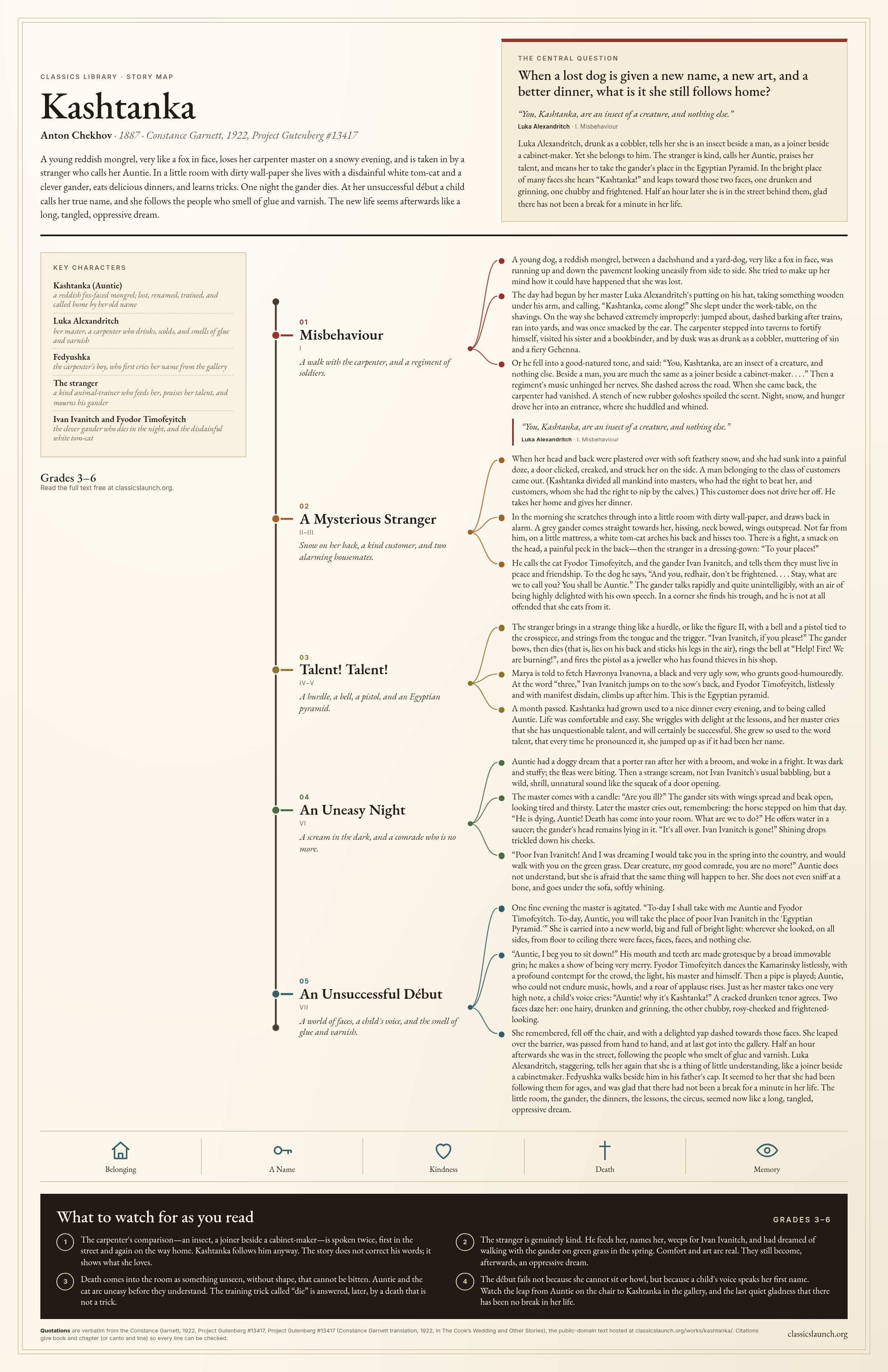
A young reddish mongrel, very like a fox in face, loses her carpenter master on a snowy evening, and is taken in by a stranger who calls her Auntie. In a little room with dirty wall-paper she lives with a disdainful white tom-cat and a clever gander, eats delicious dinners, and learns tricks. One night the gander dies. At her unsuccessful début a child calls her true name, and she follows the people who smell of glue and varnish. The new life seems afterwards like a long, tangled, oppressive dream.
The central question
When a lost dog is given a new name, a new art, and a better dinner, what is it she still follows home?
“You, Kashtanka, are an insect of a creature, and nothing else.”
Luka Alexandritch, drunk as a cobbler, tells her she is an insect beside a man, as a joiner beside a cabinet-maker. Yet she belongs to him. The stranger is kind, calls her Auntie, praises her talent, and means her to take the gander's place in the Egyptian Pyramid. In the bright place of many faces she hears “Kashtanka!” and leaps toward those two faces, one drunken and grinning, one chubby and frightened. Half an hour later she is in the street behind them, glad there has not been a break for a minute in her life.
- 01
Misbehaviour
I
A walk with the carpenter, and a regiment of soldiers.
- A young dog, a reddish mongrel, between a dachshund and a yard-dog, very like a fox in face, was running up and down the pavement looking uneasily from side to side. She tried to make up her mind how it could have happened that she was lost.
- The day had begun by her master Luka Alexandritch's putting on his hat, taking something wooden under his arm, and calling, “Kashtanka, come along!” She slept under the work-table, on the shavings. On the way she behaved extremely improperly: jumped about, dashed barking after trains, ran into yards, and was once smacked by the ear. The carpenter stepped into taverns to fortify himself, visited his sister and a bookbinder, and by dusk was as drunk as a cobbler, muttering of sin and a fiery Gehenna.
- Or he fell into a good-natured tone, and said: “You, Kashtanka, are an insect of a creature, and nothing else. Beside a man, you are much the same as a joiner beside a cabinet-maker. . . .” Then a regiment's music unhinged her nerves. She dashed across the road. When she came back, the carpenter had vanished. A stench of new rubber goloshes spoiled the scent. Night, snow, and hunger drove her into an entrance, where she huddled and whined.
“You, Kashtanka, are an insect of a creature, and nothing else.”
- 02
A Mysterious Stranger
II–III
Snow on her back, a kind customer, and two alarming housemates.
- When her head and back were plastered over with soft feathery snow, and she had sunk into a painful doze, a door clicked, creaked, and struck her on the side. A man belonging to the class of customers came out. (Kashtanka divided all mankind into masters, who had the right to beat her, and customers, whom she had the right to nip by the calves.) This customer does not drive her off. He takes her home and gives her dinner.
- In the morning she scratches through into a little room with dirty wall-paper, and draws back in alarm. A grey gander comes straight towards her, hissing, neck bowed, wings outspread. Not far from him, on a little mattress, a white tom-cat arches his back and hisses too. There is a fight, a smack on the head, a painful peck in the back—then the stranger in a dressing-gown: “To your places!”
- He calls the cat Fyodor Timofeyitch, and the gander Ivan Ivanitch, and tells them they must live in peace and friendship. To the dog he says, “And you, redhair, don't be frightened. . . . Stay, what are we to call you? You shall be Auntie.” The gander talks rapidly and quite unintelligibly, with an air of being highly delighted with his own speech. In a corner she finds his trough, and he is not at all offended that she eats from it.
- 03
Talent! Talent!
IV–V
A hurdle, a bell, a pistol, and an Egyptian pyramid.
- The stranger brings in a strange thing like a hurdle, or like the figure II, with a bell and a pistol tied to the crosspiece, and strings from the tongue and the trigger. “Ivan Ivanitch, if you please!” The gander bows, then dies (that is, lies on his back and sticks his legs in the air), rings the bell at “Help! Fire! We are burning!”, and fires the pistol as a jeweller who has found thieves in his shop.
- Marya is told to fetch Havronya Ivanovna, a black and very ugly sow, who grunts good-humouredly. At the word “three,” Ivan Ivanitch jumps on to the sow's back, and Fyodor Timofeyitch, listlessly and with manifest disdain, climbs up after him. This is the Egyptian pyramid.
- A month passed. Kashtanka had grown used to a nice dinner every evening, and to being called Auntie. Life was comfortable and easy. She wriggles with delight at the lessons, and her master cries that she has unquestionable talent, and will certainly be successful. She grew so used to the word talent, that every time he pronounced it, she jumped up as if it had been her name.
- 04
An Uneasy Night
VI
A scream in the dark, and a comrade who is no more.
- Auntie had a doggy dream that a porter ran after her with a broom, and woke in a fright. It was dark and stuffy; the fleas were biting. Then a strange scream, not Ivan Ivanitch's usual babbling, but a wild, shrill, unnatural sound like the squeak of a door opening.
- The master comes with a candle: “Are you ill?” The gander sits with wings spread and beak open, looking tired and thirsty. Later the master cries out, remembering: the horse stepped on him that day. “He is dying, Auntie! Death has come into your room. What are we to do?” He offers water in a saucer; the gander's head remains lying in it. “It's all over. Ivan Ivanitch is gone!” Shining drops trickled down his cheeks.
- “Poor Ivan Ivanitch! And I was dreaming I would take you in the spring into the country, and would walk with you on the green grass. Dear creature, my good comrade, you are no more!” Auntie does not understand, but she is afraid that the same thing will happen to her. She does not even sniff at a bone, and goes under the sofa, softly whining.
- 05
An Unsuccessful Début
VII
A world of faces, a child's voice, and the smell of glue and varnish.
- One fine evening the master is agitated. “To-day I shall take with me Auntie and Fyodor Timofeyitch. To-day, Auntie, you will take the place of poor Ivan Ivanitch in the 'Egyptian Pyramid.'” She is carried into a new world, big and full of bright light: wherever she looked, on all sides, from floor to ceiling there were faces, faces, faces, and nothing else.
- “Auntie, I beg you to sit down!” His mouth and teeth are made grotesque by a broad immovable grin; he makes a show of being very merry. Fyodor Timofeyitch dances the Kamarinsky listlessly, with a profound contempt for the crowd, the light, his master and himself. Then a pipe is played; Auntie, who could not endure music, howls, and a roar of applause rises. Just as her master takes one very high note, a child's voice cries: “Auntie! why it's Kashtanka!” A cracked drunken tenor agrees. Two faces daze her: one hairy, drunken and grinning, the other chubby, rosy-cheeked and frightened-looking.
- She remembered, fell off the chair, and with a delighted yap dashed towards those faces. She leaped over the barrier, was passed from hand to hand, and at last got into the gallery. Half an hour afterwards she was in the street, following the people who smelt of glue and varnish. Luka Alexandritch, staggering, tells her again that she is a thing of little understanding, like a joiner beside a cabinetmaker. Fedyushka walks beside him in his father's cap. It seemed to her that she had been following them for ages, and was glad that there had not been a break for a minute in her life. The little room, the gander, the dinners, the lessons, the circus, seemed now like a long, tangled, oppressive dream.
- Belonging
- A Name
- Kindness
- Death
- Memory
What to watch for as you read
Grades 3–6- The carpenter's comparison—an insect, a joiner beside a cabinet-maker—is spoken twice, first in the street and again on the way home. Kashtanka follows him anyway. The story does not correct his words; it shows what she loves.
- The stranger is genuinely kind. He feeds her, names her, weeps for Ivan Ivanitch, and had dreamed of walking with the gander on green grass in the spring. Comfort and art are real. They still become, afterwards, an oppressive dream.
- Death comes into the room as something unseen, without shape, that cannot be bitten. Auntie and the cat are uneasy before they understand. The training trick called “die” is answered, later, by a death that is not a trick.
- The début fails not because she cannot sit or howl, but because a child's voice speaks her first name. Watch the leap from Auntie on the chair to Kashtanka in the gallery, and the last quiet gladness that there has been no break in her life.
Every quotation is word for word from the Constance Garnett, 1922, Project Gutenberg #13417 hosted in this library and is checked against that text each time the site is built. Citations give book and chapter (or canto and line).