Work record
Kashtanka
Anton ChekhovKashtanka by Anton Chekhov (1887)Kashtanka is Anton Chekhov's story of a small reddish mongrel, very like a fox in face, who belongs to a tipsy carpenter named Luka Alexandritch.1887 · 19th Century · Short Stories · Russian
Read this when a lost dog finds a new home and must choose.
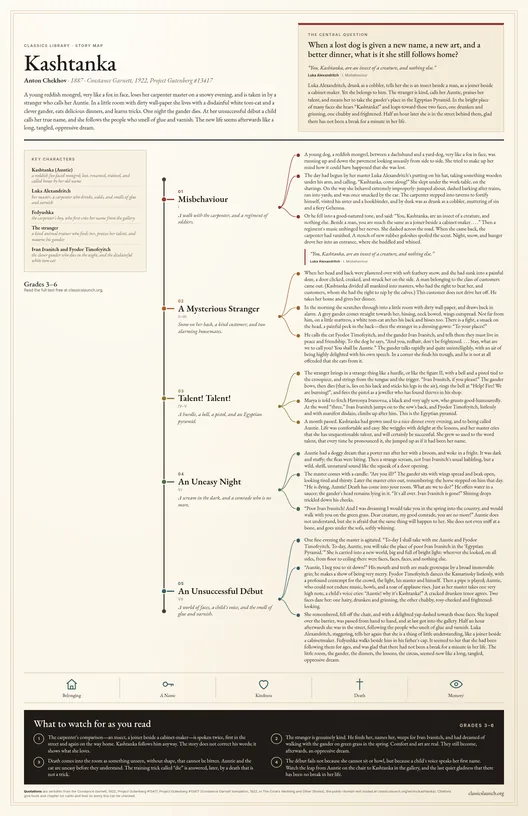 Story mapSee the story mapThe whole book on one page: the story in movements, the characters, and what to watch for. Free to print.
Abstract
Lost in the street. A carpenter's little dog is frightened by a band, loses her master in the snow, and is taken in by a stranger. His rooms already hold animal performers, and she is fed and taught.
The ring. She learns a new name and a new work, and she appears in the circus with a success she never had under the work-table.
Old voices. In the middle of a performance she hears her old master and a boy she knows, and she runs back to the carpenter's life. The story is funny and exact, and it does not say which home is better; it only shows what she loves. This library hosts Constance Garnett's 1922 English translation, a complete public-domain text of the Russian tale. Young listeners can retell the events in order and talk about the choices without needing a lecture from the narrator. A text-only reading is well paired with an illustrated copy whenever one is at hand. The complete English text of Kashtanka is hosted here from a verified public-domain transcription of the 1887 book, so families can read the words freely. Families can linger over the pictures and retell the events in their own words.
Main characters
- Kashtanka: A small reddish mongrel who is lost, trained for the circus, and called home by old voices.
- Luka Alexandritch: Her first master, a carpenter, fond and rough, whom she loses in the street.
- The circus trainer: The stranger who takes her in, feeds her, and teaches her to perform.
Summary
Kashtanka is Anton Chekhov's story of a small reddish mongrel, very like a fox in face, who belongs to a tipsy carpenter named Luka Alexandritch. One winter day she misbehaves on a long walk, is shouted at, and then loses him in the street after a military band panics her. Night and snow come down on an unfamiliar pavement. A stranger takes her in. He proves to be a circus trainer, and in his rooms she meets a new household: a gander, a pig, and a cat who already live as performers. She is fed, named again, and taught. In time she appears in the ring and tastes a kind of success she never had under the work-table. Then, during a performance, she hears familiar voices — her old master and a boy from that first life — and the old loyalty rises up. She leaves the ring and the new career and runs back to the carpenter's world of shavings and shouts. The story is funny, exact, and slightly painful. It does not lecture about which home is better; it shows what a dog loves and what a dog can learn. Children in the middle grades can follow the two households, talk about training and kindness, and notice that comfort is not the only thing that calls a creature home. This library hosts Constance Garnett's public-domain English translation of 1922, from The Cook's Wedding and Other Stories. The Russian tale dates from 1887. Garnett's version is complete and readable aloud, with the circus scenes and the snowy street intact. Families who already know Chekhov's plays will find here a shorter, animal-centered story in the same close, unsentimental watchfulness, suitable for a seminar that is not afraid of a bittersweet ending and a careful, unhurried talk afterward with an adult.
Virtues in this work
- Friendship: Her attachment to the carpenter is not based on comfort alone, and it governs the ending.
- Hope: The old household, however rough, still has a claim that a new career does not cancel; families can talk about belonging and a faithful return.
Plot or Argument
- A dog is lost
Kashtanka loses her carpenter master in a snowy street after a band frightens her.
- A circus household
A trainer takes her in; she lives with performing animals and learns to work in the ring.
- The old voices
During a performance she hears her first master and runs back to him.
Characters
- Kashtanka, protagonist
A small reddish mongrel who is lost, trained for the circus, and called home by old voices.
- Luka Alexandritch, master
Her first master, a carpenter, fond and rough, whom she loses in the street.
- The circus trainer, new master
The stranger who takes her in, feeds her, and teaches her to perform.
Lessons
Two households
The carpenter's shavings and the trainer's rooms are both real homes, with different kinds of care.
- How does Kashtanka become lost?
- What is her life like with the trainer?
A new name, an old name
Training and a circus success do not erase the first voice she knows.
- What does she learn to do in the ring?
- What makes her leave the performance?
No simple moral
The story does not declare the circus better or the carpenter better.
- Why might a reader want her to stay?
- Why might a reader be glad she goes back?
Context
Chekhov tells a winter story of a carpenter's dog who is lost, trained for the circus, and called home by familiar voices, with comic exactness and no heavy moral.
Composition
The Russian story dates from 1887. The local text is Constance Garnett's public-domain English translation of 1922, from The Cook's Wedding and Other Stories (Project Gutenberg #13417).
Reception
It is among the Chekhov stories most often offered to younger readers, because the heroine is a dog and the plot is clear, though the ending is not simple.
Comparisons
- The Cherry Orchard
Another Chekhov work about a life that cannot be kept as it was; here the choice is a dog's, and the tone is comic and close.
- The Tale of Johnny Town-Mouse
Both follow a creature between two households and let each life remain itself; Johnny and Willie go home, and so, in her own way, does Kashtanka.
Quotes
“A YOUNG dog, a reddish mongrel, between a dachshund and a "yard-dog," very like a fox in face, was running up and down the pavement looking uneasily from side to side.”
“You, Kashtanka, are an insect of a creature, and nothing else. Beside a man, you are much the same as a joiner beside a cabinet-maker. . . ."”
For Students
A reading companion for classical Christian high school students. See the student guide.
Reading Guide
Watch for
- How she becomes lost, and who takes her in.
- What she learns in the new household.
- What she hears in the ring, and what she does.
Key terms and names
- Mongrel
- A dog of mixed breed; Kashtanka is described as reddish and fox-like.
- Circus
- A show of trained animals and performers; her second household belongs to one.
- Trainer
- The stranger who teaches her to perform and gives her a new life.
- Loyalty
- A faithful attachment; here it is stronger than a new success.
Seminar Questions
- Comprehension How does Kashtanka lose her first master?
- Comprehension What happens in the circus that makes her leave?
- Interpretation Is the trainer unkind? If not, why does she still go back?
- Interpretation What does the carpenter's way of talking tell us about their life together?
- Big Question Is comfort the best reason to stay in a new home?
- Big Question How does Luke 15:4-6 help a family talk about being found and going home, without forcing the story into a parable?
Faith Connections
- Luke 15:4-6 (Scripture)
The shepherd who goes after the lost sheep can frame a talk about being found, used carefully, not as a one-to-one allegory.
- Proverbs 12:10 (Scripture)
A righteous man regards the life of his beast: a way to weigh the carpenter's roughness and the trainer's care.
Logic and Rhetoric
Central argument: A new success may be real, and an old voice may still be stronger, and a story can show that without deciding which life is finer.
Rhetorical device: Contrast. The work-table and the circus ring are set side by side so that her final run is a choice, not a blur.
Debate: Resolved: Leaving a comfortable new life can still be an act of faithfulness.
Writing Prompts
Essay: Explain, in order, how Kashtanka is lost, trained, and called back. Use two details from the text.
Comparison with The Tale of Johnny Town-Mouse: Both stories place a creature in a second household and then let home win. Compare what each one finds in the new place and why each one leaves it.
Creative Prompts
- Classroom
Make a two-column chart of the carpenter's rooms and the trainer's rooms: food, people, sounds, and work.
- Essay
Why does Kashtanka go back? Use two details from the story, not a guess about dogs in general.
- Fiction
Write the trainer's thoughts after she has left the ring.
Further Reading
Verification notes
Primary text checked against the edition identified in fullText. No unverified quotations or page numbers supplied. Recommended grades concern teaching suitability, not a mechanical reading score.
No verification flags recorded.