Story maps · Grades 10–12
Michael Kohlhaas: A Story Map
The PDF is one tabloid page (11 × 17 in). On letter paper, choose “Fit to page.”
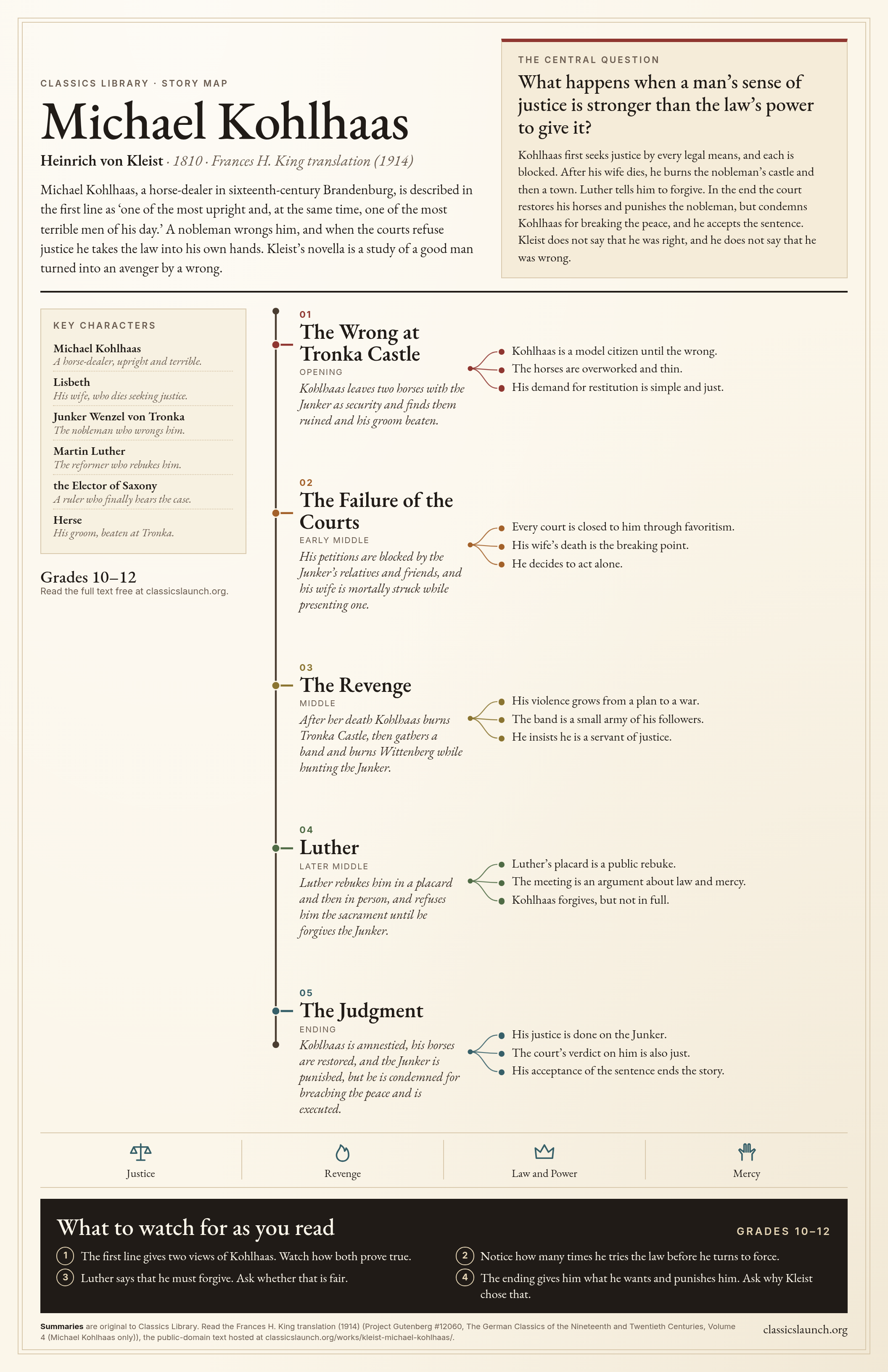
Michael Kohlhaas, a horse-dealer in sixteenth-century Brandenburg, is described in the first line as ‘one of the most upright and, at the same time, one of the most terrible men of his day.’ A nobleman wrongs him, and when the courts refuse justice he takes the law into his own hands. Kleist’s novella is a study of a good man turned into an avenger by a wrong.
The central question
What happens when a man’s sense of justice is stronger than the law’s power to give it?
Kohlhaas first seeks justice by every legal means, and each is blocked. After his wife dies, he burns the nobleman’s castle and then a town. Luther tells him to forgive. In the end the court restores his horses and punishes the nobleman, but condemns Kohlhaas for breaking the peace, and he accepts the sentence. Kleist does not say that he was right, and he does not say that he was wrong.
- 01
The Wrong at Tronka Castle
Opening
Kohlhaas leaves two horses with the Junker as security and finds them ruined and his groom beaten.
- Kohlhaas is a model citizen until the wrong.
- The horses are overworked and thin.
- His demand for restitution is simple and just.
- 02
The Failure of the Courts
Early middle
His petitions are blocked by the Junker’s relatives and friends, and his wife is mortally struck while presenting one.
- Every court is closed to him through favoritism.
- His wife’s death is the breaking point.
- He decides to act alone.
- 03
The Revenge
Middle
After her death Kohlhaas burns Tronka Castle, then gathers a band and burns Wittenberg while hunting the Junker.
- His violence grows from a plan to a war.
- The band is a small army of his followers.
- He insists he is a servant of justice.
- 04
Luther
Later middle
Luther rebukes him in a placard and then in person, and refuses him the sacrament until he forgives the Junker.
- Luther’s placard is a public rebuke.
- The meeting is an argument about law and mercy.
- Kohlhaas forgives, but not in full.
- 05
The Judgment
Ending
Kohlhaas is amnestied, his horses are restored, and the Junker is punished, but he is condemned for breaching the peace and is executed.
- His justice is done on the Junker.
- The court’s verdict on him is also just.
- His acceptance of the sentence ends the story.
- Justice
- Revenge
- Law and Power
- Mercy
What to watch for as you read
Grades 10–12- The first line gives two views of Kohlhaas. Watch how both prove true.
- Notice how many times he tries the law before he turns to force.
- Luther says that he must forgive. Ask whether that is fair.
- The ending gives him what he wants and punishes him. Ask why Kleist chose that.
Every quotation is word for word from the Frances H. King translation (1914) hosted in this library and is checked against that text each time the site is built. Citations give book and chapter (or canto and line).