Work record
Michael Kohlhaas
Heinrich von KleistMichael Kohlhaas (Kleist)Michael Kohlhaas by Heinrich von Kleist (1810)Michael Kohlhaas is Kleist's masterpiece, a novella about a good man who is driven by a wrong to become a robber and a murderer.Also known as: Michael Kohlhaas (Kleist)
1810 · 19th Century · Novella · German
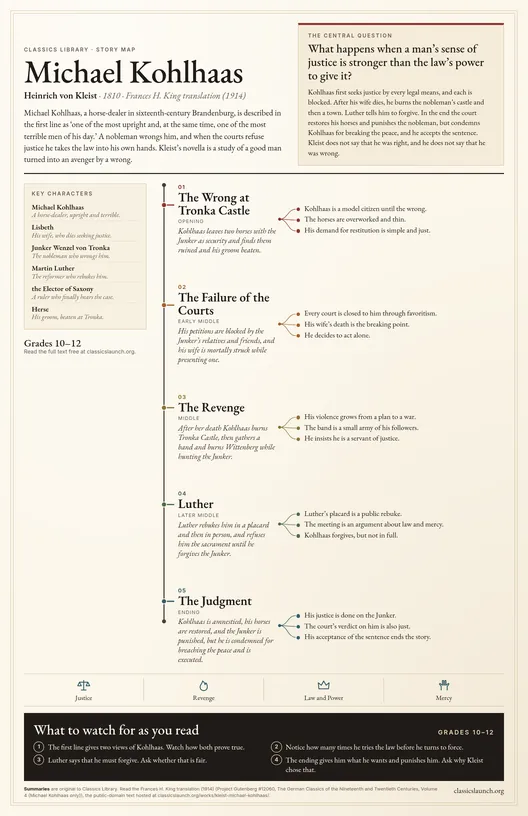 Story mapSee the story mapThe whole book on one page: the story in movements, the characters, and what to watch for. Free to print.
Abstract
Background. Kleist wrote this novella in Prussia during the Napoleonic occupation and published it in 1810. It is based on the sixteenth-century chronicle of the horse-dealer Hans Kohlhase, whose story Kleist enlarged.
Plot. A horse-dealer who has been wronged by a squire is refused justice by the courts and loses his wife in the process. He turns outlaw, burns a castle and a city, is rebuked by Luther, and in the end is condemned and executed.
Ideas. The story studies the conflict between a good cause and wicked means, between justice and revenge, and the limits of the state. It asks whether any wrong can justify refusal to forgive.
Text. Frances H. King's 1914 translation is in the German Classics anthology. The text is a single long prose narrative with no chapter divisions. The hosted text is complete as printed here, with its section headings kept as a guide to the reader, and every quotation on this page is drawn directly from that text. Teachers can pair this work with the library's study guide, seminar questions and memory-work selection to prepare a discussion, a short essay or a recitation. The full text is hosted on this site, and each quotation in the guide has been checked against the hosted translation.
Main characters
- Michael Kohlhaas: A horse-dealer driven to revenge
- Lisbeth: His devout wife
- Junker von Tronka: The squire who wrongs him
- Martin Luther: The reformer who rebukes him
- The Elector of Saxony: A troubled prince
Summary
Michael Kohlhaas is Kleist's masterpiece, a novella about a good man who is driven by a wrong to become a robber and a murderer. Its first sentence describes Kohlhaas as 'one of the most upright and, at the same time, one of the most terrible men of his day'. He is a horse-dealer in sixteenth-century Brandenburg, a model citizen until the age of thirty, with a farm, a wife, Lisbeth, and children. On a trip to Saxony, he is stopped at the castle of the Junker Wenzel von Tronka and told that he needs a pass, which does not exist. To be allowed to go on, he leaves two fine black horses as security. On his return he finds them starved, overworked at harvest, and his groom beaten and driven off. Kohlhaas takes his case to the Saxon courts, but the Junker's powerful relatives block every step. His wife tries to petition the Elector of Brandenburg on his behalf and is struck by a guard so brutally that she dies. After her funeral Kohlhaas takes up arms. With a few servants he storms Tronka Castle, kills those he finds and burns it, but the Junker escapes. He gathers a growing band of outlaws and pursues his enemy from town to town, burning Wittenberg and threatening Leipzig, until Martin Luther posts a placard rebuking him and then meets him in person. Luther, who has an eye for the good in Kohlhaas, tells him that he is no champion of justice but a rebel who has broken the order that protects the weak. Kohlhaas accepts the rebuke on every point but one: he cannot forgive the Junker. Luther refuses him the sacrament at first. In the end Kohlhaas accepts an amnesty, but the courts, while restoring his horses, sentence him to death for breaking the peace. A mysterious paper that a gypsy woman gave him decides his last satisfaction, and he is beheaded at Berlin, convinced that his claim has been met. Kleist's story asks what happens when a passion for justice becomes a passion for revenge. Kohlhaas is right in his first demand and wrong in his methods, and Kleist keeps both facts in view. The novella is an extraordinary study of how a righteous cause can destroy the person who holds it, and of the need for forgiveness. Teachers should note scenes of arson, killing, and public execution.
Virtues in this work
- Justice: Kohlhaas's first demand is just, and Kleist keeps that fact in view.
- Fortitude: He endures loss and persecution with extraordinary persistence.
- Humility: Luther asks him to accept humility and to forgive, which he cannot do.
- Charity: Lisbeth's last act is to ask her husband to forgive his enemies.
Plot or Argument
- The wrong at Tronka Castle
Kohlhaas leaves two horses with the Junker as security and finds them ruined and his groom beaten.
- The failure of the courts
His petitions are blocked, and his wife is mortally struck while presenting one.
- The revenge
After her death Kohlhaas burns Tronka Castle, then gathers a band and burns Wittenberg while hunting the Junker.
- Luther
Luther rebukes him in a placard and then in person, and refuses him the sacrament until he forgives the Junker.
- The judgment
Kohlhaas is amnestied, his horses are restored, and the Junker is punished, but he is condemned for breaching the peace and is executed.
Characters
- Michael Kohlhaas, title hero
A horse-dealer of exemplary character, driven by a denial of justice to a campaign of vengeance.
- Lisbeth, wife
A devout woman who dies of a blow while petitioning for her husband and who gives him a verse on forgiveness.
- Junker Wenzel von Tronka, aristocrat
The squire whose servants abuse Kohlhaas's horses.
- Martin Luther, reformer
The reformer who rebukes Kohlhaas and demands that he forgive.
- The Elector of Saxony, ruler
A prince who is troubled by Kohlhaas's cause.
- Herse, groom
The young servant beaten at Tronka Castle.
Lessons
A just cause does not justify any means
Kohlhaas's first demand is just, but he pursues it by arson and murder. Kleist makes him sympathetic and terrible together, and Luther's rebuke states the lesson.
- What does Luther say to Kohlhaas?
- Why does Kohlhaas accept every point except one?
Forgiveness is hard and necessary
Lisbeth's verse and Luther's refusal of the sacrament make forgiveness the test of Kohlhaas's faith. The story shows what it costs to refuse it.
- What verse does Lisbeth point to as she dies?
- How does Kohlhaas answer Luther's question about forgiveness?
Corrupt justice breeds disorder
The Saxon courts fail Kohlhaas because of favour and connection. Kleist suggests that a state which denies justice to a citizen invites his rebellion.
- How do the courts fail Kohlhaas?
- Does the state share the blame?
Context
Kleist based the story on a sixteenth-century chronicle of the horse-dealer Hans Kohlhase, who made war on Saxony and was executed at Berlin in 1540. Luther's intervention is Kleist's invention.
Composition
Kleist wrote the novella in 1808–1810, during the Napoleonic occupation of Prussia, and published a first part in 1808 and the whole in 1810 in his collection of tales.
Reception
The story was recognised in Kleist's lifetime as a work of power and has been read as a study of law, vengeance and the state. Doctorow's novel Ragtime borrows from it.
Comparisons
- Crime and Punishment
Both works show a man who convinces himself that justice entitles him to violence.
- Hamlet
Hamlet's duty of vengeance and its cost is the ancestor of Kohlhaas's story.
- The Trial
Kafka's novel shows a man crushed by the state's legal machine, and Kafka admired Kleist.
- The Robbers
Schiller's outlaw also takes the law into his own hands, and also ends in surrender.
- The Merchant of Venice
Shakespeare's Shylock, like Kohlhaas, demands the letter of the law and is ruined by it.
Quotes
Frequently cited
“one of the most upright and, at the same time, one of the most terrible men of his day.”
Frequently cited
“But the Lord, whose body you desire, forgave his enemy.”
Frequently cited
“Even the Lord did not forgive all his enemies.”
“Forgive your enemies; do good to them that hate you.”
For Students
A reading companion for classical Christian high school students. See the student guide.
Reading Guide
Watch for
- What Kohlhaas asks of the courts and what he receives.
- Every moment when Kohlhaas could turn back.
- How Luther speaks to him.
Key terms and names
- Junker
- A German country squire of the lesser nobility.
- Elector
- A prince entitled to vote in the election of the Holy Roman Emperor, such as the Elector of Saxony.
- Amnesty
- A formal pardon for offences against the state.
- Sacrament
- In the Lutheran church, Baptism and the Lord's Supper; Kohlhaas asks for the latter.
Seminar Questions
- Comprehension What wrong is done to Kohlhaas at Tronka Castle?
- Comprehension What does Luther ask of Kohlhaas?
- Interpretation Why does Kleist make Kohlhaas both sympathetic and terrible?
- Interpretation How does the novella end, and does justice triumph?
- Interpretation What is the role of Lisbeth's death?
- Big Question Can a good man ever be justified in taking revenge?
- Big Question What does a state owe a citizen it has wronged?
Faith Connections
- Romans 12:19–21 (Scripture)
'Never avenge yourselves... Overcome evil with good.' Luther's rebuke rests on this teaching.
- Matthew 5:44 (Scripture)
'Love your enemies and pray for those who persecute you.' Lisbeth's verse is a paraphrase of it.
- Matthew 6:12 (Scripture)
'Forgive us our debts, as we also have forgiven our debtors.' Kohlhaas fears to ask for forgiveness on these terms.
- Augustine, City of God, Book XIX (Great Conversation)
Augustine reflects on the sorrows of earthly justice, where courts often fail the innocent.
Logic and Rhetoric
Central argument: A just claim pursued without forgiveness and by unjust means destroys both the claimant and the order he wishes to protect.
Rhetorical device: paradoxical opening. The first sentence calls Kohlhaas both 'upright' and 'terrible' and prepares for the rest of the story.
Debate: Resolved: That Kohlhaas is more sinned against than sinning.
Memory Work
one of the most upright and, at the same time, one of the most terrible men of his day.
But the Lord, whose body you desire, forgave his enemy.
Writing Prompts
Essay: How does Luther's interview change the story's moral account of Kohlhaas?
Comparison with Crime and Punishment: Compare Kohlhaas's view of his cause with Raskolnikov's.
Medical Lens
Kohlhaas's pursuit of vengeance after his wife's death is a study of obsession and unresolved grief.
- The death of Lisbeth and the revenge
After his wife dies, Kohlhaas gives himself wholly to vengeance.
Creative Prompts
- Essay
Was Kohlhaas right? Distinguish the justice of his claim from the justice of his methods.
- Dialogue
Write a scene in which Kohlhaas explains to Lisbeth why he cannot forgive the Junker.
- Classroom
Stage the interview with Luther and discuss what Luther asks of Kohlhaas and what he refuses.
Further Reading
- The Trial, Franz Kafka
Another story of a man against a legal system, hosted in this library.
- Crime and Punishment, Fyodor Dostoevsky
A novel of a man who takes justice into his own hands, hosted in this library.
- The Broken Jug, Heinrich von Kleist
Kleist's comedy of a corrupt village judge.
- The German Classics of the Nineteenth and Twentieth Centuries, Kuno Francke (ed.)
The anthology in which this translation appears.
Verification notes
Hosted text is Frances H. King's translation (1914) from Kuno Francke's The German Classics, vol. 4 (Project Gutenberg #12060), in public domain; the hosted extract contains Michael Kohlhaas only. Quotes were checked against the hosted text. Luther's role is Kleist's invention.
- Whether the hosted text follows Kleist's complete 1810 version.
- The date of the Berlin execution of the historical Hans Kohlhase.