Story maps · Grades 9–12
Laxdæla Saga: A Story Map
The PDF is one tabloid page (11 × 17 in). On letter paper, choose “Fit to page.”
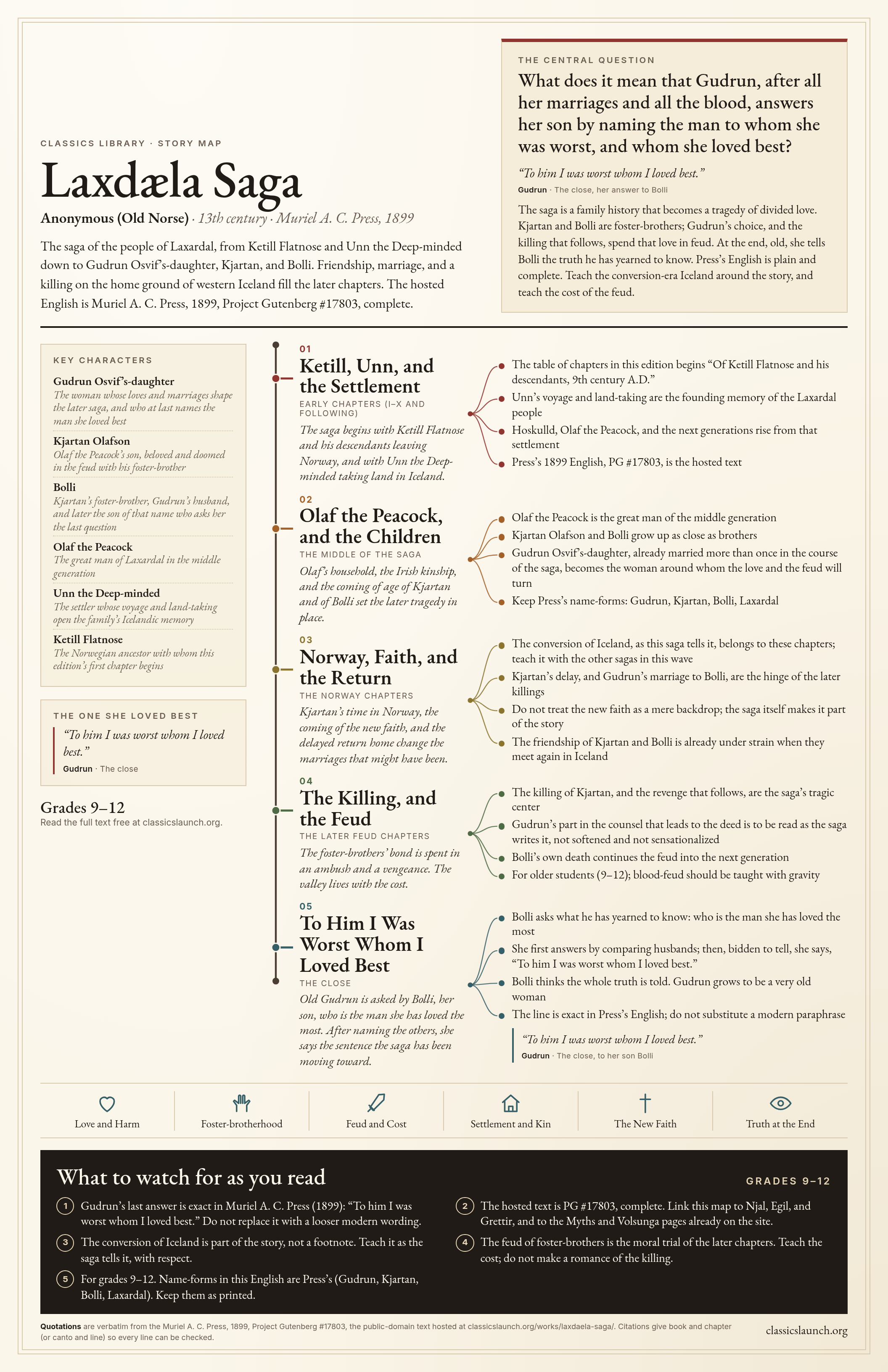
The saga of the people of Laxardal, from Ketill Flatnose and Unn the Deep-minded down to Gudrun Osvif’s-daughter, Kjartan, and Bolli. Friendship, marriage, and a killing on the home ground of western Iceland fill the later chapters. The hosted English is Muriel A. C. Press, 1899, Project Gutenberg #17803, complete.
The central question
What does it mean that Gudrun, after all her marriages and all the blood, answers her son by naming the man to whom she was worst, and whom she loved best?
“To him I was worst whom I loved best.”
The saga is a family history that becomes a tragedy of divided love. Kjartan and Bolli are foster-brothers; Gudrun’s choice, and the killing that follows, spend that love in feud. At the end, old, she tells Bolli the truth he has yearned to know. Press’s English is plain and complete. Teach the conversion-era Iceland around the story, and teach the cost of the feud.
- 01
Ketill, Unn, and the Settlement
Early chapters (I–X and following)
The saga begins with Ketill Flatnose and his descendants leaving Norway, and with Unn the Deep-minded taking land in Iceland.
- The table of chapters in this edition begins “Of Ketill Flatnose and his descendants, 9th century A.D.”
- Unn’s voyage and land-taking are the founding memory of the Laxardal people
- Hoskulld, Olaf the Peacock, and the next generations rise from that settlement
- Press’s 1899 English, PG #17803, is the hosted text
- 02
Olaf the Peacock, and the Children
The middle of the saga
Olaf’s household, the Irish kinship, and the coming of age of Kjartan and of Bolli set the later tragedy in place.
- Olaf the Peacock is the great man of the middle generation
- Kjartan Olafson and Bolli grow up as close as brothers
- Gudrun Osvif’s-daughter, already married more than once in the course of the saga, becomes the woman around whom the love and the feud will turn
- Keep Press’s name-forms: Gudrun, Kjartan, Bolli, Laxardal
- 03
Norway, Faith, and the Return
The Norway chapters
Kjartan’s time in Norway, the coming of the new faith, and the delayed return home change the marriages that might have been.
- The conversion of Iceland, as this saga tells it, belongs to these chapters; teach it with the other sagas in this wave
- Kjartan’s delay, and Gudrun’s marriage to Bolli, are the hinge of the later killings
- Do not treat the new faith as a mere backdrop; the saga itself makes it part of the story
- The friendship of Kjartan and Bolli is already under strain when they meet again in Iceland
- 04
The Killing, and the Feud
The later feud chapters
The foster-brothers’ bond is spent in an ambush and a vengeance. The valley lives with the cost.
- The killing of Kjartan, and the revenge that follows, are the saga’s tragic center
- Gudrun’s part in the counsel that leads to the deed is to be read as the saga writes it, not softened and not sensationalized
- Bolli’s own death continues the feud into the next generation
- For older students (9–12); blood-feud should be taught with gravity
- 05
To Him I Was Worst Whom I Loved Best
The close
Old Gudrun is asked by Bolli, her son, who is the man she has loved the most. After naming the others, she says the sentence the saga has been moving toward.
- Bolli asks what he has yearned to know: who is the man she has loved the most
- She first answers by comparing husbands; then, bidden to tell, she says, “To him I was worst whom I loved best.”
- Bolli thinks the whole truth is told. Gudrun grows to be a very old woman
- The line is exact in Press’s English; do not substitute a modern paraphrase
“To him I was worst whom I loved best.”
- Love and Harm
- Foster-brotherhood
- Feud and Cost
- Settlement and Kin
- The New Faith
- Truth at the End
What to watch for as you read
Grades 9–12- Gudrun’s last answer is exact in Muriel A. C. Press (1899): “To him I was worst whom I loved best.” Do not replace it with a looser modern wording.
- The hosted text is PG #17803, complete. Link this map to Njal, Egil, and Grettir, and to the Myths and Volsunga pages already on the site.
- The conversion of Iceland is part of the story, not a footnote. Teach it as the saga tells it, with respect.
- The feud of foster-brothers is the moral trial of the later chapters. Teach the cost; do not make a romance of the killing.
- For grades 9–12. Name-forms in this English are Press’s (Gudrun, Kjartan, Bolli, Laxardal). Keep them as printed.
Every quotation is word for word from the Muriel A. C. Press, 1899 hosted in this library and is checked against that text each time the site is built. Citations give book and chapter (or canto and line).