Work record
Laxdæla Saga
Anonymous (Old Norse)Laxdæla Saga by Anonymous (Old Norse) (13th century)Laxdæla Saga, the saga of the people of Salmon-river-Dale, is one of the great family sagas of medieval Iceland.13th century · Medieval · Epic · Old Norse
Read this when love, pride and jealousy threaten to undo a lifelong friendship.
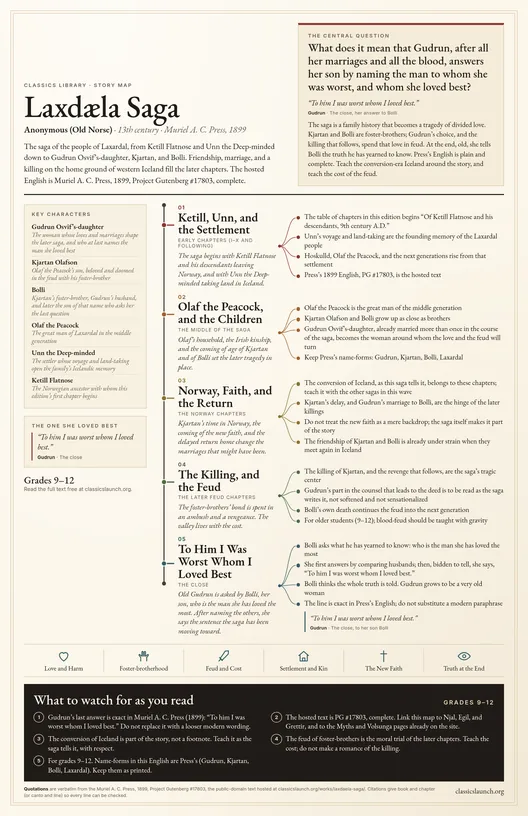 Story mapSee the story mapThe whole book on one page: the story in movements, the characters, and what to watch for. Free to print.
Abstract
Background. An unknown Icelander of the mid-1200s gathered the traditions of one Dales family into a single history. It became the most romantic of the sagas, with fine clothes, foreign courts and a famous love story. Muriel Press gave English readers their first prose version in 1899.
Narrative. Unn leads her people to Iceland and dies seated in her hall. Generations later Olaf the Peacock raises his son Kjartan beside Bolli, his nephew. Both young men go abroad, where a Norwegian king makes them Christians. Bolli comes back alone and weds Gudrun, whom Kjartan meant to marry. Quarrels over a sword, a headdress and a piece of land end with Bolli killing his friend, and Kjartan's brothers then kill Bolli.
Conversion. The change of religion runs through the second half. Kjartan fasts in Lent and lies in a new white church. Gudrun's last husband drowns carrying church timber, and she spends her widowhood at prayer in a cell.
Themes. The saga weighs love against honour and shows how pride turns friends into enemies. Its women hold real power, for good and ill. Its last words, spoken by an old woman to her son, leave readers asking what regret and repentance mean, and whether love can outlast the harm it has done.
Main characters
- Unn the Deep-minded: settler and matriarch of the Dales
- Olaf the Peacock: son of a slave-born Irish princess, builder of Herdholt
- Kjartan: Olaf's son, baptized at the Norwegian court
- Bolli: Kjartan's foster-brother and rival
- Gudrun: proud heroine, married four times, later a nun
- Olaf Tryggvason: Norwegian king who presses Iceland to convert
Summary
Laxdæla Saga, the saga of the people of Salmon-river-Dale, is one of the great family sagas of medieval Iceland. Written about the middle of the thirteenth century, it follows one kindred across nearly a hundred and fifty years, from the flight of Ketill Flatnose's family from Norway in the ninth century to the old age of Gudrun Osvif's daughter in the eleventh. The library text is the translation by Muriel A. C. Press, published in London in 1899, the first English version of the saga. The early chapters belong to Unn the Deep-minded, who leads her household from Scotland to Iceland, divides her land among her followers and dies sitting upright on the night of her grandson's wedding. Her descendants include Hoskuld, who buys a slave woman at a market and finds that she is Melkorka, the daughter of an Irish king, and their son Olaf the Peacock, who wins honour in Ireland and Norway and builds the great house at Herdholt. The heart of the saga is the story of Olaf's son Kjartan, his foster-brother and cousin Bolli, and Gudrun, the most beautiful and gifted woman of the district. Kjartan and Gudrun love each other, but Kjartan sails to Norway with Bolli and lingers at the court of King Olaf Tryggvason, who is bringing his people to the Christian faith. Kjartan is baptized and becomes the king's man. Bolli returns first, tells Gudrun that Kjartan is not likely to come back, and marries her himself. Kjartan comes home, marries Hrefna, and the old friendship turns to insults, theft and ambush, until Bolli, goaded by Gudrun and her brothers, kills the foster-brother he loves. Vengeance follows, and Bolli is himself slain. Gudrun marries a fourth time, sees her husband Thorkell drowned, and in her last years becomes a woman of prayer, the first in Iceland to know the Psalter by heart and the first nun and recluse of the land. When her son asks whom she loved most, she gives the saga's most famous answer. For Christian readers the saga is a moving picture of a people at the turning of the faith. The conversion of Iceland around the year 1000 stands at the centre of the book: Kjartan keeps the Lenten fast, churches rise at Burg and Holyfell, and the proud heroine ends her days in penitence. The saga does not excuse the pride and vengeance of its people, but it lets the reader see what the Gospel was setting out to heal.
Virtues in this work
- Friendship: Kjartan, ambushed by Bolli, throws away his weapons and chooses to die by his foster-brother's hand rather than kill him.
- Piety: Gudrun in old age learns the Psalter by heart and prays through the nights in the church at Holyfell.
- Temperance: Kjartan keeps the Lenten fast, the first man in Iceland to do so, to the wonder of his neighbours.
- Magnanimity: Olaf the Peacock repeatedly seeks peace with his brothers and neighbours and refuses to avenge himself on Bolli, whom he fostered.
Plot or Argument
- Chapters I-VII: Ketill Flatnose and Unn the Deep-minded
Ketill Flatnose's family flees the rule of Harald Fairhair; his daughter Unn leaves Scotland after her son's death, settles in the Dales of western Iceland, divides her land, and dies with dignity on the night of her grandson Olaf Feilan's wedding.
- Chapters VIII-XXVII: Hoskuld, Melkorka and Olaf the Peacock
Hoskuld buys a mute slave woman in Norway who proves to be Melkorka, an Irish king's daughter; their son Olaf the Peacock visits his grandfather in Ireland, marries Thorgerd, the daughter of Egil Skallagrimsson, and builds Herdholt.
- Chapters XXVIII-XXXVIII: Kjartan, Bolli and Gudrun's dreams
Kjartan is born and grows up with his foster-brother Bolli; Gest Oddleifson interprets Gudrun's four dreams as a prophecy of four husbands; Gudrun's first two marriages end in divorce and drowning.
- Chapters XXXIX-XLV: Norway and the change of faith
Kjartan and Bolli sail to Norway, where King Olaf Tryggvason is converting the land; after a swimming contest with the king and a stand-off over the faith, they are baptized; Bolli returns and marries Gudrun, and Kjartan, coming home, marries Hrefna and keeps the Lenten fast.
- Chapters XLVI-XLIX: The quarrel and the death of Kjartan
A lost sword, a stolen head-dress, a three-day blockade of the doors at Laugar and the forced sale of the land called Tongue sharpen the enmity, until Gudrun and her brothers send Bolli to ambush Kjartan, who throws down his weapons and dies in Bolli's lap.
- Chapters L-LVI: Vengeance on Bolli
Hrefna dies of grief, Osvif's sons are outlawed, and Thorgerd goads her sons to avenge Kjartan; Halldor and his brothers kill Bolli at his shieling, and Gudrun bears his son, Bolli Bollison.
- Chapters LVII-LXXVII: Gudrun's revenge and her fourth marriage
Gudrun brings Thorgils Hallason and later Thorkell Eyjolfson into her plans for vengeance; she marries Thorkell, peace is made between the sons of Bolli and the sons of Olaf, and Thorkell drowns while bringing church timber home from Norway.
- Chapter LXXVIII: Gudrun's old age
Gudrun becomes the first nun and recluse in Iceland, learns the Psalter by heart and prays in the church at Holyfell; in old age she answers her son's question about the man she loved best, and dies blind at Holyfell.
- Translator's notes
The text ends with the publisher's prefatory note of October 1899 and a note explaining an obscure verse spoken by Thorgils Hallason's hood; Press's footnotes are printed within the text.
Characters
- Unn the Deep-minded, matriarch and settler
Ketill Flatnose's daughter, who leads her kin from Scotland to Iceland and dies upright in her seat, honoured by all.
- Hoskuld Dale-Kollson, chieftain of Hoskuldstead
Unn's descendant, who buys the slave woman Melkorka and fathers Olaf the Peacock.
- Melkorka, Irish king's daughter
Sold as a slave, she pretends to be mute until Hoskuld hears her speaking Irish to her son.
- Olaf the Peacock, Hoskuld and Melkorka's son
Splendid and peace-loving chieftain of Herdholt, father of Kjartan and foster-father of Bolli.
- Thorgerd Egil's daughter, Olaf's wife
Daughter of Egil Skallagrimsson, who later goads her sons to avenge Kjartan.
- Kjartan Olafson, hero of the saga
The finest young man in Iceland, baptized at King Olaf Tryggvason's court and slain by his foster-brother.
- Bolli Thorleikson, Kjartan's cousin and foster-brother
Marries Gudrun while Kjartan is abroad and kills him at her urging; slain in turn by Kjartan's brothers.
- Gudrun Osvif's daughter, heroine
Beautiful, clever and proud; married four times, she ends her life as Iceland's first nun and recluse.
- Osvif Helgison, Gudrun's father
A shrewd sage of Laugar whose sons join the ambush on Kjartan.
- Hrefna, Kjartan's wife
Daughter of Asgeir; she wears the queen's head-dress Kjartan brought from Norway and dies of grief after his death.
- Gest Oddleifson, wise man
Reads Gudrun's dreams as a forecast of her four marriages.
- Olaf Tryggvason, king of Norway
Brings Norway and its Icelandic visitors to the Christian faith and keeps Kjartan as a hostage for Iceland's conversion.
- Thorkell Eyjolfson, Gudrun's fourth husband
Ambitious chieftain who drowns in Broadfirth while bringing home timber for a church.
- Bolli Bollison, Gudrun's son
Born after his father's death; serves in the Varangian guard and asks his mother the saga's last question.
- Snorri the Priest, chieftain of Holyfell
Crafty adviser who arranges Gudrun's revenge and her move to Holyfell.
Lessons
Pride and the ruin of friendship
Kjartan and Bolli are raised as brothers and love each other, yet a lie about Kjartan's return, a broken betrothal and a string of insults drive them to the killing at Swinedale. The saga shows how small wounds to pride, nursed and repeated, grow into murder. Kjartan's last words show that love can survive even when friendship has been betrayed.
- When Bolli tells Gudrun that Kjartan is unlikely to return, is he lying, hoping or simply speaking his mind?
- Which insult or injury between Laugar and Herdholt could most easily have been forgiven?
- Why does Kjartan throw down his weapons when Bolli turns on him?
The goading of the women
Gudrun, Thorgerd and others egg their men to vengeance, often with bitter words, because honour demanded that blood be answered. The saga gives these women great strength of will and great power, but it also shows the cost of their counsel in the deaths of the men they love.
- How does Gudrun persuade Bolli to join the ambush, and what does she gain?
- Is Thorgerd's egging of her sons a demand for justice or for revenge?
- What other ways of answering a wrong were open to these families?
Conversion and the life of penitence
The saga places the conversion of Iceland at its centre. Kjartan is baptized at King Olaf's court, keeps the Lenten fast at home and is buried in a newly consecrated church; Gudrun, the proud heroine, ends her life in prayer as a nun. The change of faith does not erase the old feud at once, but it gives the old woman a way to look back on her life with sorrow.
- Why does King Olaf keep Kjartan in Norway, and how does that decision shape the rest of the saga?
- What does Gudrun's life at Holyfell suggest about the meaning of her final answer to Bolli?
- Does the saga present the new faith as changing people's hearts, their customs, or both?
Context
The saga is set in the Breidafjord and Dales district of western Iceland between about 890 and 1030, the age of the settlement, the founding of the Althing and the conversion. Iceland accepted Christianity by a decision of the Althing in the year 1000, under pressure from King Olaf Tryggvason of Norway, who held Icelanders, Kjartan among them, as hostages. Many of the saga's figures, including Unn, Olaf the Peacock, Kjartan, Gudrun and Snorri the Priest, appear in the Book of Settlements and other Icelandic sources.
Composition
An unknown author wrote the saga down around 1245, drawing on genealogies, oral tradition and earlier written histories. It survives in many vellum manuscripts, and its interest in rich dress, courtly behaviour and a love triangle shows the influence of the romances being translated in Norway at the time. Muriel A. C. Press made the first English translation, revised by an Icelandic scholar, for J. M. Dent in 1899.
Reception
Laxdæla Saga has long been one of the best-loved sagas in Iceland, especially for its portrait of Gudrun. William Morris retold the Kjartan and Gudrun story in his long poem The Lovers of Gudrun in The Earthly Paradise (1868-1870), before the saga was available in English prose; later translators have kept it among the essential sagas of Icelanders.
Comparisons
- The Story of Burnt Njal (Njal's Saga)
Both sagas tell of the conversion of Iceland around the year 1000 and of a feud that runs through generations; Njal's Saga gives the Althing's decision in full, while Laxdæla shows the change of faith through Kjartan's baptism and Gudrun's last years.
- The Story of Egil Skallagrimsson (Egil's Saga)
Olaf the Peacock marries Thorgerd, the daughter of Egil Skallagrimsson, so the two sagas share a family; Egil's Saga tells the story of the poet-warrior whose grandsons are Kjartan and his brothers.
- The Story of Grettir the Strong (Grettis Saga)
Grettir's Saga is set in the same century and the same small society; both sagas end with a turn to Christian penitence, Gudrun as a recluse in Iceland and Thorstein Dromund and Spes in stone cells at Rome.
- The Story of the Volsungs (Volsunga Saga)
Readers have long compared Gudrun, Kjartan and Bolli with Brynhild, Sigurd and Gunnar: a proud woman who loses the man she loves and drives her husband to kill him.
- The Poetic Edda
The Eddic lays of Sigurd and Brynhild give the old heroic pattern that the saga author seems to echo in the love triangle at Laugar and Herdholt.
- The Prose Edda
Snorri's handbook preserves the pagan myths that Kjartan's generation left behind at the conversion, and the poetic language the saga's verses use.
- Romeo and Juliet
Both stories turn on love crossed by family quarrels, but Laxdæla ends not in a lovers' death but in a long widowhood and a life of prayer.
Quotes
Frequently cited
“To him I was worst whom I loved best”
Frequently cited
“Surely thou art minded now, my kinsman, to do a dastard's deed; but oh, my kinsman, I am much more fain to take my death from you than to cause the same to you myself”
“Gudrun now became a very religious woman. She was the first woman in Iceland who knew the Psalter by heart”
“Kjartan kept fast through Lent, following therein the example of no man in this land; and it is said he was the first man who ever kept fast in this land”
“After that Kjartan and Bolli were baptized and all their crew, and a multitude of other men as well”
“The church was newly consecrated, and as yet hung in white”
“Every one thought it a wonderful thing, how Unn had upheld her dignity to the day of her death”
“Kjartan was better proportioned than any man, so that all wondered who saw him”
For Students
A reading companion for classical Christian high school students. See the student guide.
Reading Guide
Watch for
- Gest Oddleifson's reading of Gudrun's four dreams in Chapter XXXIII, and how each dream comes true.
- The sword King Olaf gives Kjartan and the queen's head-dress he gives to Hrefna, and what happens to each at the feast at Herdholt.
- Every place where someone takes or refuses the new faith, from Nidaros to the churches at Burg and Holyfell.
- Who goads whom to vengeance, and with what words.
- How the saga describes Gudrun in her last years compared with her youth.
Key terms and names
- Thing
- An assembly of free men for law and judgment; the Althing was the national assembly at Thingvellir.
- Godi (priest)
- A chieftain who held a local priesthood and authority at the Things; the title survived the conversion.
- Foster-brother
- A boy raised in another family's house, bound to his foster-kin by strong ties of loyalty.
- Egging
- Urging a kinsman, often with taunts, to take vengeance for a killing.
- Shieling
- A summer hut in the upland pastures, where Bolli is slain.
- Psalter
- The Book of Psalms, used for daily prayer; Gudrun is the first woman in Iceland to learn it by heart.
Seminar Questions
- Comprehension How does Hoskuld discover who Melkorka really is?
- Comprehension Why does Kjartan stay in Norway when Bolli sails home?
- Interpretation Is Bolli more to blame for Kjartan's death than Gudrun and her brothers?
- Interpretation What does the saga mean by describing Kjartan's Lenten fast and his burial in a church hung in white?
- Interpretation How should we read Gudrun's final answer in light of her years of prayer at Holyfell?
- Big Question Can a person truly repent of a wrong that was done out of love and pride at the same time?
Faith Connections
- Romans 12:17-21 (Scripture)
Paul forbids repaying evil for evil and leaves vengeance to God. The chain from Kjartan's death to Bolli's and beyond shows the very cycle this teaching breaks.
- Psalm 51 (Scripture)
David's psalm of repentance belongs to the Psalter Gudrun learned by heart; her old age at Holyfell reads like a life spent praying it.
- John 15:13 (Scripture)
Kjartan chooses to die by his foster-brother's hand rather than kill him, a pagan-hearted man's glimpse of the love that lays down its life for a friend.
- Bede, Ecclesiastical History of the English People (Great Conversation)
Bede tells how kings and councils brought the English to the faith; Laxdæla shows the same process in Iceland, through a king's pressure and a chieftain's baptism.
Logic and Rhetoric
Central argument: The saga argues by example: love joined to pride becomes jealousy, jealousy breeds insult, and insult demanded blood in a society bound by honour; only the new faith, received slowly, offers an end to the chain, as Gudrun's penitent old age shows.
Rhetorical device: Prophetic dream and fulfilment. In Chapter XXXIII Gest reads Gudrun's four dreams of a coif, a ring, a second ring and a helmet as four husbands, and the rest of the saga fulfils each in turn.
Debate: Resolved: Gudrun is more to blame than Bolli for the death of Kjartan.
Memory Work
To him I was worst whom I loved best
Surely thou art minded now, my kinsman, to do a dastard's deed; but oh, my kinsman, I am much more fain to take my death from you than to cause the same to you myself
Writing Prompts
Essay: Trace the conversion of Iceland through Laxdæla Saga, from King Olaf's court to Gudrun's cell, and argue whether the new faith changes the outcome of the feud.
Comparison with The Story of the Volsungs (Volsunga Saga): Compare Gudrun Osvif's daughter with Brynhild in the Volsunga Saga: how does each woman respond to the loss of the man she loved, and how do their endings differ?
Medical Lens
The saga is not a medical text, but it records grief that kills (Hrefna dies of a broken heart), prophetic dreams, battle wounds and the blindness of old age.
- Chapter XXXIII
Gudrun tells Gest Oddleifson four dreams, which he reads as a prophecy of her four husbands.
- Chapter L
Hrefna, Kjartan's widow, is said to have died of a broken heart.
- Chapter LXXVIII
Gudrun grows very old and, some say, loses her sight before her death at Holyfell.
Creative Prompts
- Dialogue
Write the conversation between Bolli and Gudrun in Chapter XLII, when Bolli brings news of Kjartan from Norway, as a modern scene, showing what each of them hopes and fears.
- Essay
Gudrun says, To him I was worst whom I loved best. Write an essay on whether this is a confession of sin, a statement of love, or both, using her last years at Holyfell as evidence.
- Fiction
Tell the story of Melkorka's silence from her own point of view, from the slave market to the day Hoskuld hears her speaking to her son.
- Classroom
Build a family tree on the board from Ketill Flatnose to Bolli Bollison, marking every marriage and every killing, and discuss how kinship both binds and divides the Dales.
Further Reading
- Laxdaela Saga, trans. Magnus Magnusson and Hermann Pálsson
A widely read modern translation (1969).
- The Earthly Paradise, William Morris
Includes The Lovers of Gudrun, Morris's verse retelling of the Kjartan and Gudrun story.
- Viking Age Iceland, Jesse L. Byock
The society, law and economy behind the family sagas.
- Bloodtaking and Peacemaking: Feud, Law, and Society in Saga Iceland, William Ian Miller
How feud and settlement worked in the world of the sagas.
Verification notes
All quotations were checked by exact search against the stored Project Gutenberg text (#17803) of Muriel A. C. Press's 1899 translation, with line breaks collapsed to single spaces. Chapter numbers are those of the translation. Press's marginal sidenotes have been removed from the reading text; her footnotes remain. Dates and identifications of historical figures follow the translation's chapter headings and standard reference works.
- The date of composition (c. 1245) and any link to the Sturlung circle are scholarly estimates.