Story maps · Grades 6–12
Lepanto: A Story Map
The PDF is one tabloid page (11 × 17 in). On letter paper, choose “Fit to page.”
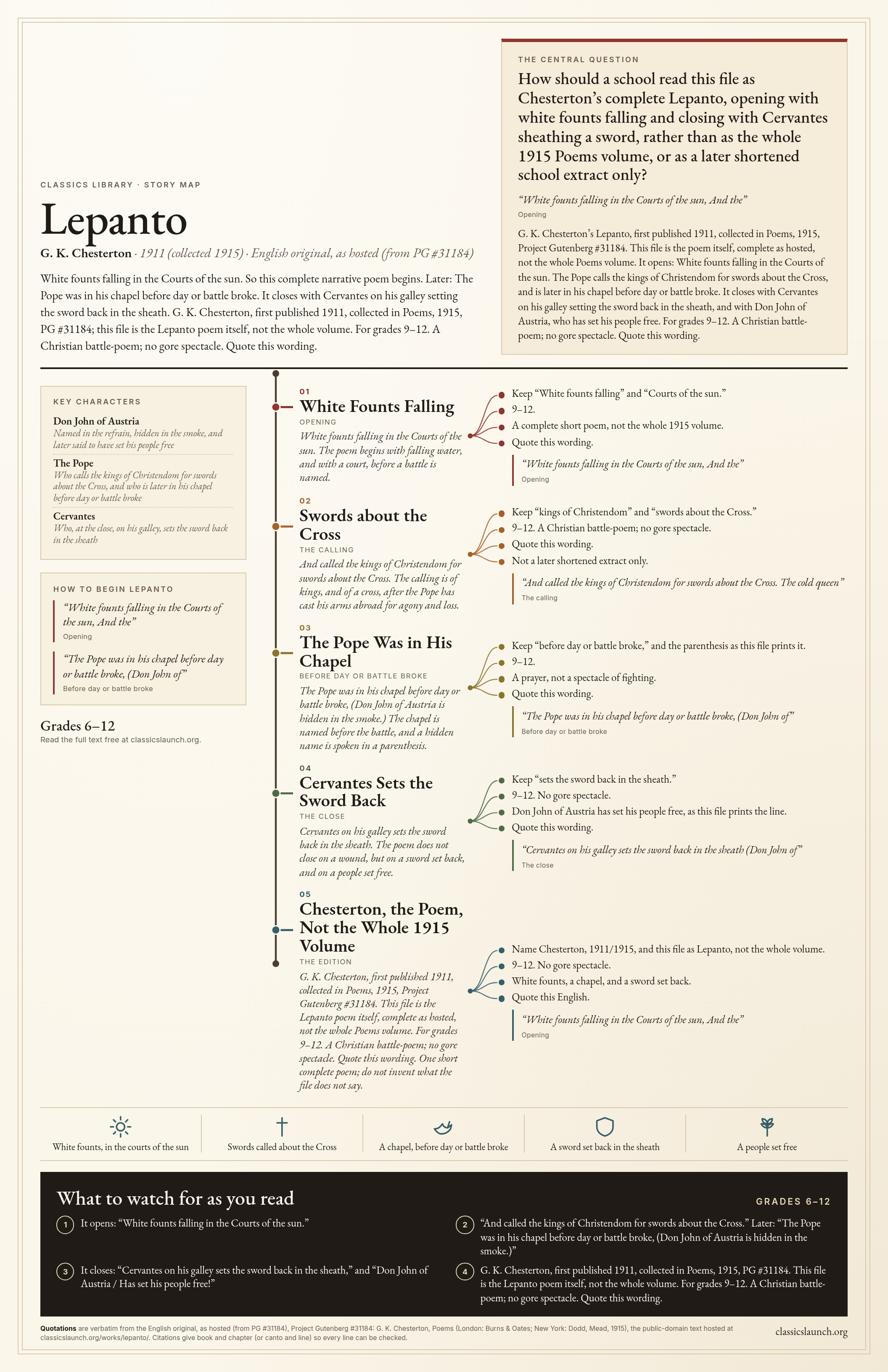
White founts falling in the Courts of the sun. So this complete narrative poem begins. Later: The Pope was in his chapel before day or battle broke. It closes with Cervantes on his galley setting the sword back in the sheath. G. K. Chesterton, first published 1911, collected in Poems, 1915, PG #31184; this file is the Lepanto poem itself, not the whole volume. For grades 9–12. A Christian battle-poem; no gore spectacle. Quote this wording.
The central question
How should a school read this file as Chesterton’s complete Lepanto, opening with white founts falling and closing with Cervantes sheathing a sword, rather than as the whole 1915 Poems volume, or as a later shortened school extract only?
“White founts falling in the Courts of the sun, And the”
G. K. Chesterton’s Lepanto, first published 1911, collected in Poems, 1915, Project Gutenberg #31184. This file is the poem itself, complete as hosted, not the whole Poems volume. It opens: White founts falling in the Courts of the sun. The Pope calls the kings of Christendom for swords about the Cross, and is later in his chapel before day or battle broke. It closes with Cervantes on his galley setting the sword back in the sheath, and with Don John of Austria, who has set his people free. For grades 9–12. A Christian battle-poem; no gore spectacle. Quote this wording.
- 01
White Founts Falling
Opening
White founts falling in the Courts of the sun. The poem begins with falling water, and with a court, before a battle is named.
- Keep “White founts falling” and “Courts of the sun.”
- 9–12.
- A complete short poem, not the whole 1915 volume.
- Quote this wording.
“White founts falling in the Courts of the sun, And the”
- 02
Swords about the Cross
The calling
And called the kings of Christendom for swords about the Cross. The calling is of kings, and of a cross, after the Pope has cast his arms abroad for agony and loss.
- Keep “kings of Christendom” and “swords about the Cross.”
- 9–12. A Christian battle-poem; no gore spectacle.
- Quote this wording.
- Not a later shortened extract only.
“And called the kings of Christendom for swords about the Cross. The cold queen”
- 03
The Pope Was in His Chapel
Before day or battle broke
The Pope was in his chapel before day or battle broke, (Don John of Austria is hidden in the smoke.) The chapel is named before the battle, and a hidden name is spoken in a parenthesis.
- Keep “before day or battle broke,” and the parenthesis as this file prints it.
- 9–12.
- A prayer, not a spectacle of fighting.
- Quote this wording.
“The Pope was in his chapel before day or battle broke, (Don John of”
- 04
Cervantes Sets the Sword Back
The close
Cervantes on his galley sets the sword back in the sheath. The poem does not close on a wound, but on a sword set back, and on a people set free.
- Keep “sets the sword back in the sheath.”
- 9–12. No gore spectacle.
- Don John of Austria has set his people free, as this file prints the line.
- Quote this wording.
“Cervantes on his galley sets the sword back in the sheath (Don John of”
- 05
Chesterton, the Poem, Not the Whole 1915 Volume
The edition
G. K. Chesterton, first published 1911, collected in Poems, 1915, Project Gutenberg #31184. This file is the Lepanto poem itself, complete as hosted, not the whole Poems volume. For grades 9–12. A Christian battle-poem; no gore spectacle. Quote this wording. One short complete poem; do not invent what the file does not say.
- Name Chesterton, 1911/1915, and this file as Lepanto, not the whole volume.
- 9–12. No gore spectacle.
- White founts, a chapel, and a sword set back.
- Quote this English.
“White founts falling in the Courts of the sun, And the”
- White founts, in the courts of the sun
- Swords called about the Cross
- A chapel, before day or battle broke
- A sword set back in the sheath
- A people set free
What to watch for as you read
Grades 6–12- It opens: “White founts falling in the Courts of the sun.”
- “And called the kings of Christendom for swords about the Cross.” Later: “The Pope was in his chapel before day or battle broke, (Don John of Austria is hidden in the smoke.)”
- It closes: “Cervantes on his galley sets the sword back in the sheath,” and “Don John of Austria / Has set his people free!”
- G. K. Chesterton, first published 1911, collected in Poems, 1915, PG #31184. This file is the Lepanto poem itself, not the whole volume. For grades 9–12. A Christian battle-poem; no gore spectacle. Quote this wording.
Every quotation is word for word from the English original, as hosted (from PG #31184) hosted in this library and is checked against that text each time the site is built. Citations give book and chapter (or canto and line).