Story maps · Grades 11–12
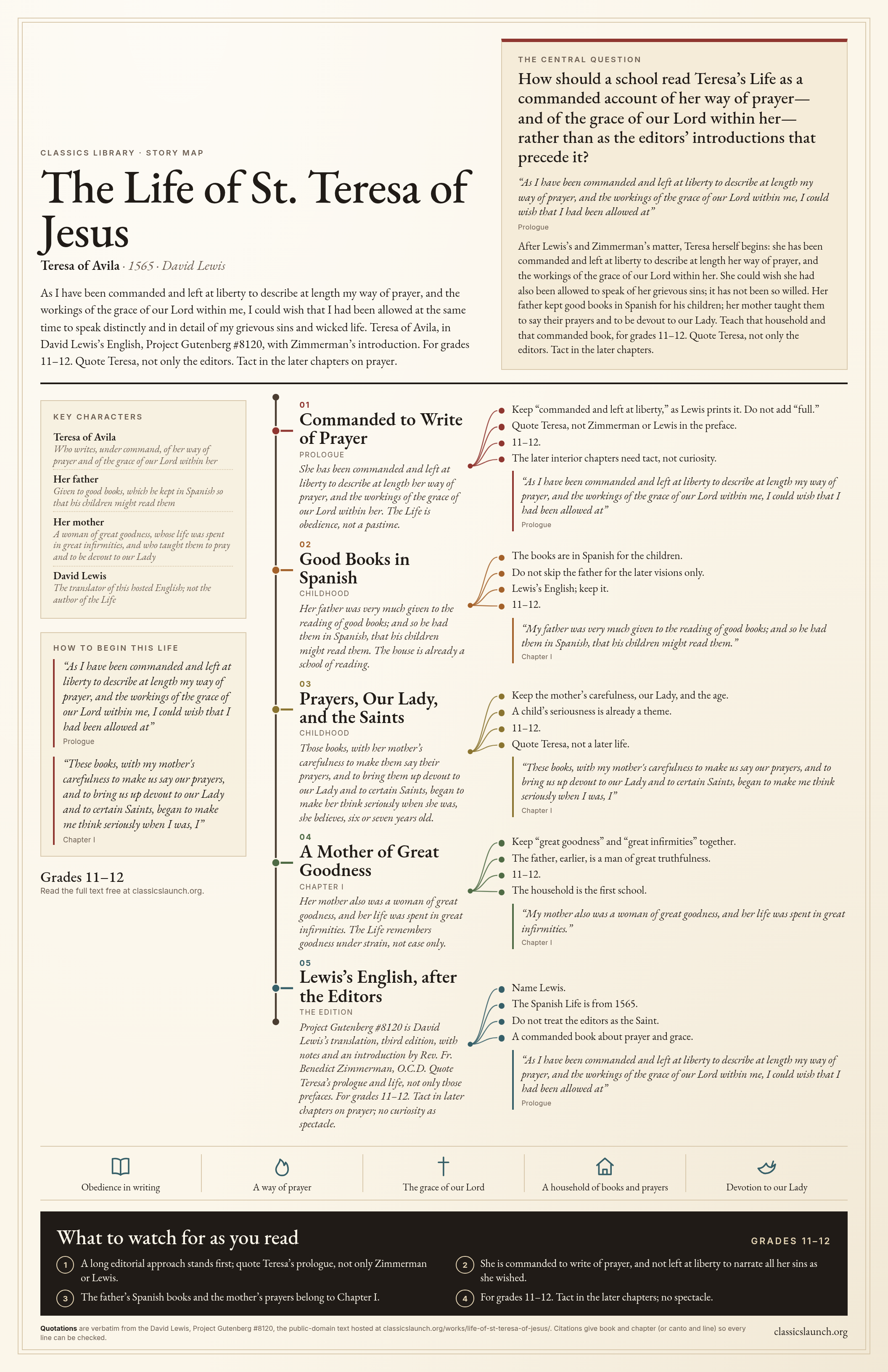
The Life of St. Teresa of Jesus: A Story Map
The PDF is one tabloid page (11 × 17 in). On letter paper, choose “Fit to page.”
As I have been commanded and left at liberty to describe at length my way of prayer, and the workings of the grace of our Lord within me, I could wish that I had been allowed at the same time to speak distinctly and in detail of my grievous sins and wicked life. Teresa of Avila, in David Lewis’s English, Project Gutenberg #8120, with Zimmerman’s introduction. For grades 11–12. Quote Teresa, not only the editors. Tact in the later chapters on prayer.
The central question
How should a school read Teresa’s Life as a commanded account of her way of prayer—and of the grace of our Lord within her—rather than as the editors’ introductions that precede it?
“As I have been commanded and left at liberty to describe at length my way of prayer, and the workings of the grace of our Lord within me, I could wish that I had been allowed at”
After Lewis’s and Zimmerman’s matter, Teresa herself begins: she has been commanded and left at liberty to describe at length her way of prayer, and the workings of the grace of our Lord within her. She could wish she had also been allowed to speak of her grievous sins; it has not been so willed. Her father kept good books in Spanish for his children; her mother taught them to say their prayers and to be devout to our Lady. Teach that household and that commanded book, for grades 11–12. Quote Teresa, not only the editors. Tact in the later chapters.
- 01
Commanded to Write of Prayer
Prologue
She has been commanded and left at liberty to describe at length her way of prayer, and the workings of the grace of our Lord within her. The Life is obedience, not a pastime.
- Keep “commanded and left at liberty,” as Lewis prints it. Do not add “full.”
- Quote Teresa, not Zimmerman or Lewis in the preface.
- 11–12.
- The later interior chapters need tact, not curiosity.
“As I have been commanded and left at liberty to describe at length my way of prayer, and the workings of the grace of our Lord within me, I could wish that I had been allowed at”
- 02
Good Books in Spanish
Childhood
Her father was very much given to the reading of good books; and so he had them in Spanish, that his children might read them. The house is already a school of reading.
- The books are in Spanish for the children.
- Do not skip the father for the later visions only.
- Lewis’s English; keep it.
- 11–12.
“My father was very much given to the reading of good books; and so he had them in Spanish, that his children might read them.”
- 03
Prayers, Our Lady, and the Saints
Childhood
Those books, with her mother’s carefulness to make them say their prayers, and to bring them up devout to our Lady and to certain Saints, began to make her think seriously when she was, she believes, six or seven years old.
- Keep the mother’s carefulness, our Lady, and the age.
- A child’s seriousness is already a theme.
- 11–12.
- Quote Teresa, not a later life.
“These books, with my mother's carefulness to make us say our prayers, and to bring us up devout to our Lady and to certain Saints, began to make me think seriously when I was, I”
- 04
A Mother of Great Goodness
Chapter I
Her mother also was a woman of great goodness, and her life was spent in great infirmities. The Life remembers goodness under strain, not ease only.
- Keep “great goodness” and “great infirmities” together.
- The father, earlier, is a man of great truthfulness.
- 11–12.
- The household is the first school.
“My mother also was a woman of great goodness, and her life was spent in great infirmities.”
- 05
Lewis’s English, after the Editors
The edition
Project Gutenberg #8120 is David Lewis’s translation, third edition, with notes and an introduction by Rev. Fr. Benedict Zimmerman, O.C.D. Quote Teresa’s prologue and life, not only those prefaces. For grades 11–12. Tact in later chapters on prayer; no curiosity as spectacle.
- Name Lewis.
- The Spanish Life is from 1565.
- Do not treat the editors as the Saint.
- A commanded book about prayer and grace.
“As I have been commanded and left at liberty to describe at length my way of prayer, and the workings of the grace of our Lord within me, I could wish that I had been allowed at”
- Obedience in writing
- A way of prayer
- The grace of our Lord
- A household of books and prayers
- Devotion to our Lady
What to watch for as you read
Grades 11–12- A long editorial approach stands first; quote Teresa’s prologue, not only Zimmerman or Lewis.
- She is commanded to write of prayer, and not left at liberty to narrate all her sins as she wished.
- The father’s Spanish books and the mother’s prayers belong to Chapter I.
- For grades 11–12. Tact in the later chapters; no spectacle.
Every quotation is word for word from the David Lewis hosted in this library and is checked against that text each time the site is built. Citations give book and chapter (or canto and line).