Story maps · Grades 11–12
Pharsalia (The Civil War): A Story Map
The PDF is one tabloid page (11 × 17 in). On letter paper, choose “Fit to page.”
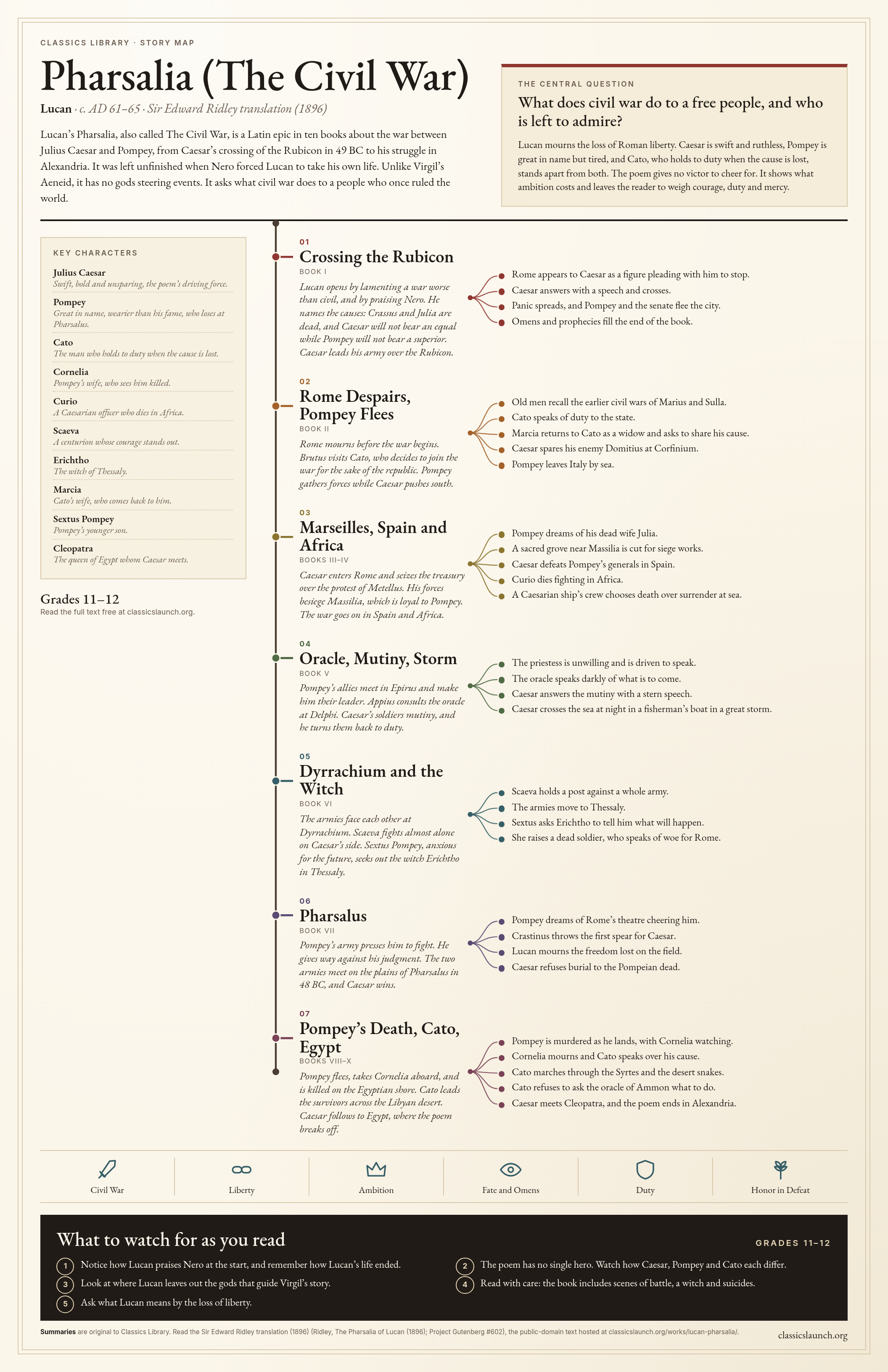
Lucan’s Pharsalia, also called The Civil War, is a Latin epic in ten books about the war between Julius Caesar and Pompey, from Caesar’s crossing of the Rubicon in 49 BC to his struggle in Alexandria. It was left unfinished when Nero forced Lucan to take his own life. Unlike Virgil’s Aeneid, it has no gods steering events. It asks what civil war does to a people who once ruled the world.
The central question
What does civil war do to a free people, and who is left to admire?
Lucan mourns the loss of Roman liberty. Caesar is swift and ruthless, Pompey is great in name but tired, and Cato, who holds to duty when the cause is lost, stands apart from both. The poem gives no victor to cheer for. It shows what ambition costs and leaves the reader to weigh courage, duty and mercy.
- 01
Crossing the Rubicon
Book I
Lucan opens by lamenting a war worse than civil, and by praising Nero. He names the causes: Crassus and Julia are dead, and Caesar will not bear an equal while Pompey will not bear a superior. Caesar leads his army over the Rubicon.
- Rome appears to Caesar as a figure pleading with him to stop.
- Caesar answers with a speech and crosses.
- Panic spreads, and Pompey and the senate flee the city.
- Omens and prophecies fill the end of the book.
- 02
Rome Despairs, Pompey Flees
Book II
Rome mourns before the war begins. Brutus visits Cato, who decides to join the war for the sake of the republic. Pompey gathers forces while Caesar pushes south.
- Old men recall the earlier civil wars of Marius and Sulla.
- Cato speaks of duty to the state.
- Marcia returns to Cato as a widow and asks to share his cause.
- Caesar spares his enemy Domitius at Corfinium.
- Pompey leaves Italy by sea.
- 03
Marseilles, Spain and Africa
Books III–IV
Caesar enters Rome and seizes the treasury over the protest of Metellus. His forces besiege Massilia, which is loyal to Pompey. The war goes on in Spain and Africa.
- Pompey dreams of his dead wife Julia.
- A sacred grove near Massilia is cut for siege works.
- Caesar defeats Pompey’s generals in Spain.
- Curio dies fighting in Africa.
- A Caesarian ship’s crew chooses death over surrender at sea.
- 04
Oracle, Mutiny, Storm
Book V
Pompey’s allies meet in Epirus and make him their leader. Appius consults the oracle at Delphi. Caesar’s soldiers mutiny, and he turns them back to duty.
- The priestess is unwilling and is driven to speak.
- The oracle speaks darkly of what is to come.
- Caesar answers the mutiny with a stern speech.
- Caesar crosses the sea at night in a fisherman’s boat in a great storm.
- 05
Dyrrachium and the Witch
Book VI
The armies face each other at Dyrrachium. Scaeva fights almost alone on Caesar’s side. Sextus Pompey, anxious for the future, seeks out the witch Erichtho in Thessaly.
- Scaeva holds a post against a whole army.
- The armies move to Thessaly.
- Sextus asks Erichtho to tell him what will happen.
- She raises a dead soldier, who speaks of woe for Rome.
- 06
Pharsalus
Book VII
Pompey’s army presses him to fight. He gives way against his judgment. The two armies meet on the plains of Pharsalus in 48 BC, and Caesar wins.
- Pompey dreams of Rome’s theatre cheering him.
- Crastinus throws the first spear for Caesar.
- Lucan mourns the freedom lost on the field.
- Caesar refuses burial to the Pompeian dead.
- 07
Pompey’s Death, Cato, Egypt
Books VIII–X
Pompey flees, takes Cornelia aboard, and is killed on the Egyptian shore. Cato leads the survivors across the Libyan desert. Caesar follows to Egypt, where the poem breaks off.
- Pompey is murdered as he lands, with Cornelia watching.
- Cornelia mourns and Cato speaks over his cause.
- Cato marches through the Syrtes and the desert snakes.
- Cato refuses to ask the oracle of Ammon what to do.
- Caesar meets Cleopatra, and the poem ends in Alexandria.
- Civil War
- Liberty
- Ambition
- Fate and Omens
- Duty
- Honor in Defeat
What to watch for as you read
Grades 11–12- Notice how Lucan praises Nero at the start, and remember how Lucan’s life ended.
- The poem has no single hero. Watch how Caesar, Pompey and Cato each differ.
- Look at where Lucan leaves out the gods that guide Virgil’s story.
- Read with care: the book includes scenes of battle, a witch and suicides.
- Ask what Lucan means by the loss of liberty.
Every quotation is word for word from the Sir Edward Ridley translation (1896) hosted in this library and is checked against that text each time the site is built. Citations give book and chapter (or canto and line).