Work record
Pharsalia (The Civil War)
LucanThe Civil War; Bellum Civile; De Bello Civili; PharsaliaPharsalia (The Civil War) by Lucan (c. AD 61–65)Lucan's Pharsalia, also called The Civil War, is a Latin epic in ten books about the war between Julius Caesar and Pompey the Great.Also known as: The Civil War · Bellum Civile · De Bello Civili · Pharsalia
c. AD 61–65 · Ancient · Epic · Latin
Read this when you want Rome's civil war told by a poet who mourned it.
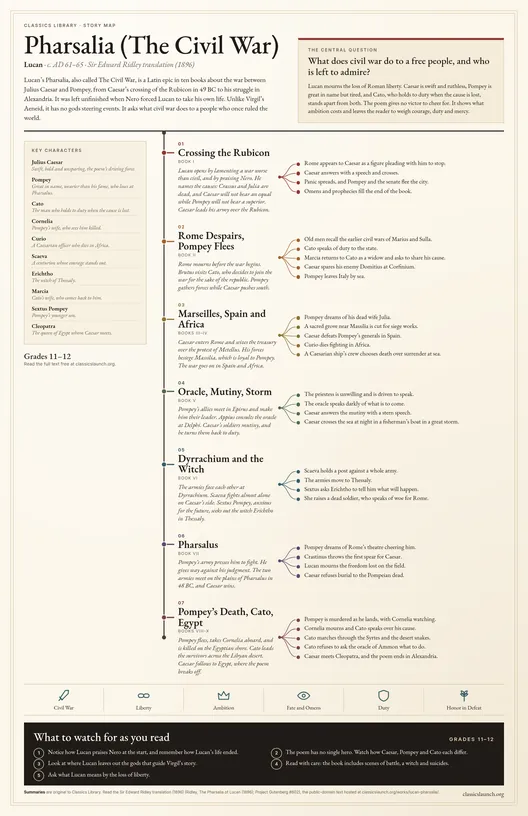 Story mapSee the story mapThe whole book on one page: the story in movements, the characters, and what to watch for. Free to print.
Abstract
The poem. The Pharsalia tells of the war between Julius Caesar and Pompey from the crossing of the Rubicon to Caesar's arrival in Egypt. The poet, nephew of Seneca, wrote under Nero and left the epic unfinished at the end of the tenth book.
The war. Caesar moves swiftly, Pompey and the Senate flee, and battles follow across Marseilles, Spain, Africa and Greece. At Pharsalus in 48 BC, Pompey fights against his own judgment and loses. Lucan mourns the freedom that fell with the Republic.
The aftermath. Pompey is killed on the Egyptian shore, and Cato leads the survivors across the Libyan desert. Caesar follows to Alexandria, where the poem ends. Scenes of a witch's magic and of wartime suicide make the poem hard going for younger readers.
Why it matters. The poem leaves out the gods and has no clear hero, which sets it apart from Virgil's Aeneid. Its central figure of moral steadiness is Cato. It offers a bitter lament for liberty and an early lesson in how ambition can ruin a state. It is best read slowly, a book at a time, with attention to the speeches of Caesar, Pompey and Cato.
Main characters
- Julius Caesar: The swift, ruthless general who crosses the Rubicon.
- Pompey the Great: The leader of the Senate's side, great in name but weary.
- Cato: The Stoic who holds to duty when the cause is lost.
- Cornelia: Pompey's wife, who sees him killed.
- Scaeva: A centurion whose courage stands out in the fighting.
- Erichtho: A witch of Thessaly whom Sextus Pompey consults.
- Marcia: Cato's wife, who returns to him.
- Cleopatra: The queen of Egypt, whom Caesar meets.
Summary
Lucan's Pharsalia, also called The Civil War, is a Latin epic in ten books about the war between Julius Caesar and Pompey the Great. It begins with Caesar's crossing of the Rubicon in January 49 BC and breaks off, unfinished, while Caesar is besieged in Alexandria in 48 BC. The poet, who was the nephew of Seneca, wrote it in the reign of Nero and died at twenty-five, forced to take his own life after a conspiracy against the emperor was found out in AD 65. The poem opens by lamenting a war worse than civil, fought by kinsmen on the plains of Thessaly, and then names its causes. Crassus is dead, Pompey's wife Julia, who was Caesar's daughter, is dead, and the two rivals will not live as equals. Lucan has the figure of Rome herself appear to Caesar at the Rubicon, and Caesar answers her and crosses. In the early books Pompey and the Senate flee Italy, Caesar enters Rome and takes the treasury by force, and the fighting spreads to Marseilles, Spain, Africa and the Adriatic. In Rome the Stoic Cato, having refused both leaders, decides to join the cause of the Republic, and his wife Marcia returns to him. In the middle books, the armies meet at Dyrrachium, where the centurion Scaeva fights almost alone for Caesar. Before the great battle, Pompey's son Sextus visits the witch Erichtho in Thessaly and has her raise a dead soldier to foretell the outcome, which is among the most horrifying scenes in Latin poetry. In Book VII, the armies meet at Pharsalus in 48 BC. Pompey fights against his better judgment, and Caesar wins. Lucan does not celebrate the victory. He mourns the freedom that died on the field, and he says that Caesar refused burial to the Pompeian dead. In the last books, Pompey flees and is murdered on the Egyptian shore as his wife Cornelia watches. Cato leads the survivors on a long march across the Libyan desert, enduring heat, thirst and snakes, and he refuses to consult the oracle of Ammon. Caesar follows to Egypt and meets Cleopatra, and the poem ends there. Unlike Virgil's Aeneid, the Pharsalia has no gods guiding events, and it has no single hero. Pompey is great in name only, Caesar is swift and ruthless, and Cato stands apart as the man who holds to duty when the cause is lost. The poem asks what civil war does to a free people, and it has been read as both a warning and a lament.
Virtues in this work
- Fortitude: Cato and the better Pompeians stand when standing cannot win.
- Temperance: The poem is a warning against a people that will not limit its own will to power.
Plot or Argument
- Books I-III
Caesar crosses the Rubicon, Pompey and the Senate flee, Cato and Marcia are brought into the story, and the war spreads to Marseilles.
- Books IV-VII
The war moves to Spain, Africa and the Adriatic. At Dyrrachium Scaeva holds out, the witch Erichtho is consulted, and the armies meet at Pharsalus, where Caesar wins.
- Books VIII-X
Pompey is murdered on the Egyptian shore, Cato leads the survivors across the desert, and Caesar reaches Alexandria, where the poem breaks off.
Characters
- Julius Caesar, The driving force of the war
Swift, daring, and, in Lucan’s telling, a calamity to the republic.
- Pompey the Great, The opposing commander
The fading champion of the senate, whose death in Egypt is one of the poem’s great scenes.
- Cato, The moral center, for many readers
The Stoic republican who will not bow.
Lessons
The cost of civil war
Lucan presents the war as a crime against the Roman people. The poem teaches students to ask what is lost when citizens fight one another.
- What does Lucan say is lost on the field at Pharsalus?
- Why does he call this war worse than civil?
Duty without victory
Cato holds to duty in a lost cause. The poem asks what virtue is worth when it cannot win, and how a man should act when the state is broken.
- How does Cato differ from Caesar and Pompey?
- What does Cato's refusal of the oracle show about his view of duty?
Epic without a hero
Lucan removes the gods and leaves a poem without a clear hero. Students can ask what this does to the idea of epic and how it differs from Virgil.
- How does Lucan's treatment of fate differ from Virgil's?
- Whom does the poem ask the reader to admire?
Context
Lucan wrote in the reign of Nero, in the 60s AD, about a war that had ended the Republic over a century before. He was the nephew of Seneca and was at first a favorite of the emperor.
Composition
The poem was left unfinished in ten books. Lucan fell out with Nero, joined the conspiracy of Piso, and was forced to take his own life in AD 65 at the age of twenty-five.
Reception
Lucan was widely read in antiquity and the Middle Ages, and Dante set him in Limbo among the great poets. The English version in the library is the blank verse translation of Sir Edward Ridley, published in 1896.
Comparisons
- The Aeneid
Virgil’s epic founds Rome under providence; Lucan’s epic watches Rome tear herself, with the gods largely withdrawn.
- The Civil War
Caesar’s own prose commentarii are the victor’s account of the same war; Lucan writes in verse against that victory.
- The Fourteen Philippics
Cicero’s last speeches belong to the next civil crisis; Lucan looks back to Caesar and Pompey.
- The Annals of Imperial Rome
Tacitus, a generation later, writes the prose history of the empire Lucan’s war helped to make.
Quotes
Frequently cited
“And crime let loose we sing; how Rome's high race Plunged in her vitals her victorious sword;”
“Wars worse than civil on Emathian (1) plains,”
For Students
A reading companion for classical Christian high school students. See the student guide.
Reading Guide
Watch for
- How Lucan praises Nero at the start, and what that tells you about the poet's own position.
- How each of the three leaders differs, and whom the poem seems to admire.
- The places where Lucan leaves out the gods who guide Virgil's story.
Key terms and names
- Bellum Civile
- The Latin title, meaning 'the civil war'; Pharsalia is a later name from the battle.
- apostrophe
- A turn in a poem to address someone, as Lucan addresses Nero and Rome.
- Stoic
- A follower of the school that held that virtue lies in doing one's duty whatever happens; Cato is the Stoic hero.
- necromancy
- The raising of the dead to learn the future, as in the scene with Erichtho.
Seminar Questions
- Comprehension What causes does Lucan give for the war between Caesar and Pompey?
- Comprehension What happens at Pharsalus, and how does Lucan describe it?
- Interpretation Why does Lucan remove the gods from the action of his epic?
- Interpretation Why does Cato refuse to consult the oracle of Ammon?
- Big Question What does civil war do to a free people?
- Big Question Is there any virtue that can survive the loss of liberty?
Faith Connections
- Matthew 26:52 (Scripture)
They that take the sword shall perish with the sword; Lucan’s Rome is a people perishing by its own.
- Dante, Inferno IV (Church Fathers)
Dante places Lucan among the virtuous pagans in Limbo; the poem is great, and it is not a Christian poem.
- James 4:1–2 (Scripture)
Whence come wars and fightings among you? Lucan answers, for Rome, with a story of pride and mastery.
Logic and Rhetoric
Central argument: Lucan argues that civil war is a crime that destroys the freedom of the people who fight it, whichever side wins.
Rhetorical device: Apostrophe. He addresses Rome and Nero directly, which turns the narrative into a lament and a political statement.
Debate: Resolved: that civil war cannot be justified, even in defense of the Republic.
Memory Work
And crime let loose we sing; how Rome's high race Plunged in her vitals her victorious sword;
Writing Prompts
Essay: Explain how Lucan treats Caesar, Pompey and Cato and say which of them the poem asks readers to admire.
Comparison with The Fourteen Philippics: Compare how Lucan and Cicero show the danger of one man seeking to rule the Republic.
Creative Prompts
- Essay
Compare Lucan's picture of Caesar with Caesar's own account in the Civil War. Use at least two scenes.
- Dialogue
Write a conversation between Cato and Marcia on the night she returns to him.
- Classroom
Have students list the omens and prophecies of the poem and sort them into those that come true and those that mislead.
Further Reading
- Lucan: Civil War, Lucan, trans. Susan H. Braund
Oxford World's Classics; a modern verse translation.
- Lucan: An Introduction, Frederick M. Ahl
A critical study of the poem.
- The Aeneid, Virgil
The epic against which Lucan wrote.
Verification notes
Ten books, unfinished as Lucan left the poem. Ridley is credited from the 1896 text, though the Gutenberg header does not name him. Footnote markers such as (1) in the opening line are retained as in the source.
- Ridley’s lineation and footnotes are those of a Victorian verse translation, not a line-for-line match to the Latin.