Story maps · Grades 9–12
Lays of Ancient Rome: A Story Map
The PDF is one tabloid page (11 × 17 in). On letter paper, choose “Fit to page.”
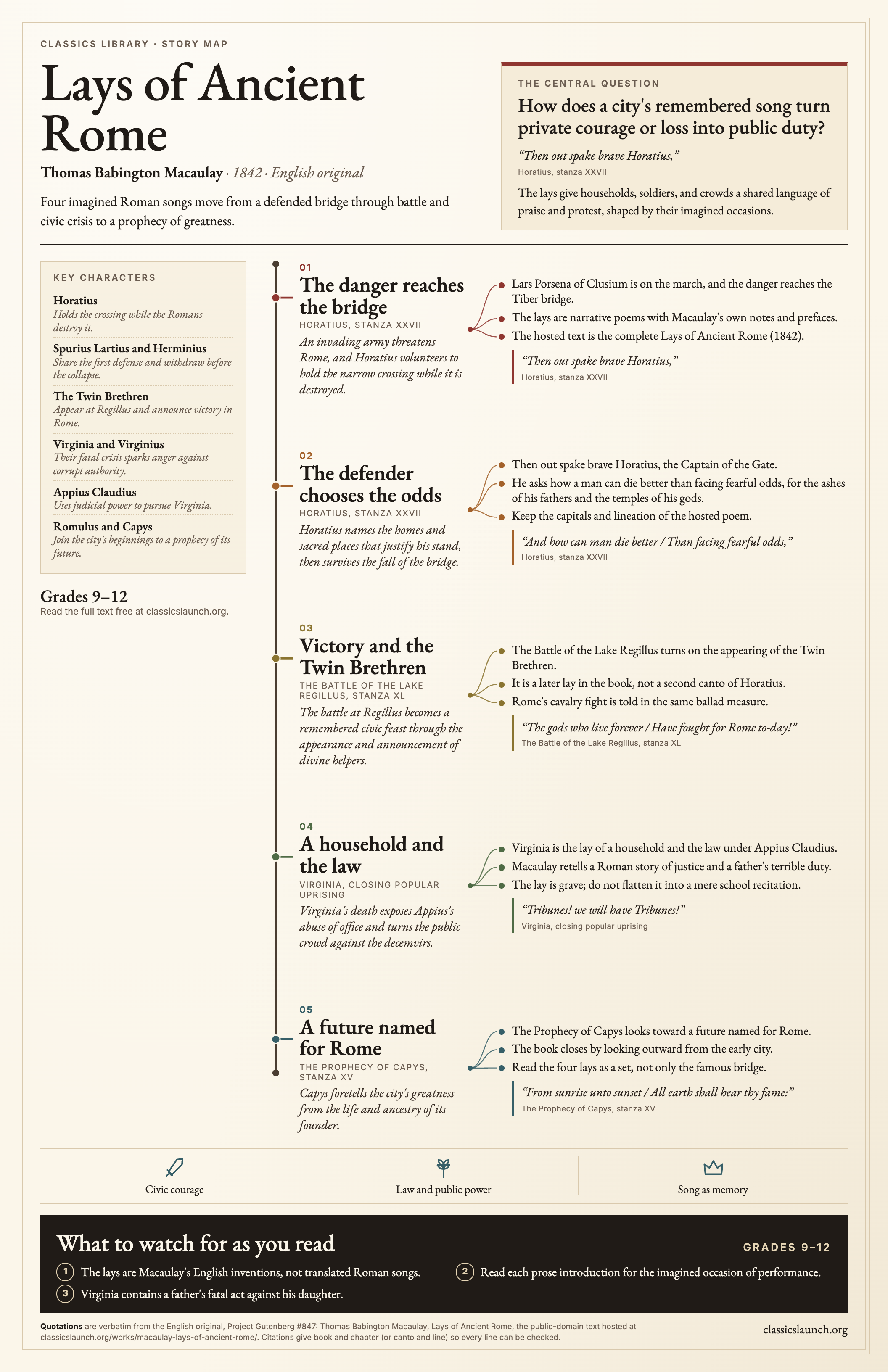
Four imagined Roman songs move from a defended bridge through battle and civic crisis to a prophecy of greatness.
The central question
How does a city's remembered song turn private courage or loss into public duty?
“Then out spake brave Horatius,”
The lays give households, soldiers, and crowds a shared language of praise and protest, shaped by their imagined occasions.
- 01
The danger reaches the bridge
Horatius, stanza XXVII
An invading army threatens Rome, and Horatius volunteers to hold the narrow crossing while it is destroyed.
- Lars Porsena of Clusium is on the march, and the danger reaches the Tiber bridge.
- The lays are narrative poems with Macaulay's own notes and prefaces.
- The hosted text is the complete Lays of Ancient Rome (1842).
“Then out spake brave Horatius,”
- 02
The defender chooses the odds
Horatius, stanza XXVII
Horatius names the homes and sacred places that justify his stand, then survives the fall of the bridge.
- Then out spake brave Horatius, the Captain of the Gate.
- He asks how a man can die better than facing fearful odds, for the ashes of his fathers and the temples of his gods.
- Keep the capitals and lineation of the hosted poem.
“And how can man die better / Than facing fearful odds,”
- 03
Victory and the Twin Brethren
The Battle of the Lake Regillus, stanza XL
The battle at Regillus becomes a remembered civic feast through the appearance and announcement of divine helpers.
- The Battle of the Lake Regillus turns on the appearing of the Twin Brethren.
- It is a later lay in the book, not a second canto of Horatius.
- Rome's cavalry fight is told in the same ballad measure.
“The gods who live forever / Have fought for Rome to-day!”
- 04
A household and the law
Virginia, closing popular uprising
Virginia's death exposes Appius's abuse of office and turns the public crowd against the decemvirs.
- Virginia is the lay of a household and the law under Appius Claudius.
- Macaulay retells a Roman story of justice and a father's terrible duty.
- The lay is grave; do not flatten it into a mere school recitation.
“Tribunes! we will have Tribunes!”
- 05
A future named for Rome
The Prophecy of Capys, stanza XV
Capys foretells the city's greatness from the life and ancestry of its founder.
- The Prophecy of Capys looks toward a future named for Rome.
- The book closes by looking outward from the early city.
- Read the four lays as a set, not only the famous bridge.
“From sunrise unto sunset / All earth shall hear thy fame:”
- Civic courage
- Law and public power
- Song as memory
What to watch for as you read
Grades 9–12- The lays are Macaulay's English inventions, not translated Roman songs.
- Read each prose introduction for the imagined occasion of performance.
- Virginia contains a father's fatal act against his daughter.
Every quotation is word for word from the English original hosted in this library and is checked against that text each time the site is built. Citations give book and chapter (or canto and line).