Work record
Lays of Ancient Rome
Thomas Babington MacaulayLays of Ancient Rome by Thomas Babington Macaulay (1842)Lays of Ancient Rome asks readers to imagine that some famous episodes of early Roman history once lived as songs before prose historians preserved them.1842 · 19th Century · Poetry · English
Read this when public courage, remembered song, and the rise of Rome deserve a ringing voice.
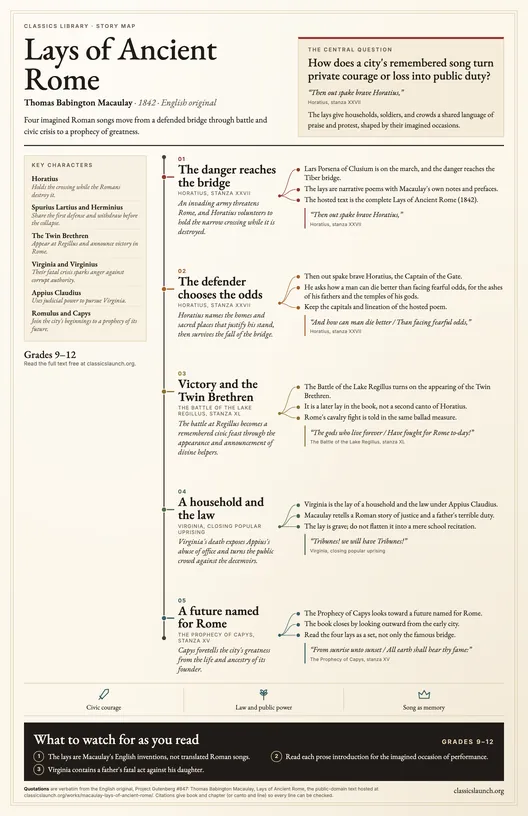 Story mapSee the story mapThe whole book on one page: the story in movements, the characters, and what to watch for. Free to print.
Abstract
Background. Published in 1842, Macaulay's four lays reconstruct an imagined Roman ballad tradition through English narrative verse. Prose introductions describe the historical legends and the occasions assigned to the singers. The project rests on a theory about remembered song, rather than a claim to have recovered lost Latin originals or documentary transcripts.
Content. One defender holds a bridge against an invading army; another poem celebrates victory near Regillus with divine assistance. Virginia recounts a fatal abuse of judicial power and the popular anger that follows. Capys addresses Rome's founder with a vision of future military greatness, connecting origins to later civic triumph.
Themes. Public duty is repeatedly given a family setting: mothers, wives, children, and ancestral homes make the city worth defending. Internal conflict also matters, especially where official authority becomes personal appetite. The poems ask how courageous acts and grievous losses become possessions of a whole community through festival, monument, and repeated narration.
Significance. Strong beats, catalogues, direct speeches, and recurring formulas make the sequence especially rewarding aloud. Its political voices also require attention to who is imagined to be singing and why. Read as nineteenth-century poetry built from ancient materials, the volume offers both memorable heroic scenes and a sustained experiment in turning historical tradition back into dramatic communal song.
Main characters
- Horatius: Holds the crossing while the Romans destroy it.
- Spurius Lartius and Herminius: Share the first defense and withdraw before the collapse.
- The Twin Brethren: Appear at Regillus and announce victory in Rome.
- Virginia and Virginius: Their fatal crisis sparks anger against corrupt authority.
- Appius Claudius: Uses judicial power to pursue Virginia.
- Romulus and Capys: Join the city's beginnings to a prophecy of its future.
Summary
Lays of Ancient Rome asks readers to imagine that some famous episodes of early Roman history once lived as songs before prose historians preserved them. Macaulay's preface explains this literary experiment and distinguishes legendary narrative from secure documentary knowledge. The four poems are English compositions in imagined ancient voices, each attached to a civic occasion or partisan memory. Their energetic rhythms make public action sound ready for communal recitation. Horatius tells of an Etruscan army advancing toward Rome after the expulsion of the kings. The wooden bridge across the Tiber offers a route into the city. Horatius and two companions defend its far end while the Romans cut it down. Once his fellow defenders have crossed, Horatius remains alone until the bridge falls. He then commits himself to the river and reaches safety. The poem's account of later remembrance places the deed in the city's homes and future storytelling as well as on its battlefield. The Battle of the Lake Regillus enlarges the scale. Roman and Latin forces meet in a struggle joined to the fortunes of the exiled royal house. Detailed challenges, named fighters, and changing battle lines give the engagement a crowded ballad form. The mysterious Twin Brethren appear as helpers and bring news of victory to Rome. Religious celebration becomes the means by which the battle continues to be remembered. Virginia moves the danger inside the city. Appius Claudius uses authority and a false legal claim to seek control over a freeborn girl. Her father kills her rather than surrender her, and the resulting fury turns against the decemvirs. The poem presents civic liberty through a dreadful family loss and the angry voice of popular memory. The Prophecy of Capys then turns to Rome's beginnings, foretelling the city's martial future from the story of Romulus. Together the lays join family loyalty, civic courage, religious tradition, and political conflict. Their speakers do not stand outside Roman passions: they praise, blame, mourn, and forecast from within them. Reading the introductions alongside the verse reveals Macaulay's double achievement as a maker of stirring stories and an imaginative student of how communities remember their past.
Virtues in this work
Plot or Argument
- The danger reaches the bridge
An invading army threatens Rome, and Horatius volunteers to hold the narrow crossing while it is destroyed.
- The defender chooses the odds
Horatius names the homes and sacred places that justify his stand, then survives the fall of the bridge.
- Victory and the Twin Brethren
The battle at Regillus becomes a remembered civic feast through the appearance and announcement of divine helpers.
- A household and the law
Virginia's death exposes Appius's abuse of office and turns the public crowd against the decemvirs.
- A future named for Rome
Capys foretells the city's greatness from the life and ancestry of its founder.
Characters
- Horatius, Bridge defender
Holds the crossing while the Romans destroy it.
- Spurius Lartius and Herminius, Companions
Share the first defense and withdraw before the collapse.
- The Twin Brethren, Divine helpers
Appear at Regillus and announce victory in Rome.
- Virginia and Virginius, Daughter and father
Their fatal crisis sparks anger against corrupt authority.
- Appius Claudius, Decemvir
Uses judicial power to pursue Virginia.
- Romulus and Capys, Founder and seer
Join the city's beginnings to a prophecy of its future.
Lessons
Hear the imagined singer
Each lay belongs to a proposed occasion and point of view. The introductions help identify the interests behind its praise and anger.
- Who is supposed to hear each song?
- How does a festival change the telling of a battle?
Duty has particular objects
Horatius names people and places rather than courage in the abstract. His speech gives the city's survival a household scale.
- What does he believe he is defending?
- Why do family details matter in a public poem?
Power requires lawful limits
Virginia makes an officer's private desire a public crisis. The crowd's response connects household safety with political institutions.
- How is a legal claim used against Virginia?
- Why does the crowd demand tribunes?
Context
Macaulay drew on Roman historical tradition while treating much early history as legendary. His introductions explain how he imagined oral poetry preceding the surviving prose narratives, and the lays enact that hypothesis in English.
Composition
The four lays were published in 1842. Their ancient performance settings are part of Macaulay's reconstruction, not evidence of surviving Roman songs.
Reception
Horatius became particularly familiar in recitation and memorization; the other lays broaden the collection from defense of the city to civic conflict and predictions of greatness.
Comparisons
- The Aeneid
Both connect Rome's origin traditions with its later destiny, but Macaulay uses separate imagined civic songs.
- Julius Caesar
Compare public speeches and popular judgment in Shakespeare's late republican crisis with the lays' imagined early Roman voices.
Quotes
“Then out spake brave Horatius,”
“And how can man die better Than facing fearful odds,”
“The gods who live forever Have fought for Rome to-day!”
“Tribunes! we will have Tribunes!”
“From sunrise unto sunset All earth shall hear thy fame:”
For Students
A reading companion for classical Christian high school students. See the student guide.
Reading Guide
Watch for
- The lays are Macaulay's English inventions, not translated Roman songs.
- Read each prose introduction for the imagined occasion of performance.
- Virginia contains a father's fatal act against his daughter.
Key terms and names
- lay
- A narrative song or poem associated with remembered deeds.
- decemvir
- One of a board of ten officials, here the Roman lawmakers.
- tribune
- A Roman official charged with protecting the interests of the plebeians.
- ballad
- A narrative poem shaped for strong rhythms and oral delivery.
- pontiff
- A priestly official responsible for aspects of Roman religious practice.
Seminar Questions
- Comprehension Why must the Romans destroy the bridge?
- Comprehension What identifies the mysterious helpers after Regillus?
- Interpretation How does Horatius's speech connect family and city?
- Interpretation Why does Macaulay supply prose introductions?
- Big Question When can a community's song become an argument about its laws?
- Big Question Does predicting greatness change how a founding story is heard?
Faith Connections
- John 15:13 (Scripture)
The willingness to risk life for others supplies a careful comparison with the bridge defense, without equating Roman religion with the Gospel.
- Augustine, The City of God, Book V (Church Fathers)
Augustine's discussion of Roman glory and civic virtue offers a sustained conversation about the motives praised by the lays.
Logic and Rhetoric
Central argument: Communities preserve and shape their public ideals through songs that give courage, anger, and collective memory a dramatic voice.
Rhetorical device: rhetorical question. The bridge defender frames the choice of a worthy death as a question whose answer names family, ancestors, and sacred places.
Debate: Resolved: the lays' imagined performance settings are essential to understanding their political voices.
Memory Work
And how can man die better Than facing fearful odds,
Writing Prompts
Essay: Compare public memory in Horatius and Virginia, attending to who tells each story and what response is desired.
Comparison with The Aeneid: Compare the future promised in Capys's prophecy with the relation between origins and destiny in The Aeneid.
Medical Lens
Virginia's killing is central to one lay's public crisis; bodily danger elsewhere chiefly belongs to heroic battle narrative.
- Virginia, confrontation and death
Virginius kills his daughter rather than surrender her to Appius, provoking a political uprising.
Creative Prompts
- Poetry
Write a short ballad stanza about a narrow place defended while others complete an urgent task.
- Dialogue
Stage a discussion between two Roman listeners who disagree about what the Virginia song asks them to remember.
- Classroom
Mark the changes in pace during Horatius's stand, collapse, swim, and later commemoration.
Further Reading
- The Early History of Rome, Livy
- The History of England from the Accession of James the Second, Thomas Babington Macaulay
Verification notes
All quotations match the hosted Project Gutenberg #847 text, including indentation in multiline selections. The narrative accounts are identified as Roman legends recast by Macaulay; the reconstructed performance dates and singers are not treated as historical discoveries.
No verification flags recorded.