Story maps · Grades 11–12
Madame Bovary: A Story Map
The PDF is one tabloid page (11 × 17 in). On letter paper, choose “Fit to page.”
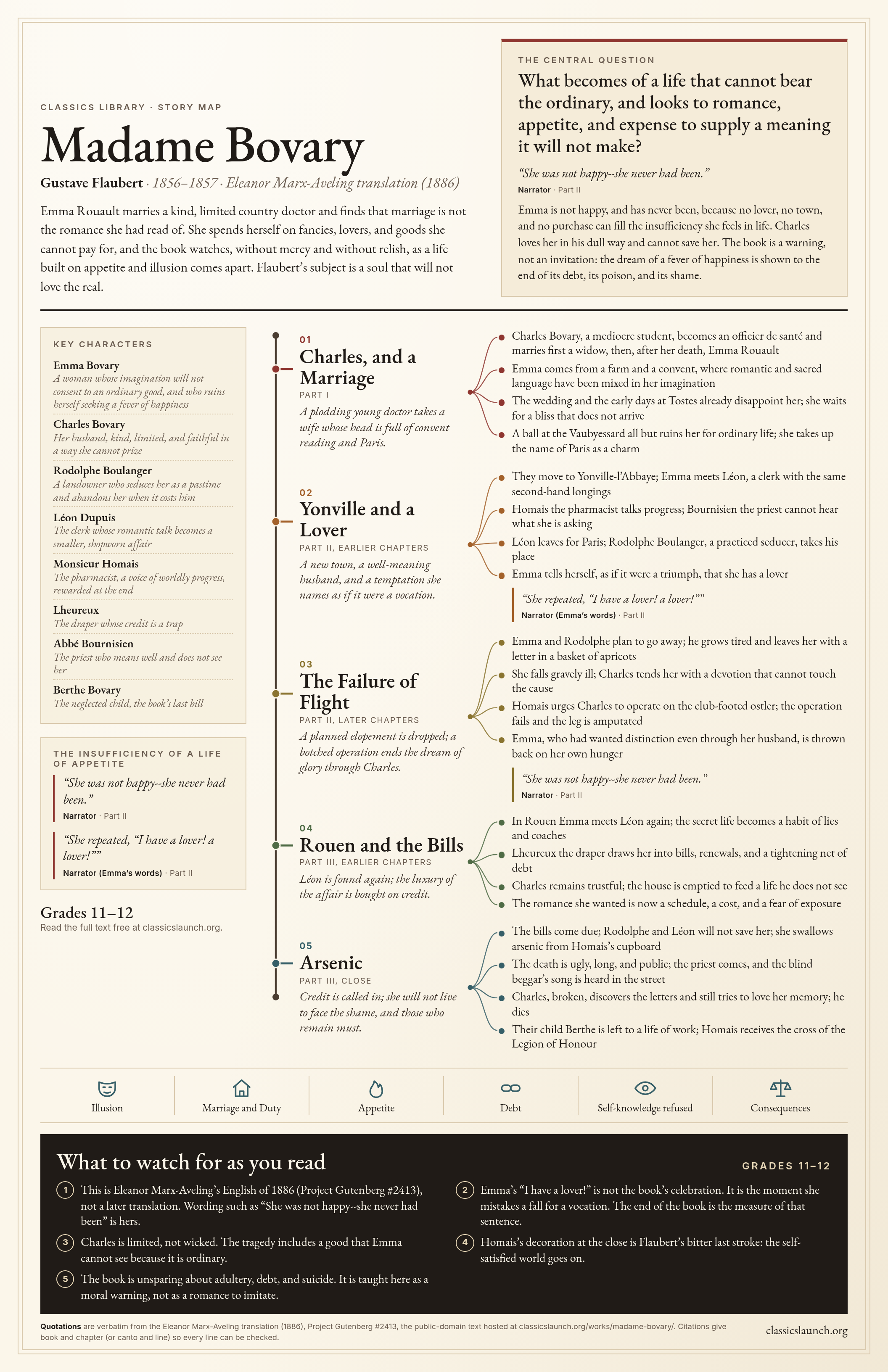
Emma Rouault marries a kind, limited country doctor and finds that marriage is not the romance she had read of. She spends herself on fancies, lovers, and goods she cannot pay for, and the book watches, without mercy and without relish, as a life built on appetite and illusion comes apart. Flaubert’s subject is a soul that will not love the real.
The central question
What becomes of a life that cannot bear the ordinary, and looks to romance, appetite, and expense to supply a meaning it will not make?
“She was not happy--she never had been.”
Emma is not happy, and has never been, because no lover, no town, and no purchase can fill the insufficiency she feels in life. Charles loves her in his dull way and cannot save her. The book is a warning, not an invitation: the dream of a fever of happiness is shown to the end of its debt, its poison, and its shame.
- 01
Charles, and a Marriage
Part I
A plodding young doctor takes a wife whose head is full of convent reading and Paris.
- Charles Bovary, a mediocre student, becomes an officier de santé and marries first a widow, then, after her death, Emma Rouault
- Emma comes from a farm and a convent, where romantic and sacred language have been mixed in her imagination
- The wedding and the early days at Tostes already disappoint her; she waits for a bliss that does not arrive
- A ball at the Vaubyessard all but ruins her for ordinary life; she takes up the name of Paris as a charm
- 02
Yonville and a Lover
Part II, earlier chapters
A new town, a well-meaning husband, and a temptation she names as if it were a vocation.
- They move to Yonville-l’Abbaye; Emma meets Léon, a clerk with the same second-hand longings
- Homais the pharmacist talks progress; Bournisien the priest cannot hear what she is asking
- Léon leaves for Paris; Rodolphe Boulanger, a practiced seducer, takes his place
- Emma tells herself, as if it were a triumph, that she has a lover
“She repeated, “I have a lover! a lover!””
- 03
The Failure of Flight
Part II, later chapters
A planned elopement is dropped; a botched operation ends the dream of glory through Charles.
- Emma and Rodolphe plan to go away; he grows tired and leaves her with a letter in a basket of apricots
- She falls gravely ill; Charles tends her with a devotion that cannot touch the cause
- Homais urges Charles to operate on the club-footed ostler; the operation fails and the leg is amputated
- Emma, who had wanted distinction even through her husband, is thrown back on her own hunger
“She was not happy--she never had been.”
- 04
Rouen and the Bills
Part III, earlier chapters
Léon is found again; the luxury of the affair is bought on credit.
- In Rouen Emma meets Léon again; the secret life becomes a habit of lies and coaches
- Lheureux the draper draws her into bills, renewals, and a tightening net of debt
- Charles remains trustful; the house is emptied to feed a life he does not see
- The romance she wanted is now a schedule, a cost, and a fear of exposure
- 05
Arsenic
Part III, close
Credit is called in; she will not live to face the shame, and those who remain must.
- The bills come due; Rodolphe and Léon will not save her; she swallows arsenic from Homais’s cupboard
- The death is ugly, long, and public; the priest comes, and the blind beggar’s song is heard in the street
- Charles, broken, discovers the letters and still tries to love her memory; he dies
- Their child Berthe is left to a life of work; Homais receives the cross of the Legion of Honour
- Illusion
- Marriage and Duty
- Appetite
- Debt
- Self-knowledge refused
- Consequences
What to watch for as you read
Grades 11–12- This is Eleanor Marx-Aveling’s English of 1886 (Project Gutenberg #2413), not a later translation. Wording such as “She was not happy--she never had been” is hers.
- Emma’s “I have a lover!” is not the book’s celebration. It is the moment she mistakes a fall for a vocation. The end of the book is the measure of that sentence.
- Charles is limited, not wicked. The tragedy includes a good that Emma cannot see because it is ordinary.
- Homais’s decoration at the close is Flaubert’s bitter last stroke: the self-satisfied world goes on.
- The book is unsparing about adultery, debt, and suicide. It is taught here as a moral warning, not as a romance to imitate.
Every quotation is word for word from the Eleanor Marx-Aveling translation (1886) hosted in this library and is checked against that text each time the site is built. Citations give book and chapter (or canto and line).