Story maps · Grades 11–12
The Betrothed (I Promessi Sposi): A Story Map
The PDF is one tabloid page (11 × 17 in). On letter paper, choose “Fit to page.”
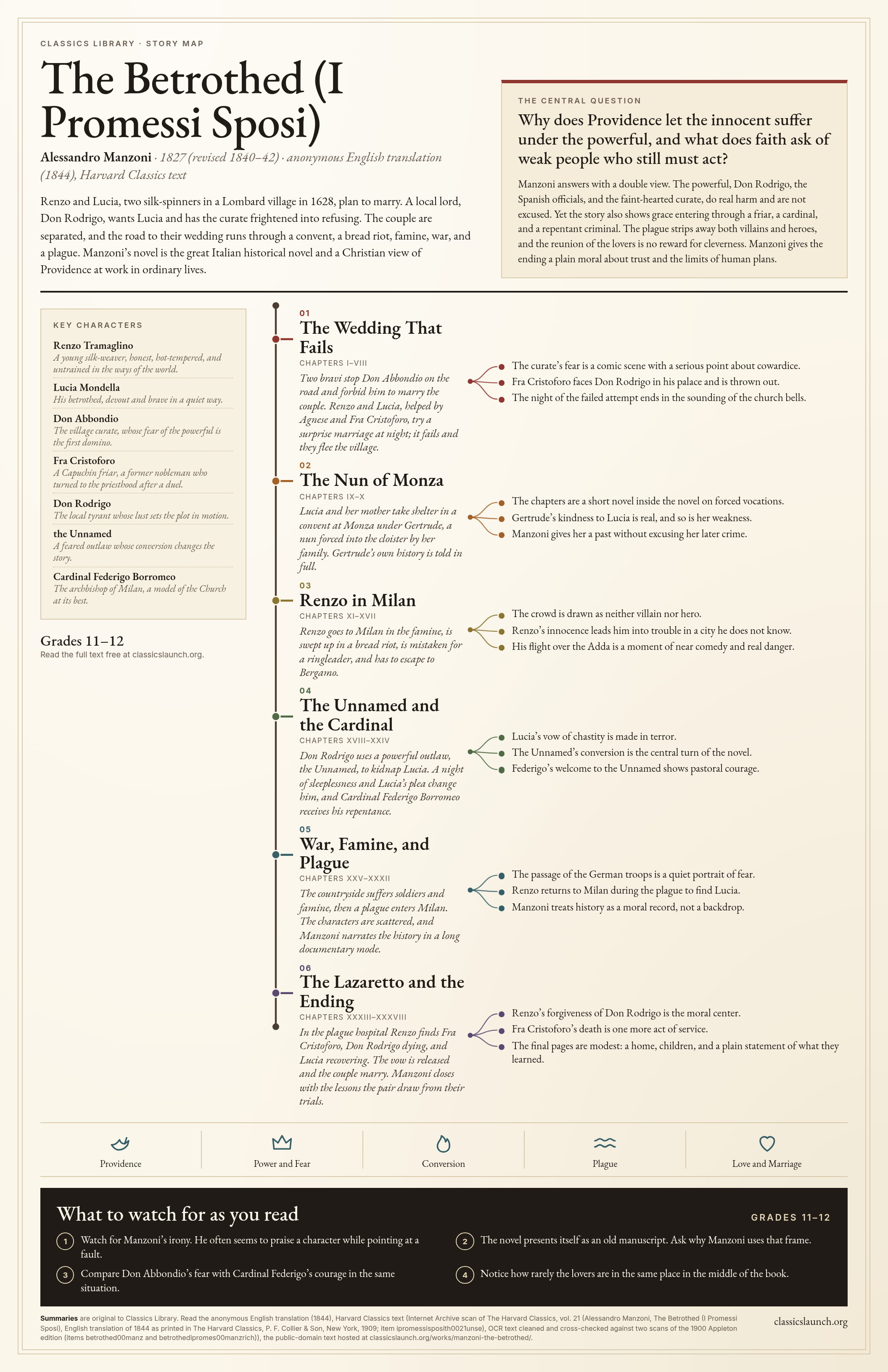
Renzo and Lucia, two silk-spinners in a Lombard village in 1628, plan to marry. A local lord, Don Rodrigo, wants Lucia and has the curate frightened into refusing. The couple are separated, and the road to their wedding runs through a convent, a bread riot, famine, war, and a plague. Manzoni’s novel is the great Italian historical novel and a Christian view of Providence at work in ordinary lives.
The central question
Why does Providence let the innocent suffer under the powerful, and what does faith ask of weak people who still must act?
Manzoni answers with a double view. The powerful, Don Rodrigo, the Spanish officials, and the faint-hearted curate, do real harm and are not excused. Yet the story also shows grace entering through a friar, a cardinal, and a repentant criminal. The plague strips away both villains and heroes, and the reunion of the lovers is no reward for cleverness. Manzoni gives the ending a plain moral about trust and the limits of human plans.
- 01
The Wedding That Fails
Chapters I–VIII
Two bravi stop Don Abbondio on the road and forbid him to marry the couple. Renzo and Lucia, helped by Agnese and Fra Cristoforo, try a surprise marriage at night; it fails and they flee the village.
- The curate’s fear is a comic scene with a serious point about cowardice.
- Fra Cristoforo faces Don Rodrigo in his palace and is thrown out.
- The night of the failed attempt ends in the sounding of the church bells.
- 02
The Nun of Monza
Chapters IX–X
Lucia and her mother take shelter in a convent at Monza under Gertrude, a nun forced into the cloister by her family. Gertrude’s own history is told in full.
- The chapters are a short novel inside the novel on forced vocations.
- Gertrude’s kindness to Lucia is real, and so is her weakness.
- Manzoni gives her a past without excusing her later crime.
- 03
Renzo in Milan
Chapters XI–XVII
Renzo goes to Milan in the famine, is swept up in a bread riot, is mistaken for a ringleader, and has to escape to Bergamo.
- The crowd is drawn as neither villain nor hero.
- Renzo’s innocence leads him into trouble in a city he does not know.
- His flight over the Adda is a moment of near comedy and real danger.
- 04
The Unnamed and the Cardinal
Chapters XVIII–XXIV
Don Rodrigo uses a powerful outlaw, the Unnamed, to kidnap Lucia. A night of sleeplessness and Lucia’s plea change him, and Cardinal Federigo Borromeo receives his repentance.
- Lucia’s vow of chastity is made in terror.
- The Unnamed’s conversion is the central turn of the novel.
- Federigo’s welcome to the Unnamed shows pastoral courage.
- 05
War, Famine, and Plague
Chapters XXV–XXXII
The countryside suffers soldiers and famine, then a plague enters Milan. The characters are scattered, and Manzoni narrates the history in a long documentary mode.
- The passage of the German troops is a quiet portrait of fear.
- Renzo returns to Milan during the plague to find Lucia.
- Manzoni treats history as a moral record, not a backdrop.
- 06
The Lazaretto and the Ending
Chapters XXXIII–XXXVIII
In the plague hospital Renzo finds Fra Cristoforo, Don Rodrigo dying, and Lucia recovering. The vow is released and the couple marry. Manzoni closes with the lessons the pair draw from their trials.
- Renzo’s forgiveness of Don Rodrigo is the moral center.
- Fra Cristoforo’s death is one more act of service.
- The final pages are modest: a home, children, and a plain statement of what they learned.
- Providence
- Power and Fear
- Conversion
- Plague
- Love and Marriage
What to watch for as you read
Grades 11–12- Watch for Manzoni’s irony. He often seems to praise a character while pointing at a fault.
- The novel presents itself as an old manuscript. Ask why Manzoni uses that frame.
- Compare Don Abbondio’s fear with Cardinal Federigo’s courage in the same situation.
- Notice how rarely the lovers are in the same place in the middle of the book.
Every quotation is word for word from the anonymous English translation (1844), Harvard Classics text hosted in this library and is checked against that text each time the site is built. Citations give book and chapter (or canto and line).