Work record
The Betrothed (I promessi sposi)
Alessandro ManzoniI promessi sposi; The Betrothed Lovers; The Betrothed (Manzoni); The Betrothed (Harvard Classics); Renzo and Lucia; Manzoni's BetrothedThe Betrothed (I promessi sposi) by Alessandro Manzoni (1827)The Betrothed (I promessi sposi) is the great Italian historical novel, set in Lombardy in 1628–1630 under Spanish rule.Also known as: I promessi sposi · The Betrothed Lovers · The Betrothed (Manzoni) · The Betrothed (Harvard Classics) · Renzo and Lucia · Manzoni's Betrothed
1827 (revised 1840–1842) · 19th Century · Novel · Italian
Read this when an honest couple faces a powerful bully and must trust Providence.
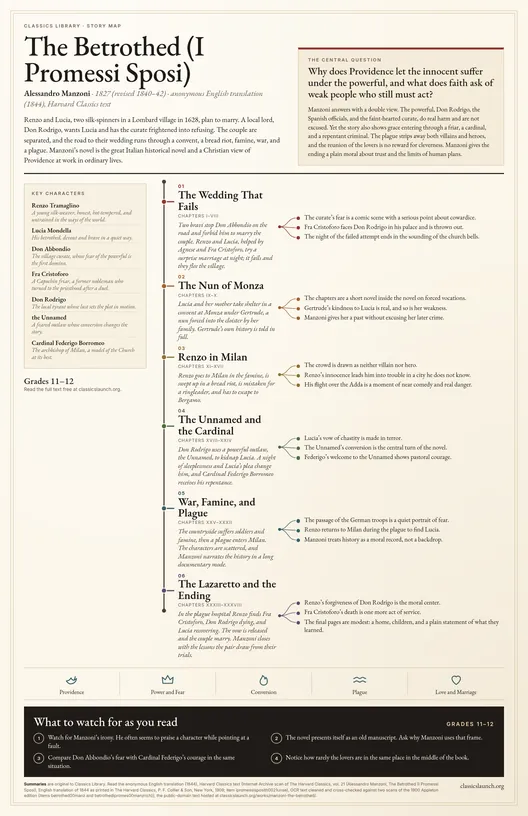 Story mapSee the story mapThe whole book on one page: the story in movements, the characters, and what to watch for. Free to print.
Abstract
Background. Manzoni wrote this novel in the 1820s and revised it in the early 1840s. He set it in Lombardy under Spain in the years of famine, war and plague, 1628–1630, and he drew on the chronicles of the time.
Plot. Renzo and Lucia are to be married, but the lord Don Rodrigo orders the priest, by threats, not to marry them. They flee; Lucia is held in a convent and is then seized for the Unnamed, who is converted by her prayer. Renzo is caught in a riot at Milan. In the plague of 1630 they meet again at the Lazzaretto, where Renzo forgives Don Rodrigo, and they are married.
Method. The narrator speaks to the reader with irony and compassion, and he shows the powerful, the clergy and the poor in turn.
Why it matters. It is the first great Italian novel and a model of the Christian historical novel. It shows how a humble and faithful people may bear injustice, and how repentance and forgiveness make a new beginning, so that trust in Providence is shown to be more than an idea. The book rewards a patient reader with a wide and humane picture of a whole society.
Main characters
- Renzo: A young silk-weaver
- Lucia: His betrothed
- Don Abbondio: The timid priest
- Don Rodrigo: The nobleman who bars the marriage
- Fra Cristoforo: The Capuchin friar
- The Unnamed: A feared lord who is converted
Summary
The Betrothed (I promessi sposi) is the great Italian historical novel, set in Lombardy in 1628–1630 under Spanish rule. Renzo Tramaglino and Lucia Mondella, two young villagers near Lecco, are to be married, but on the way to the church the parish priest, Don Abbondio, is stopped by two armed bravi who tell him in the name of Don Rodrigo, the local lord, that the wedding must not take place. Don Rodrigo wants Lucia for himself. Don Abbondio, a timid man, finds excuse after excuse, and Renzo and Lucia, helped by Lucia's mother Agnese and by the good Capuchin friar Cristoforo, try a trick to marry before witnesses, which fails. They are forced to flee across the lake of Como, Lucia to a convent at Monza where the nun Gertrude, a girl forced into the cloister, rules her fate, and Renzo to Milan. There Renzo is caught up in a bread riot at the time of famine, is arrested and flees to the territory of Bergamo. Lucia is seized by Don Rodrigo's agents and carried to the castle of a fearsome lord, the Unnamed. The sight and prayers of Lucia stir his conscience; he is converted after a sleepless night, and the good Cardinal Federigo Borromeo receives him with joy. Lucia is set free and given shelter, and Don Abbondio is called to account by the Cardinal. The war of Mantuan succession brings German soldiers and then the plague of 1630 to Milan. Renzo returns, sick, and goes to the plague hospital, the Lazzaretto, in search of Lucia. There he finds Fra Cristoforo tending the dying, sees Don Rodrigo dying among them and, urged by the friar, forgives him. Lucia is found alive, and the friar frees her from a vow she had made in her fear. After the plague, Renzo and Lucia are married at last by Don Abbondio, and they set up house and raise a family. The tale ends with Renzo's own conclusion that trouble comes to the guilty and the innocent, but that with trust in God it can be turned to good. Manzoni writes with irony and compassion and draws his people from every rank of society. He wished to show a Christian view of history, in which the weak are not lost when the strong abuse their power, and Providence works through the humble.
Virtues in this work
- Faith: Lucia trusts in God through every trial and her trust is shown to bring about a good she did not foresee.
- Charity: Cardinal Federigo and Fra Cristoforo give their goods and their lives for the poor and the plague-stricken.
- Fortitude: Lucia and Renzo bear exile, hunger and plague without losing faith in one another.
- Justice: The Cardinal calls the priest to his duty, and the story shows that wrongdoing must be put right by repentance.
- Humility: The Unnamed and Fra Cristoforo both humble themselves to repent and make amends.
Plot or Argument
- Chapters I–VIII: The forbidden wedding
Don Abbondio is stopped by Don Rodrigo's bravi and refuses to marry the couple. Fra Cristoforo, who has himself repented of a murder, tries to speak to Don Rodrigo and is dismissed. A night attempt to marry by declaring themselves before the priest fails, and the two flee.
- Chapters IX–XI: The nun of Monza
Lucia is sheltered at the convent in Monza, where the nun Gertrude, forced into religion by her family, tells her unhappy story and is drawn into a crime.
- Chapters XII–XVII: Renzo in Milan
In a year of famine Renzo is swept into the bread riot of Milan, is arrested, escapes, and takes refuge in Bergamo.
- Chapters XVIII–XXIII: The Unnamed
Lucia is kidnapped to the castle of the Unnamed, a feared lord. In a night of remorse the Unnamed is converted by her prayer and goes to the Cardinal.
- Chapters XXIII–XXVI: The Cardinal
Cardinal Federigo Borromeo receives the Unnamed, restores Lucia to her friends and calls Don Abbondio to account for his timidity.
- Chapters XXVII–XXXII: War, famine and plague
Imperial soldiers march through Lombardy, famine grows, and the plague enters Milan. Don Rodrigo falls ill.
- Chapters XXXIII–XXXVII: The Lazzaretto
Renzo goes to Milan in search of Lucia and finds her at the plague hospital, where Fra Cristoforo is nursing the sick. Renzo forgives Don Rodrigo, and the friar releases Lucia from her vow.
- Chapter XXXVIII: The marriage
The plague ends, Don Rodrigo's heir takes the estate and the couple are free of its lord, and Don Abbondio at last marries the couple. Renzo tells what he has learned, and the novel closes.
Characters
- Renzo Tramaglino, young silk-weaver of good heart and a quick temper
A young silk-weaver of good heart and a quick temper, who learns patience.
- Lucia Mondella, his betrothed
His betrothed, a modest and devout girl, steadfast in danger.
- Don Abbondio, timid parish priest
The timid parish priest who dares not marry them.
- Don Rodrigo, local nobleman
The local nobleman who wishes to possess Lucia and uses force to prevent the marriage.
- Fra Cristoforo, capuchin friar
A Capuchin friar who repented of a murder and became a protector of the poor.
- Agnese, Lucia's mother
Lucia's mother, shrewd and warm-hearted.
- The Unnamed, powerful and feared lord
A powerful and feared lord who is converted by remorse and Lucia's prayer.
- Cardinal Federigo Borromeo, archbishop of Milan
The Archbishop of Milan, a model of Christian charity.
- Gertrude (the nun of Monza), young woman forced into a convent
A young woman forced into a convent who is led into sin.
- Perpetua, Don Abbondio's housekeeper and scold
Don Abbondio's housekeeper and scold.
Lessons
Providence and the humble
Manzoni shows that the lowly are not forgotten by God, though the book never says that they will be spared. Students can trace how each trial of Renzo and Lucia turns out to serve a good they did not foresee, and compare this with the story of Joseph in Genesis.
- How does each of Lucia's sufferings lead to some good?
- What does Lucia's remark on the God who sends sorrow to prepare a surer joy mean?
The cowardly shepherd
Don Abbondio is amusing, but he is also a warning about the priest who would rather be safe than do his duty. Cardinal Federigo gives the contrary example. The book teaches that fear of the strong is a grave sin in those who are called to protect the weak.
- Why does Don Abbondio obey the bravi?
- What does the Cardinal say that a pastor owes his flock?
Conversion and mercy
The Unnamed turns from a life of crime after one night of remorse, and Renzo forgives Don Rodrigo at the end. The novel presents conversion and forgiveness as the heart of Christian life and the answer to the cycle of revenge.
- What brings about the conversion of the Unnamed?
- Why is Renzo able to forgive Don Rodrigo?
Power, law and the poor
Manzoni shows how unjust powers use the law and the weakness of officials to wrong the poor in Lombardy under Spanish rule. The lesson is that law without justice protects the strong, and that charity must make good what law fails to do.
- How do the lawyer Azzecca-Garbugli and the officials serve Don Rodrigo?
- What does the bread riot show about justice and the rights of the poor?
Context
The story is set in Lombardy under the rule of Spain in 1628–1630. These were years of famine in 1628, war over the succession to Mantua in which imperial troops passed through the country in 1629–1630, and the great plague of 1630, which killed a large part of the population of Milan. Manzoni draws his history from contemporary chronicles, notably those of Ripamonti and Tadino, and sets his fiction in it. He wrote in the age of the Risorgimento, when Italians were rebuilding their sense of nationhood.
Composition
Manzoni began the novel in 1821 and published a first edition in three volumes in 1827. He then spent years revising the language to the Tuscan of Florence, and the final edition came out in parts in 1840–1842, with the History of the Column of Infamy. The English translation of 1844, used here, was published in London and reprinted in 1909 as volume 21 of the Harvard Classics.
Reception
The novel was received with great admiration and became the national novel of Italy, a standard text in schools, and a model for the Italian prose language. Giuseppe Verdi composed his Requiem in 1874 in Manzoni's honour. Later critics have noted its Christian view of history and the humour of its narrator.
Comparisons
- Ivanhoe
Scott's historical novel was the model for Manzoni's, though Manzoni puts common people at the centre and speaks more directly of Providence.
- Les Misérables
Hugo's novel has its own bishop of great charity and a convict who is changed by mercy, as Manzoni has Cardinal Federigo and the Unnamed.
- War and Peace
Tolstoy's history of an age also shows how ordinary lives are carried along by great events, and both books mix history and fiction.
- The Plague
Camus's novel takes the plague as an image of evil, and Manzoni's plague of 1630 is a Christian account of suffering and charity.
- The Decameron
Boccaccio's frame story begins with the plague of Florence in 1348 and is a good contrast to Manzoni's plague.
- The Leopard (Il Gattopardo)
Lampedusa's novel looks at the rule of the powerful in Italy with irony and without Manzoni's trust in Providence, and the two books may be read together.
- The House by the Medlar-Tree (I Malavoglia)
Verga's novel of a poor family in Sicily is the next great Italian novel and may be read as a darker answer to Manzoni's trust in Providence.
- The Pilgrim's Progress
Bunyan's allegory is a Protestant story of the soul's journey, and compares with Manzoni's Catholic view of trial and trust.
Quotes
Frequently cited
“That branch of the lake of Como, which extends towards the south, is enclosed by two unbroken chains of mountains, which, as they advance and recede, diversify its shores with numerous bays and inlets.”
Frequently cited
“Our Abbondio, not noble, not rich, not courageous, was therefore accustomed from his very infancy to look upon himself as a vessel of fragile earthenware, obliged to journey in company with many vessels of iron.”
Frequently cited
“He who imparted to you such gladness is everywhere; and He never disturbs the joy of his children, but to prepare them for one more certain and durable.”
Frequently cited
“I’ve forgiven him from my heart,’ said Renzo”
“‘But,’ said the Cardinal, with a voice and look much more serious than usual, ‘it is your Bishop who, for his own duty’s sake, and for your justification, wishes to learn from you why you have not done what, in your regular duties, you were bound to do?’”
“he said that perhaps the Lord has designed to show mercy to that poor fellow ... (now I really cannot give him any other name) ... and waits to take him at the right moment, but wishes that we should pray for him together.”
For Students
A reading companion for classical Christian high school students. See the student guide.
Reading Guide
Watch for
- How the narrator speaks of Don Abbondio, and what he thinks of him.
- What Fra Cristoforo does in each of the scenes in which he appears.
- How the Unnamed changes, and what the Cardinal says to him.
- How Manzoni describes the famine, the war and the plague.
Key terms and names
- Bravi
- Armed retainers who did a nobleman's violence for him.
- Capuchin
- A friar of the strict Franciscan reform, such as Fra Cristoforo.
- Providence
- God's ordering of events for the good of those who trust him, which is the book's theme.
- Lazzaretto
- The great plague hospital outside Milan where the sick were isolated.
- Grida
- A proclamation or decree, such as the many ineffective edicts against the bravi.
- Monatti
- The men who carried the dead and the sick in the plague, and who were notorious for their cruelty.
Seminar Questions
- Comprehension What do the bravi say to Don Abbondio, and why does he obey?
- Comprehension How does Lucia come to be taken to the castle of the Unnamed, and what is the effect of her prayer?
- Interpretation How does Manzoni use humour to treat Don Abbondio, and where does his humour stop?
- Interpretation What does the character of Cardinal Federigo show about the duty of a Christian shepherd?
- Interpretation What does the plague show about the ways in which people respond to a public danger?
- Big Question How can a person believe in Providence in the midst of famine, war and plague?
- Big Question Is forgiveness of an enemy possible without justice?
Faith Connections
- Genesis 50:20 (Scripture)
Joseph's word to his brothers that what they meant for evil God meant for good is the pattern of Manzoni's idea of Providence, which brings good out of the wrongs done to Renzo and Lucia.
- Matthew 6:12–15 (Scripture)
The petition to forgive us our trespasses as we forgive those who trespass against us is the text of Renzo's act at the end, and of the Unnamed's conversion.
- Ezekiel 34:1–10 (Scripture)
The word of the Lord against shepherds who feed themselves is the standard by which Don Abbondio is judged and Cardinal Federigo is praised.
Logic and Rhetoric
Central argument: God's Providence works through the humble, and a world of violent and unjust power is not left without remedy: repentance, forgiveness and charity turn evil to good.
Rhetorical device: irony. The narrator's gentle mockery of Don Abbondio's cowardice and his praise of Federigo's courage make the reader see both clearly without a sermon.
Debate: Resolved: That a Christian novelist should show the working of Providence in the lives of ordinary people.
Memory Work
Our Abbondio, not noble, not rich, not courageous, was therefore accustomed from his very infancy to look upon himself as a vessel of fragile earthenware, obliged to journey in company with many vessels of iron.
I’ve forgiven him from my heart,’ said Renzo
Writing Prompts
Essay: Using at least three passages, explain how Manzoni shows Providence at work in the lives of Renzo, Lucia and the Unnamed.
Comparison with Les Misérables: Compare Cardinal Federigo's charity and the conversion of the Unnamed with Bishop Myriel and Jean Valjean, and say how each writer treats mercy.
Medical Lens
The novel contains a long and careful account of the Milan plague of 1630. Manzoni, using the chroniclers, shows the denial of the first cases, the neglect of the physicians, the belief in plague-spreaders and anointers, the confusion of the sanitary board, the crowded hospital called the Lazzaretto, and the work of the monatti who carried the dead. The famine of 1628 and the bread riot are also described. It is a valuable literary source on the history of epidemics, the public health of the seventeenth century, and the part played by the church in the care of the sick.
- Chapters XXXI–XXXII
The first cases of the plague are denied by the physicians and the magistrates, and the sanitary board is slow to act.
- Chapters XXXII–XXXIV
The plague spreads in Milan, the people accuse strangers of anointing the walls with poison, and the death carts go through the streets.
- Chapters XXXV–XXXVI
The Lazzaretto, where thousands of the sick lie in sheds and Fra Cristoforo nurses the dying.
- Chapter XII
The famine of 1628 and its effect on the poor of Milan.
Creative Prompts
- Essay
Write an essay on the conversion of the Unnamed, showing what leads to it, what the Cardinal says to him, and how the story compares with the conversion of Saul in the Acts.
- Dialogue
Write a conversation between Don Abbondio and Cardinal Federigo in which the priest tries to excuse himself and the Cardinal answers with kindness and firmness.
- Classroom
Hold a debate on the resolution that Renzo was right to forgive Don Rodrigo, with one side using the Lord's Prayer and the other using the claims of justice.
- Fiction
Write a letter from Lucia to her mother Agnese from the Lazzaretto, telling what she has seen and what she has learned from the friar.
Further Reading
- The Column of Infamy, Alessandro Manzoni
Manzoni's essay on the trial of the supposed plague-spreaders, printed with the final novel; read in a modern translation.
- Les Misérables, Victor Hugo
Another novel of mercy and conversion, in this library.
- Ivanhoe, Walter Scott
The historical novel that influenced Manzoni, in this library.
- Alessandro Manzoni: The Man and the Writer, Archibald Colquhoun
A study in English of Manzoni's life and work; check the exact title before citing.
- The Betrothed, Alessandro Manzoni, tr. Bruce Penman
A modern translation of the 1840–42 text; check the edition before citing.
Verification notes
The text is the anonymous English translation of 1844 as reprinted in The Harvard Classics, volume 21 (New York, 1909), taken from Internet Archive scans and corrected against a second scan, with many OCR defects repaired by hand. The translation is of the 1840–1842 Italian text, and it is not complete in every detail: the translator's and the editor's footnotes and some other notes are omitted. Some small errors from the scans may remain, and the Italian original is not hosted here. The plot and chapter outlines follow the hosted text and standard summaries.
- The dates of the editions (1827 and 1840–1842) and of Manzoni's life follow standard reference works and are not in the hosted text.
- The chapter ranges in the plot outline are approximate and follow standard summaries of the novel.
- The statement that Verdi composed his Requiem in Manzoni's honour follows standard music histories.
- The statement that the heir of Don Rodrigo takes over the estate is taken from standard summaries of Chapter XXXVIII.
- The names of Manzoni's chronicle sources, Ripamonti and Tadino, follow standard accounts; Tadino is quoted in the hosted text.
- Residual scan errors (OCR) may remain in the text, and the footnotes of the Harvard edition are omitted.
- The title and translator of the modern translation by Penman and the book by Colquhoun should be checked before citing.