Story maps · Grades 9–12
Typee: A Peep at Polynesian Life: A Story Map
The PDF is one tabloid page (11 × 17 in). On letter paper, choose “Fit to page.”
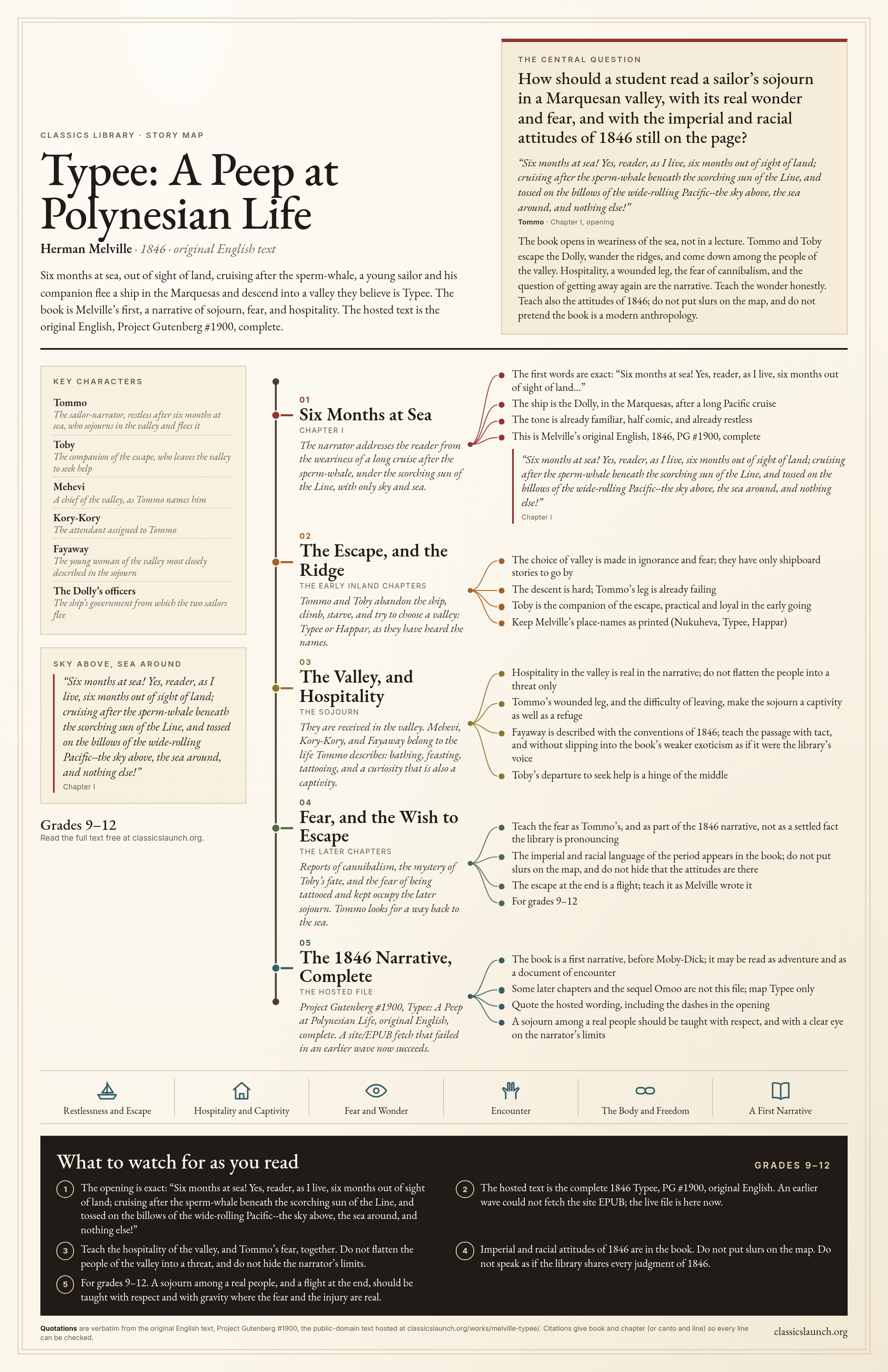
Six months at sea, out of sight of land, cruising after the sperm-whale, a young sailor and his companion flee a ship in the Marquesas and descend into a valley they believe is Typee. The book is Melville’s first, a narrative of sojourn, fear, and hospitality. The hosted text is the original English, Project Gutenberg #1900, complete.
The central question
How should a student read a sailor’s sojourn in a Marquesan valley, with its real wonder and fear, and with the imperial and racial attitudes of 1846 still on the page?
“Six months at sea! Yes, reader, as I live, six months out of sight of land; cruising after the sperm-whale beneath the scorching sun of the Line, and tossed on the billows of the wide-rolling Pacific--the sky above, the sea around, and nothing else!”
The book opens in weariness of the sea, not in a lecture. Tommo and Toby escape the Dolly, wander the ridges, and come down among the people of the valley. Hospitality, a wounded leg, the fear of cannibalism, and the question of getting away again are the narrative. Teach the wonder honestly. Teach also the attitudes of 1846; do not put slurs on the map, and do not pretend the book is a modern anthropology.
- 01
Six Months at Sea
Chapter I
The narrator addresses the reader from the weariness of a long cruise after the sperm-whale, under the scorching sun of the Line, with only sky and sea.
- The first words are exact: “Six months at sea! Yes, reader, as I live, six months out of sight of land…”
- The ship is the Dolly, in the Marquesas, after a long Pacific cruise
- The tone is already familiar, half comic, and already restless
- This is Melville’s original English, 1846, PG #1900, complete
“Six months at sea! Yes, reader, as I live, six months out of sight of land; cruising after the sperm-whale beneath the scorching sun of the Line, and tossed on the billows of the wide-rolling Pacific--the sky above, the sea around, and nothing else!”
- 02
The Escape, and the Ridge
The early inland chapters
Tommo and Toby abandon the ship, climb, starve, and try to choose a valley: Typee or Happar, as they have heard the names.
- The choice of valley is made in ignorance and fear; they have only shipboard stories to go by
- The descent is hard; Tommo’s leg is already failing
- Toby is the companion of the escape, practical and loyal in the early going
- Keep Melville’s place-names as printed (Nukuheva, Typee, Happar)
- 03
The Valley, and Hospitality
The sojourn
They are received in the valley. Mehevi, Kory-Kory, and Fayaway belong to the life Tommo describes: bathing, feasting, tattooing, and a curiosity that is also a captivity.
- Hospitality in the valley is real in the narrative; do not flatten the people into a threat only
- Tommo’s wounded leg, and the difficulty of leaving, make the sojourn a captivity as well as a refuge
- Fayaway is described with the conventions of 1846; teach the passage with tact, and without slipping into the book’s weaker exoticism as if it were the library’s voice
- Toby’s departure to seek help is a hinge of the middle
- 04
Fear, and the Wish to Escape
The later chapters
Reports of cannibalism, the mystery of Toby’s fate, and the fear of being tattooed and kept occupy the later sojourn. Tommo looks for a way back to the sea.
- Teach the fear as Tommo’s, and as part of the 1846 narrative, not as a settled fact the library is pronouncing
- The imperial and racial language of the period appears in the book; do not put slurs on the map, and do not hide that the attitudes are there
- The escape at the end is a flight; teach it as Melville wrote it
- For grades 9–12
- 05
The 1846 Narrative, Complete
The hosted file
Project Gutenberg #1900, Typee: A Peep at Polynesian Life, original English, complete. A site/EPUB fetch that failed in an earlier wave now succeeds.
- The book is a first narrative, before Moby-Dick; it may be read as adventure and as a document of encounter
- Some later chapters and the sequel Omoo are not this file; map Typee only
- Quote the hosted wording, including the dashes in the opening
- A sojourn among a real people should be taught with respect, and with a clear eye on the narrator’s limits
- Restlessness and Escape
- Hospitality and Captivity
- Fear and Wonder
- Encounter
- The Body and Freedom
- A First Narrative
What to watch for as you read
Grades 9–12- The opening is exact: “Six months at sea! Yes, reader, as I live, six months out of sight of land; cruising after the sperm-whale beneath the scorching sun of the Line, and tossed on the billows of the wide-rolling Pacific--the sky above, the sea around, and nothing else!”
- The hosted text is the complete 1846 Typee, PG #1900, original English. An earlier wave could not fetch the site EPUB; the live file is here now.
- Teach the hospitality of the valley, and Tommo’s fear, together. Do not flatten the people of the valley into a threat, and do not hide the narrator’s limits.
- Imperial and racial attitudes of 1846 are in the book. Do not put slurs on the map. Do not speak as if the library shares every judgment of 1846.
- For grades 9–12. A sojourn among a real people, and a flight at the end, should be taught with respect and with gravity where the fear and the injury are real.
Every quotation is word for word from the original English text hosted in this library and is checked against that text each time the site is built. Citations give book and chapter (or canto and line).