Story maps · Grades 9–12
Turkish Embassy Letters: A Story Map
The PDF is one tabloid page (11 × 17 in). On letter paper, choose “Fit to page.”
In August 1716 Lady Mary Wortley Montagu writes from Rotterdam that she has safely passed the sea, though they had the ill fortune of a storm. The letters that follow, published in 1763, carry her through the Dutch towns, Germany, Vienna, and the road to Belgrade and Adrianople, and then into a residence at Constantinople, before the return by Tunis, Italy, France, and Dover in 1718. They are a journey in letters, not one plotted novel. Teach them with respect.
The central question
What can a woman’s embassy letters show of Europe and the Ottoman world, if they are a road and a residence, and not a single story with one climax?
“The small-pox, so fatal, and so general amongst us, is here entirely harmless, by the invention of ingrafting, which is the term they give it.”
The hosted book is a sequence of letters, dated from place to place, from the stormy crossing of 1716 to Dover in the autumn of 1718. Along the road she notices towns, courts, and customs; at Adrianople and Constantinople she writes of women’s lives, of dress, of houses, and, in a famous letter, of the ingrafting against the small-pox, performed by a set of old women in September when the great heat is abated. The letters do not form a plot. They form a journey, and that is enough to map them by.
- 01
Letters of a Journey, and a Limit
The hosted book
Fifty-eight letters of a 1790 edition, not a novel and not the whole apparatus of the volume.
- The hosted text is the Turkish Embassy Letters of Lady Mary Wortley Montagu, written during her travels in Europe, Asia and Africa, in the one-volume edition printed for Thomas Martin, London, 1790. Coverage is Letters 1–58 of that edition, ending with the Letter to the Count (translated from the French). The editor’s advertisement and preface, the verses at the end of the book, and the summary of contents are not included. Name that limit.
- Addressee names are printed in the 1790 edition as initials or dashes. The letters are a travel narrative in many short movements, not one continuous plot. If they feel episodic, that is their form: a woman writing, from stage to stage, to friends and family.
- Teach with respect. Lady Mary is a European Christian traveller and an ambassador’s wife, often delighted, often comparative, sometimes sure of her own eye. Read her curiosity as her own, and do not turn Ottoman households into a spectacle, or her praise into a weapon.
- 02
A Storm, and the Dutch Towns
August 1716
Rotterdam, the Hague, and a first pleasure in neatness.
- Letter 1 is dated Rotterdam, August 3, O.S. 1716, to the Countess of ----. “I FLATTER, myself, dear sister, that I shall give you some pleasure in letting you know that I have safely passed the sea, though we had the ill fortune of a storm.” The captain of the yacht had persuaded them to set out in a calm; after two days the wind blew so hard that none of the sailors could keep their feet, and they were all Sunday night tossed very handsomely.
- She was lucky, she says, neither to suffer from fear nor seasickness, but was so impatient to see herself once more upon dry land that she would not stay till the yacht could get to Rotterdam, and went in the long-boat to Helvoetsluys. She is charmed with the neatness of that little town.
- At Rotterdam a new scene of pleasure: the streets paved with broad stones, and seats of various coloured marbles before many doors, so neatly kept “that, I assure you, I walked almost all over the town yesterday, incognito, in my slippers without receiving one spot of dirt;” A letter from the Hague follows two days later. The journey has begun in observation already, before any Ottoman city is in view.
- 03
Germany and Vienna
Autumn 1716 to the new year
Nuremberg, Ratisbon, a long stay, and a court.
- The dates run on through Nuremberg and Ratisbon in late August, and then a cluster of Vienna letters from September into the winter and the new year of 1717, with excursions of the page to Prague, Leipzig, Brunswick, and Hanover.
- These are letters from courts and cities of the Empire, written while the embassy is still on the European side of its road. They have the same habit as the Dutch letters: a place, a date, a friend, and what she has seen.
- Do not rush this stretch as if the book only began at Belgrade. The comparison she will later make is prepared on this road: she has already been looking hard at Europe when she looks at the Ottoman towns.
- 04
The Road to Adrianople
Early 1717
Peterwaradin, Belgrade, and a famous invention.
- At the end of January 1717 she writes from Peterwaradin; in February from Belgrade; by April she is at Adrianople, from which a cluster of letters is dated, and then, in May, from Constantinople.
- From this Ottoman stretch comes the letter on ingrafting. “A propos of distempers, I am going to tell you a thing that will make you wish yourself here. The small-pox, so fatal, and so general amongst us, is here entirely harmless, by the invention of ingrafting, which is the term they give it. There is a set of old women, who make it their business to perform the operation, every autumn, in the month of September, when the great heat is abated. People send to one another to know if any of their family has a mind to have the small-pox: they make parties for this purpose, and when they are met”
- Other letters from Adrianople and Constantinople describe houses, dress, and the lives of women as she is allowed to see them. Read those pages as hospitality and attention, not as a keyhole. She is often writing against European ignorance as much as she is writing to satisfy it.
“The small-pox, so fatal, and so general amongst us, is here entirely harmless, by the invention of ingrafting, which is the term they give it.”
- 05
Pera, and the Road Home
1717–1718
A residence, then Tunis, Italy, Paris, and Dover.
- From late May 1717 the dates include Constantinople, Belgrade Village, and then Pera of Constantinople in the following winter and spring. The embassy has become a residence. The letters continue to be short, occasional, and addressed to different friends.
- In the summer of 1718 the return begins: Tunis, July 31; Genoa, August 28; Turin, September 12; Lyons, September 28; Paris in October; and Dover at the end of October and the first of November, O.S. 1718. The last movement of the hosted sequence is the Letter to the Count, translated from the French, which closes Letters 1–58 of the 1790 edition.
- The book does not need a plotted climax to be a narrative. The sea is crossed, the road is ridden, a court and a city are lived in, and the sea is crossed again. What she chose to notice—storms, slippers on clean stones, ingrafting, the manners of women and of courts—is the journey’s own selection, as Justin would have said of a different kind of book. Map it as a road, and do not invent a single plot the letters do not have.
- A Journey
- Letters
- Observation
- Women
- Ingrafting
What to watch for as you read
Grades 9–12- This is a letter-form travel narrative with a clear road: the Dutch crossing, Germany and Vienna, the Ottoman journey, a residence at Constantinople, and the return of 1718. It is not a plotted novel. The hosted file is Letters 1–58 of the 1790 edition, not the editor’s preface or the closing verses.
- Teach with respect. Lady Mary’s comparisons can be pointed, and her pleasure in what she sees is real. Do not use her pages to sneer at Islam, at Turkish customs, or at her own eighteenth-century eye.
- The ingrafting letter is famous for a reason, and it is not the whole book. Keep it in its place on the road, among other letters about towns, courts, dress, and households.
- Dates are given in the Old Style, as the letters print them. Some headings in this transcription are irregular. Follow the place-names and the years 1716–1718, and do not invent an itinerary the dates do not support.
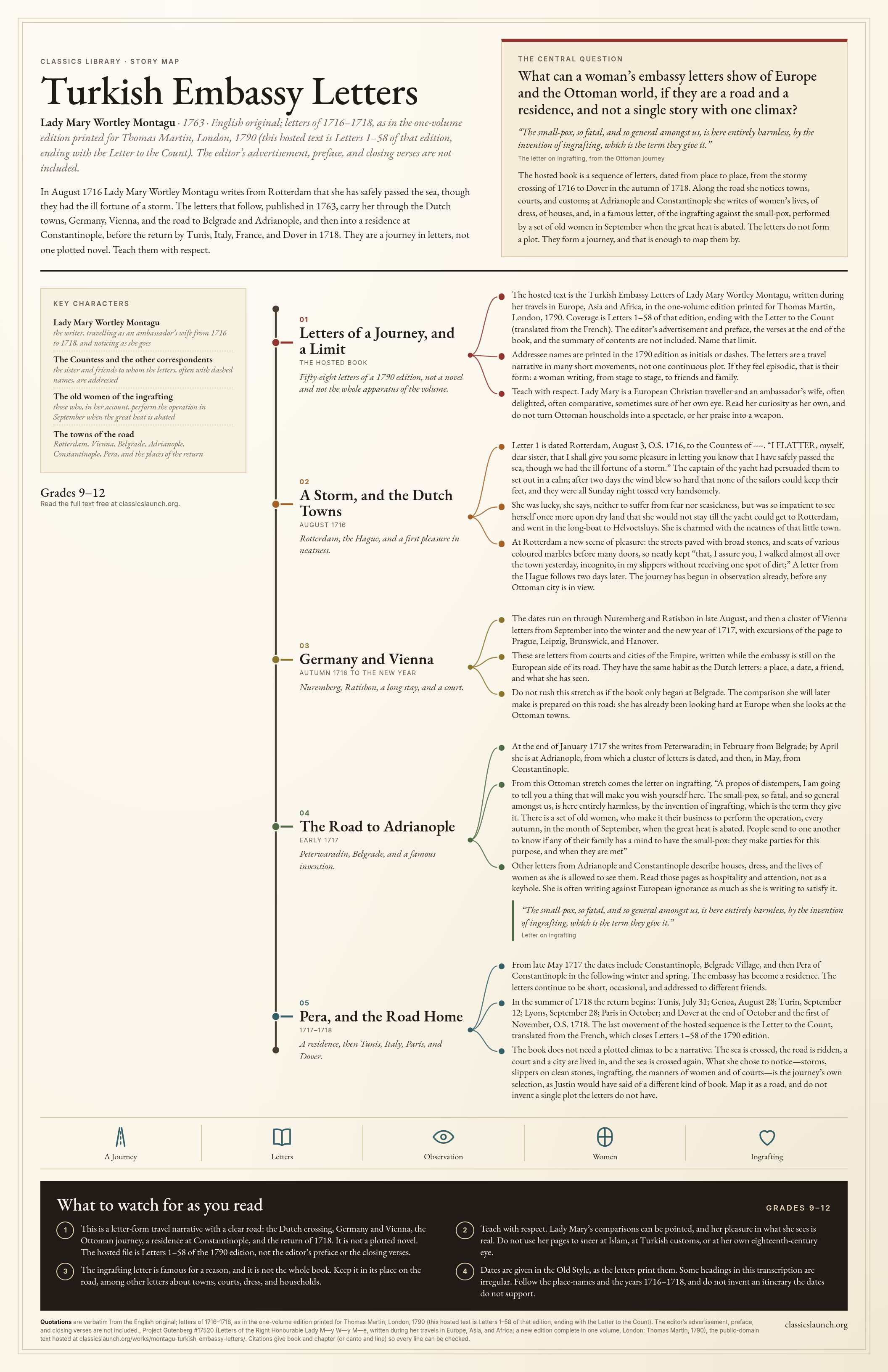
Every quotation is word for word from the English original; letters of 1716–1718, as in the one-volume edition printed for Thomas Martin, London, 1790 (this hosted text is Letters 1–58 of that edition, ending with the Letter to the Count). The editor’s advertisement, preface, and closing verses are not included. hosted in this library and is checked against that text each time the site is built. Citations give book and chapter (or canto and line).