Story maps · Grades 9–12
Much Ado About Nothing: A Story Map
The PDF is one tabloid page (11 × 17 in). On letter paper, choose “Fit to page.”
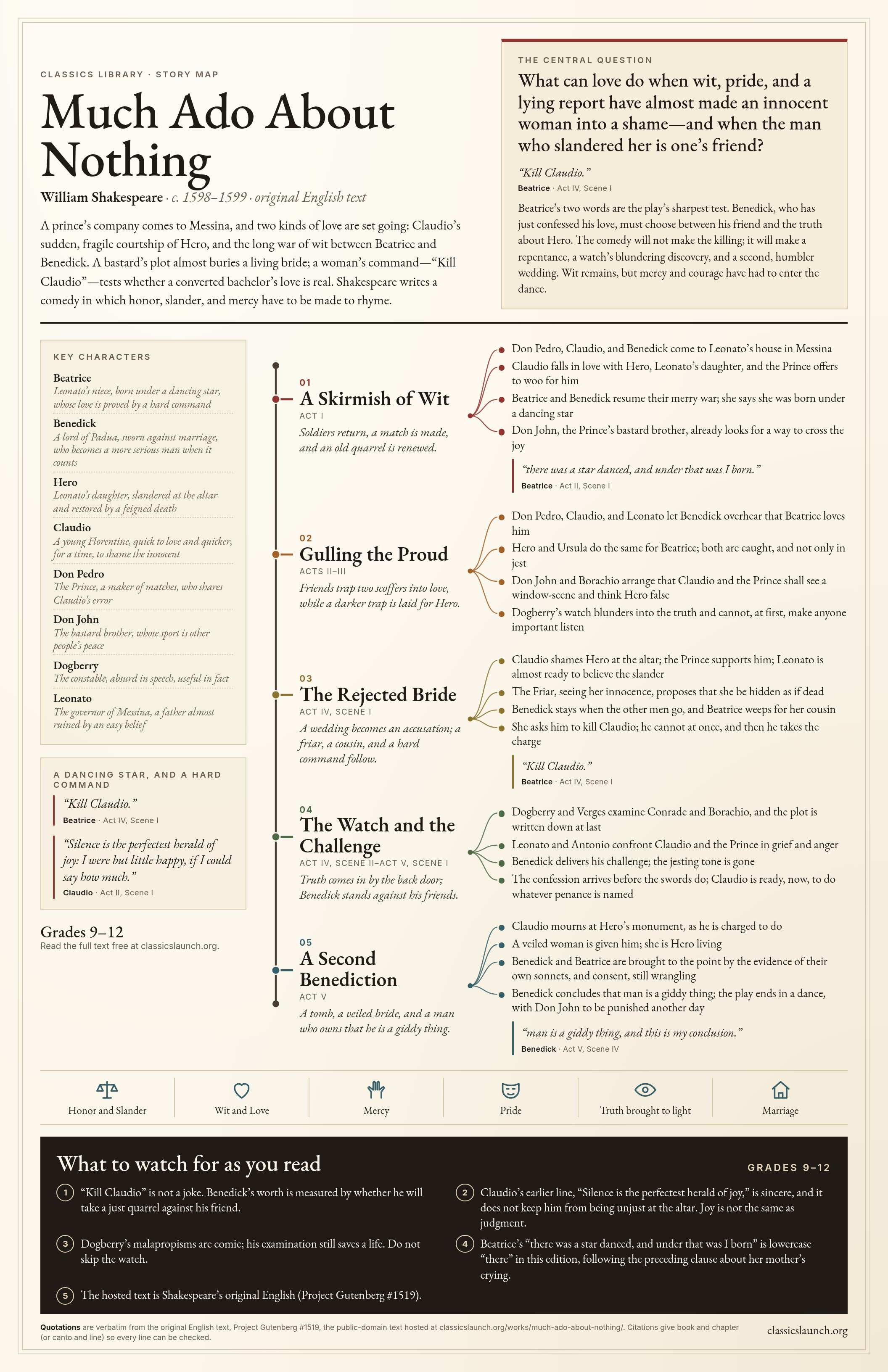
A prince’s company comes to Messina, and two kinds of love are set going: Claudio’s sudden, fragile courtship of Hero, and the long war of wit between Beatrice and Benedick. A bastard’s plot almost buries a living bride; a woman’s command—“Kill Claudio”—tests whether a converted bachelor’s love is real. Shakespeare writes a comedy in which honor, slander, and mercy have to be made to rhyme.
The central question
What can love do when wit, pride, and a lying report have almost made an innocent woman into a shame—and when the man who slandered her is one’s friend?
“Kill Claudio.”
Beatrice’s two words are the play’s sharpest test. Benedick, who has just confessed his love, must choose between his friend and the truth about Hero. The comedy will not make the killing; it will make a repentance, a watch’s blundering discovery, and a second, humbler wedding. Wit remains, but mercy and courage have had to enter the dance.
- 01
A Skirmish of Wit
Act I
Soldiers return, a match is made, and an old quarrel is renewed.
- Don Pedro, Claudio, and Benedick come to Leonato’s house in Messina
- Claudio falls in love with Hero, Leonato’s daughter, and the Prince offers to woo for him
- Beatrice and Benedick resume their merry war; she says she was born under a dancing star
- Don John, the Prince’s bastard brother, already looks for a way to cross the joy
“there was a star danced, and under that was I born.”
- 02
Gulling the Proud
Acts II–III
Friends trap two scoffers into love, while a darker trap is laid for Hero.
- Don Pedro, Claudio, and Leonato let Benedick overhear that Beatrice loves him
- Hero and Ursula do the same for Beatrice; both are caught, and not only in jest
- Don John and Borachio arrange that Claudio and the Prince shall see a window-scene and think Hero false
- Dogberry’s watch blunders into the truth and cannot, at first, make anyone important listen
- 03
The Rejected Bride
Act IV, Scene I
A wedding becomes an accusation; a friar, a cousin, and a hard command follow.
- Claudio shames Hero at the altar; the Prince supports him; Leonato is almost ready to believe the slander
- The Friar, seeing her innocence, proposes that she be hidden as if dead
- Benedick stays when the other men go, and Beatrice weeps for her cousin
- She asks him to kill Claudio; he cannot at once, and then he takes the charge
“Kill Claudio.”
- 04
The Watch and the Challenge
Act IV, Scene II–Act V, Scene I
Truth comes in by the back door; Benedick stands against his friends.
- Dogberry and Verges examine Conrade and Borachio, and the plot is written down at last
- Leonato and Antonio confront Claudio and the Prince in grief and anger
- Benedick delivers his challenge; the jesting tone is gone
- The confession arrives before the swords do; Claudio is ready, now, to do whatever penance is named
- 05
A Second Benediction
Act V
A tomb, a veiled bride, and a man who owns that he is a giddy thing.
- Claudio mourns at Hero’s monument, as he is charged to do
- A veiled woman is given him; she is Hero living
- Benedick and Beatrice are brought to the point by the evidence of their own sonnets, and consent, still wrangling
- Benedick concludes that man is a giddy thing; the play ends in a dance, with Don John to be punished another day
“man is a giddy thing, and this is my conclusion.”
- Honor and Slander
- Wit and Love
- Mercy
- Pride
- Truth brought to light
- Marriage
What to watch for as you read
Grades 9–12- “Kill Claudio” is not a joke. Benedick’s worth is measured by whether he will take a just quarrel against his friend.
- Claudio’s earlier line, “Silence is the perfectest herald of joy,” is sincere, and it does not keep him from being unjust at the altar. Joy is not the same as judgment.
- Dogberry’s malapropisms are comic; his examination still saves a life. Do not skip the watch.
- Beatrice’s “there was a star danced, and under that was I born” is lowercase “there” in this edition, following the preceding clause about her mother’s crying.
- The hosted text is Shakespeare’s original English (Project Gutenberg #1519).
Every quotation is word for word from the original English text hosted in this library and is checked against that text each time the site is built. Citations give book and chapter (or canto and line).