Story maps · Grades 3–8
The Turkish Jester: The Pleasantries of Cogia Nasr Eddin Efendi: A Story Map
The PDF is one tabloid page (11 × 17 in). On letter paper, choose “Fit to page.”
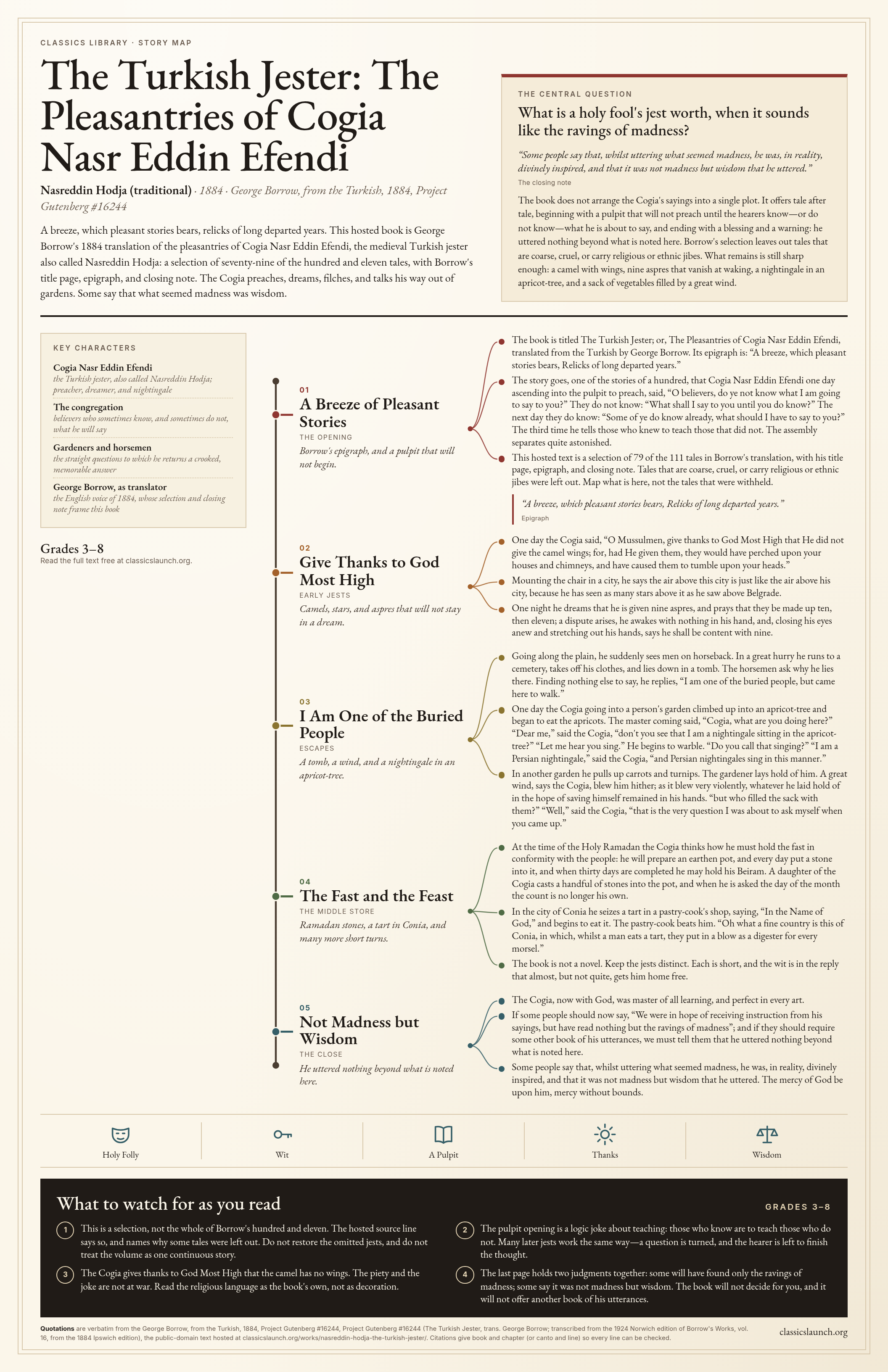
A breeze, which pleasant stories bears, relicks of long departed years. This hosted book is George Borrow's 1884 translation of the pleasantries of Cogia Nasr Eddin Efendi, the medieval Turkish jester also called Nasreddin Hodja: a selection of seventy-nine of the hundred and eleven tales, with Borrow's title page, epigraph, and closing note. The Cogia preaches, dreams, filches, and talks his way out of gardens. Some say that what seemed madness was wisdom.
The central question
What is a holy fool's jest worth, when it sounds like the ravings of madness?
“Some people say that, whilst uttering what seemed madness, he was, in reality, divinely inspired, and that it was not madness but wisdom that he uttered.”
The book does not arrange the Cogia's sayings into a single plot. It offers tale after tale, beginning with a pulpit that will not preach until the hearers know—or do not know—what he is about to say, and ending with a blessing and a warning: he uttered nothing beyond what is noted here. Borrow's selection leaves out tales that are coarse, cruel, or carry religious or ethnic jibes. What remains is still sharp enough: a camel with wings, nine aspres that vanish at waking, a nightingale in an apricot-tree, and a sack of vegetables filled by a great wind.
- 01
A Breeze of Pleasant Stories
The opening
Borrow's epigraph, and a pulpit that will not begin.
- The book is titled The Turkish Jester; or, The Pleasantries of Cogia Nasr Eddin Efendi, translated from the Turkish by George Borrow. Its epigraph is: “A breeze, which pleasant stories bears, Relicks of long departed years.”
- The story goes, one of the stories of a hundred, that Cogia Nasr Eddin Efendi one day ascending into the pulpit to preach, said, “O believers, do ye not know what I am going to say to you?” They do not know: “What shall I say to you until you do know?” The next day they do know: “Some of ye do know already, what should I have to say to you?” The third time he tells those who knew to teach those that did not. The assembly separates quite astonished.
- This hosted text is a selection of 79 of the 111 tales in Borrow's translation, with his title page, epigraph, and closing note. Tales that are coarse, cruel, or carry religious or ethnic jibes were left out. Map what is here, not the tales that were withheld.
“A breeze, which pleasant stories bears, Relicks of long departed years.”
- 02
Give Thanks to God Most High
Early jests
Camels, stars, and aspres that will not stay in a dream.
- One day the Cogia said, “O Mussulmen, give thanks to God Most High that He did not give the camel wings; for, had He given them, they would have perched upon your houses and chimneys, and have caused them to tumble upon your heads.”
- Mounting the chair in a city, he says the air above this city is just like the air above his city, because he has seen as many stars above it as he saw above Belgrade.
- One night he dreams that he is given nine aspres, and prays that they be made up ten, then eleven; a dispute arises, he awakes with nothing in his hand, and, closing his eyes anew and stretching out his hands, says he shall be content with nine.
- 03
I Am One of the Buried People
Escapes
A tomb, a wind, and a nightingale in an apricot-tree.
- Going along the plain, he suddenly sees men on horseback. In a great hurry he runs to a cemetery, takes off his clothes, and lies down in a tomb. The horsemen ask why he lies there. Finding nothing else to say, he replies, “I am one of the buried people, but came here to walk.”
- One day the Cogia going into a person's garden climbed up into an apricot-tree and began to eat the apricots. The master coming said, “Cogia, what are you doing here?” “Dear me,” said the Cogia, “don't you see that I am a nightingale sitting in the apricot-tree?” “Let me hear you sing.” He begins to warble. “Do you call that singing?” “I am a Persian nightingale,” said the Cogia, “and Persian nightingales sing in this manner.”
- In another garden he pulls up carrots and turnips. The gardener lays hold of him. A great wind, says the Cogia, blew him hither; as it blew very violently, whatever he laid hold of in the hope of saving himself remained in his hands. “but who filled the sack with them?” “Well,” said the Cogia, “that is the very question I was about to ask myself when you came up.”
- 04
The Fast and the Feast
The middle store
Ramadan stones, a tart in Conia, and many more short turns.
- At the time of the Holy Ramadan the Cogia thinks how he must hold the fast in conformity with the people: he will prepare an earthen pot, and every day put a stone into it, and when thirty days are completed he may hold his Beiram. A daughter of the Cogia casts a handful of stones into the pot, and when he is asked the day of the month the count is no longer his own.
- In the city of Conia he seizes a tart in a pastry-cook's shop, saying, “In the Name of God,” and begins to eat it. The pastry-cook beats him. “Oh what a fine country is this of Conia, in which, whilst a man eats a tart, they put in a blow as a digester for every morsel.”
- The book is not a novel. Keep the jests distinct. Each is short, and the wit is in the reply that almost, but not quite, gets him home free.
- 05
Not Madness but Wisdom
The close
He uttered nothing beyond what is noted here.
- The Cogia, now with God, was master of all learning, and perfect in every art.
- If some people should now say, “We were in hope of receiving instruction from his sayings, but have read nothing but the ravings of madness”; and if they should require some other book of his utterances, we must tell them that he uttered nothing beyond what is noted here.
- Some people say that, whilst uttering what seemed madness, he was, in reality, divinely inspired, and that it was not madness but wisdom that he uttered. The mercy of God be upon him, mercy without bounds.
- Holy Folly
- Wit
- A Pulpit
- Thanks
- Wisdom
What to watch for as you read
Grades 3–8- This is a selection, not the whole of Borrow's hundred and eleven. The hosted source line says so, and names why some tales were left out. Do not restore the omitted jests, and do not treat the volume as one continuous story.
- The pulpit opening is a logic joke about teaching: those who know are to teach those who do not. Many later jests work the same way—a question is turned, and the hearer is left to finish the thought.
- The Cogia gives thanks to God Most High that the camel has no wings. The piety and the joke are not at war. Read the religious language as the book's own, not as decoration.
- The last page holds two judgments together: some will have found only the ravings of madness; some say it was not madness but wisdom. The book will not decide for you, and it will not offer another book of his utterances.
Every quotation is word for word from the George Borrow, from the Turkish, 1884, Project Gutenberg #16244 hosted in this library and is checked against that text each time the site is built. Citations give book and chapter (or canto and line).