Story maps · Grades 10–12
Henry of Ofterdingen: A Story Map
The PDF is one tabloid page (11 × 17 in). On letter paper, choose “Fit to page.”
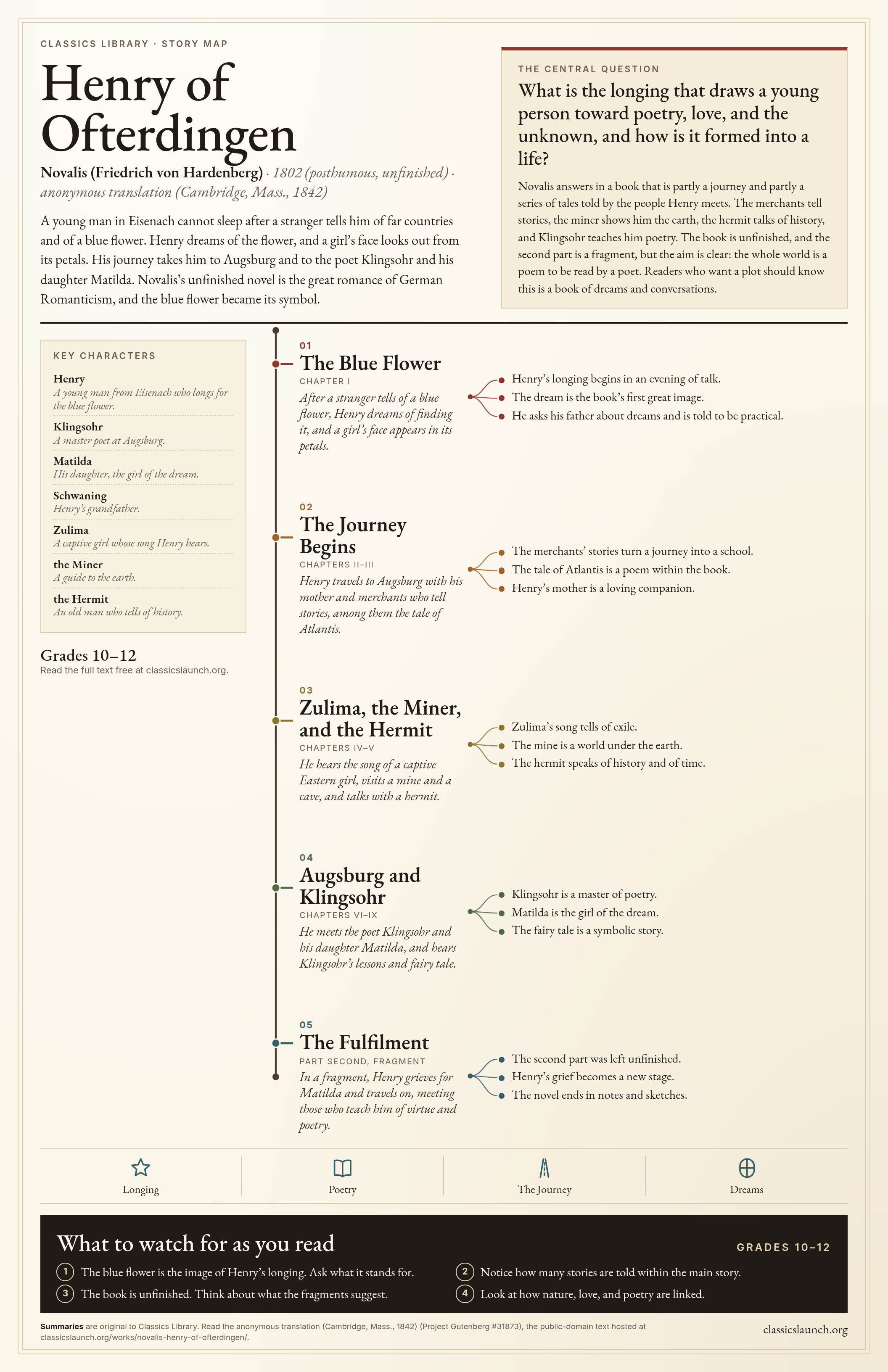
A young man in Eisenach cannot sleep after a stranger tells him of far countries and of a blue flower. Henry dreams of the flower, and a girl’s face looks out from its petals. His journey takes him to Augsburg and to the poet Klingsohr and his daughter Matilda. Novalis’s unfinished novel is the great romance of German Romanticism, and the blue flower became its symbol.
The central question
What is the longing that draws a young person toward poetry, love, and the unknown, and how is it formed into a life?
Novalis answers in a book that is partly a journey and partly a series of tales told by the people Henry meets. The merchants tell stories, the miner shows him the earth, the hermit talks of history, and Klingsohr teaches him poetry. The book is unfinished, and the second part is a fragment, but the aim is clear: the whole world is a poem to be read by a poet. Readers who want a plot should know this is a book of dreams and conversations.
- 01
The Blue Flower
Chapter I
After a stranger tells of a blue flower, Henry dreams of finding it, and a girl’s face appears in its petals.
- Henry’s longing begins in an evening of talk.
- The dream is the book’s first great image.
- He asks his father about dreams and is told to be practical.
- 02
The Journey Begins
Chapters II–III
Henry travels to Augsburg with his mother and merchants who tell stories, among them the tale of Atlantis.
- The merchants’ stories turn a journey into a school.
- The tale of Atlantis is a poem within the book.
- Henry’s mother is a loving companion.
- 03
Zulima, the Miner, and the Hermit
Chapters IV–V
He hears the song of a captive Eastern girl, visits a mine and a cave, and talks with a hermit.
- Zulima’s song tells of exile.
- The mine is a world under the earth.
- The hermit speaks of history and of time.
- 04
Augsburg and Klingsohr
Chapters VI–IX
He meets the poet Klingsohr and his daughter Matilda, and hears Klingsohr’s lessons and fairy tale.
- Klingsohr is a master of poetry.
- Matilda is the girl of the dream.
- The fairy tale is a symbolic story.
- 05
The Fulfilment
Part Second, fragment
In a fragment, Henry grieves for Matilda and travels on, meeting those who teach him of virtue and poetry.
- The second part was left unfinished.
- Henry’s grief becomes a new stage.
- The novel ends in notes and sketches.
- Longing
- Poetry
- The Journey
- Dreams
What to watch for as you read
Grades 10–12- The blue flower is the image of Henry’s longing. Ask what it stands for.
- Notice how many stories are told within the main story.
- The book is unfinished. Think about what the fragments suggest.
- Look at how nature, love, and poetry are linked.
Every quotation is word for word from the anonymous translation (Cambridge, Mass., 1842) hosted in this library and is checked against that text each time the site is built. Citations give book and chapter (or canto and line).