Work record
Henry of Ofterdingen
Novalis (Friedrich von Hardenberg)Heinrich von Ofterdingen; Henry von OfterdingenHenry of Ofterdingen by Novalis (Friedrich von Hardenberg) (1802)Henry of Ofterdingen is Novalis's unfinished novel, the great romance of German Romanticism and the work that made the blue flower its symbol.Also known as: Heinrich von Ofterdingen · Henry von Ofterdingen
1802 · 19th Century · Novel · German
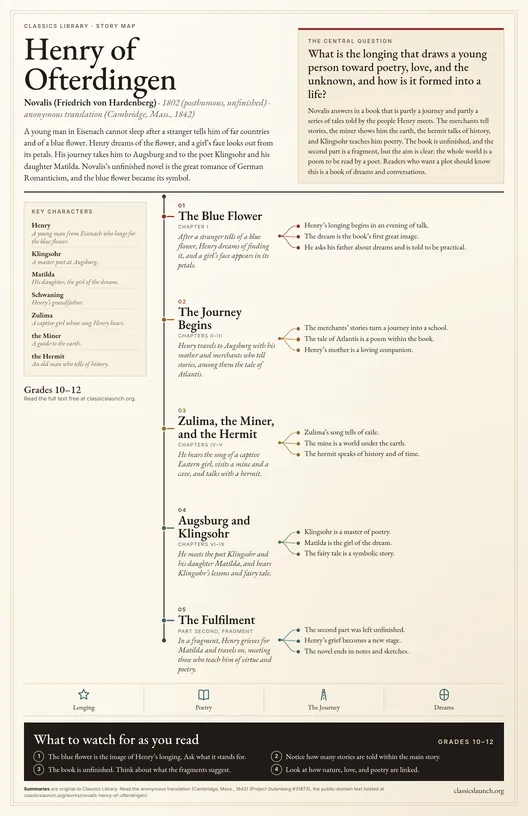 Story mapSee the story mapThe whole book on one page: the story in movements, the characters, and what to watch for. Free to print.
Abstract
Background. Novalis wrote this novel in 1799–1801 as a Romantic answer to Goethe's Wilhelm Meister, and died before finishing it. Tieck published it in 1802.
Plot. A young man longs for a blue flower he has heard of in a dream. He travels to Augsburg, hears stories from many people, meets a poet and falls in love with the poet's daughter. The fragment of the second part finds him in grief.
Ideas. The book is an allegory of the poet's formation through longing, travel, love and loss. It links poetry and virtue, and sets the marvellous against the prose of the world.
Text. The 1842 translation is anonymous, with a biographical sketch of the author and a note on the plan of the sequel. The text is episodic and rich in inset tales. The hosted text is complete as printed here, with its section headings kept as a guide to the reader, and every quotation on this page is drawn directly from that text. Teachers can pair this work with the library's study guide, seminar questions and memory-work selection to prepare a discussion, a short essay or a recitation. The full text is hosted on this site, and each quotation in the guide has been checked against the hosted translation.
Main characters
- Henry: A young man who becomes a poet
- Klingsohr: His master in poetry
- Matilda: Klingsohr's daughter
- Schwaning: Henry's grandfather
- Zulima: A captive Eastern singer
- The Hermit: A recluse who tells of the past
Summary
Henry of Ofterdingen is Novalis's unfinished novel, the great romance of German Romanticism and the work that made the blue flower its symbol. The first part, 'The Expectation', opens in the house of a young man in Eisenach, the son of a craftsman, who cannot sleep because a stranger has told stories of far countries and of a blue flower. 'I long to behold the blue flower,' he says to himself. He dreams that he finds the flower, and as he bends over it the petals open on the face of a girl. Soon afterward his mother takes him to Augsburg, to visit his grandfather, and he travels with a company of merchants who tell stories to pass the time. The journey is the book's chief part. On the way Henry hears a tale of Atlantis, meets the crusader's captive Zulima, who sings of her homeland, and descends into a mine with a miner who talks of the earth's secret life. He visits a cave in which a hermit lives among the tombs of old heroes and tells him of the past, and a castle in which the Count of Hohenzollern speaks of war. Each is a figure of a way in which a man comes to know the world, and each leaves Henry nearer to his own calling as a poet. In Augsburg Henry meets the poet Klingsohr and his daughter Matilda. Klingsohr gives him lessons in poetry, tells a long allegorical fairy tale of a golden age lost and regained, and consents to the marriage of Henry and Matilda. The first part breaks off there. The second, 'The Fulfilment', is a fragment, in which Henry, mourning the death of Matilda, travels on and is changed by a series of meetings, and in which a visitor describes virtue as the pure will that chooses at the moment of decision. Novalis died of tuberculosis at twenty-eight, before he could finish it. The book is not easy: it has little plot, it is a series of conversations and tales, and its meaning is symbolic. But it is a lovely imaginative picture of how a poet is formed, by longing, travel, friendship, loss and a deepening faith. Novalis called it his defence of poetry against the prose of the age. The hosted text is the 1842 American translation, with a biography of the author, and the end of the book is a set of notes describing the author's plan.
Virtues in this work
- Hope: Henry's longing keeps him moving toward a goal he cannot yet see.
- Friendship: The hermit, the miner and Klingsohr each give Henry their counsel.
- Piety: The book places poetry in the service of faith and virtue.
Plot or Argument
- Chapter I: The blue flower
After a stranger tells of a blue flower, Henry dreams of finding it, and a girl's face appears in its petals.
- Chapters II–III: The journey begins
Henry travels to Augsburg with his mother and merchants who tell stories, including the tale of Atlantis.
- Chapters IV–V: Zulima, the miner and the hermit
He hears the song of a captive Eastern girl, visits a mine and a cave, and talks with a hermit.
- Chapters VI–IX: Augsburg and Klingsohr
He meets the poet Klingsohr and Matilda, and hears Klingsohr's lessons and fairy tale.
- Part Second: The Fulfilment
In a fragment, Henry grieves for Matilda and travels on, meeting those who teach him of virtue and poetry.
Characters
- Henry, young hero
A thoughtful young man who becomes a poet through longing and loss.
- Klingsohr, master poet
An Augsburg poet who becomes Henry's teacher and father-in-law.
- Matilda, Klingsohr's daughter
The young woman Henry loves, who resembles the girl of the blue flower.
- Schwaning, grandfather
An old man who receives Henry in Augsburg and loves poetry.
- Zulima, captive singer
An Eastern girl whose song makes Henry think of other lands.
- The Miner, guide
A man who speaks of the earth's secret life.
- The Hermit, old man
A recluse who tells Henry of the past.
Lessons
Longing is the beginning of a vocation
The blue flower stands for a desire that the world cannot satisfy and that leads the hero toward his work. Novalis shows how a calling begins in an unexplained desire.
- What does the blue flower mean to Henry?
- How does the journey answer it?
Many ways of knowing
The merchants, the crusader, the miner, the hermit and the poet each show Henry a different way of knowing the world. Together they make up his education.
- What does Henry learn from the miner?
- What does he learn from the hermit?
Virtue is the heart of poetry
In the second part, Henry says that the true spirit of fable is the spirit of virtue in friendly disguise. Novalis, who believed that poetry should serve something higher than itself, connects art with conscience.
- How does Henry link song and action?
- Is the claim that poetry and virtue are one persuasive?
Context
Henry of Ofterdingen is set in the early thirteenth century and is loosely based on a medieval legend of a minstrel at the Wartburg court. Novalis made it a symbolic romance of the poet's formation.
Composition
Novalis began the novel in 1799 in conscious opposition to Goethe's Wilhelm Meister, and had completed most of the first part when he fell ill. He died in March 1801, and Tieck published the work in 1802.
Reception
The book was the central work of Jena Romanticism, and the blue flower became its emblem. The English version of 1842 was among the first to bring Novalis to American readers.
Comparisons
- Wilhelm Meister's Apprenticeship
Novalis wrote his novel as a Romantic answer to Goethe's novel of formation.
- Hymns to the Night
The Hymns share the novel's vision of love and death as ways to the divine.
- The Golden Pot
Hoffmann's fairy tale is a later Romantic story of a young man called by the marvellous.
- The Pilgrim's Progress
Bunyan's allegory is a Protestant journey toward a heavenly goal, as Henry's journey is a Romantic search for the flower.
Quotes
Frequently cited
“It is not the treasures," said he to himself, "that have awakened in me such unutterable longings. Far from me is all avarice; but I long to behold the blue flower.”
“Language," said Henry, "is indeed a little world in signs and sounds. As man rules over it, so would he rule the great world, and in it express himself freely. And in this very joy of expressing in the world what is without it, and of doing that which in reality was the primal object of our existence, lies the origin of poetry.”
“It is very unfortunate," said Klingsohr, "that poetry has a particular name, and that poets constitute a particular class.”
“Thus the true spirit of Fable is the spirit of virtue in friendly disguise; and the proper spirit of the subordinate art of poetry is the emotion of the loftiest, most personal existence.”
For Students
A reading companion for classical Christian high school students. See the student guide.
Reading Guide
Watch for
- Each story told on the road, and what Henry makes of it.
- The recurrence of the blue flower and of Matilda's face.
- What Klingsohr teaches about poetry.
Key terms and names
- The blue flower
- The Romantic symbol of infinite longing and of poetry, drawn from Henry's dream.
- Märchen
- A German fairy tale; Klingsohr's is the book's centrepiece.
- Atlantis
- The legendary island in Plato's dialogues, here the scene of a tale.
- Jena Romanticism
- The early German Romantic circle, including Novalis and the Schlegels.
Seminar Questions
- Comprehension What does Henry dream in Chapter I?
- Comprehension Who is Klingsohr, and what does he teach Henry?
- Interpretation Why does Novalis tell the book through stories?
- Interpretation How does Henry's grief change him in the second part?
- Interpretation What does Klingsohr mean by saying poetry should not be a separate class?
- Big Question Is longing a good guide to a vocation?
- Big Question What is the relation of art to virtue?
Faith Connections
- Psalm 63:1 (Scripture)
'My soul thirsts for you; my flesh faints for you.' The blue flower is a figure of an unsatisfied longing for God.
- Ecclesiastes 3:11 (Scripture)
God has put eternity into man's heart. Novalis expresses the same idea in the blue flower.
- Augustine, Confessions, Book I (Great Conversation)
'Our heart is restless until it rests in thee.' Henry's longing is of this kind.
Logic and Rhetoric
Central argument: Poetry arises from a longing that nothing in the world satisfies and that points beyond the world, and it is joined to virtue.
Rhetorical device: symbol. The blue flower recurs through the book as an image that cannot be reduced to a single meaning.
Debate: Resolved: That poetry is a form of moral education.
Memory Work
It is not the treasures," said he to himself, "that have awakened in me such unutterable longings. Far from me is all avarice; but I long to behold the blue flower.
Thus the true spirit of Fable is the spirit of virtue in friendly disguise; and the proper spirit of the subordinate art of poetry is the emotion of the loftiest, most personal existence.
Writing Prompts
Essay: How does Novalis use the journey to Augsburg to describe the formation of a poet?
Comparison with Wilhelm Meister's Apprenticeship: Compare Henry's formation with Wilhelm's. Which is more convincing, and why?
Creative Prompts
- Essay
What does the blue flower stand for? Use Chapter I and the later chapters to show how its meaning changes.
- Fiction
Write a short tale that a merchant on the journey might tell to pass the time.
- Classroom
Compare the miner's view of the earth with the hermit's view of history.
Further Reading
- Hymns to the Night, Novalis
Novalis's lyric cycle, hosted in this library.
- Wilhelm Meister's Apprenticeship, Johann Wolfgang von Goethe
The novel to which Novalis's romance is a reply.
- The Golden Pot, E. T. A. Hoffmann
A Romantic fairy tale in Carlyle's translation, hosted in this library.
- German Romance, Thomas Carlyle
Carlyle's collection of German tales.
Verification notes
Full text from Project Gutenberg #31873, the anonymous 1842 translation published by John Owen of Cambridge, Massachusetts, in public domain, with a biographical sketch of the author and notes on the unfinished second part. The translator is unnamed. Quotes were checked against the hosted text.
- The identity of the anonymous translator (sometimes attributed to John Owen's circle).
- The author of the Life of the Author in the hosted edition.