Story maps · Grades 7–12
O Pioneers!: A Story Map
The PDF is one tabloid page (11 × 17 in). On letter paper, choose “Fit to page.”
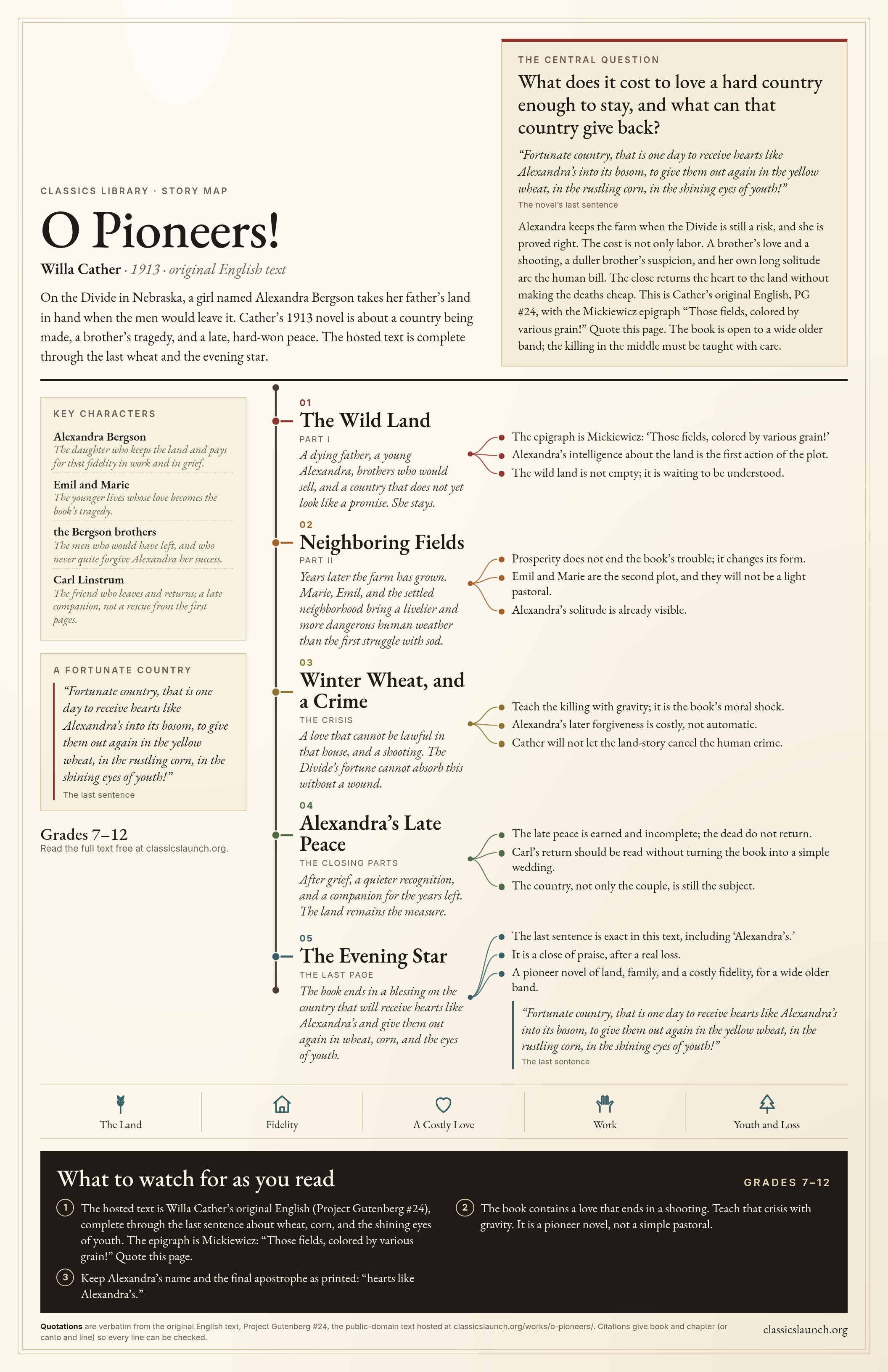
On the Divide in Nebraska, a girl named Alexandra Bergson takes her father’s land in hand when the men would leave it. Cather’s 1913 novel is about a country being made, a brother’s tragedy, and a late, hard-won peace. The hosted text is complete through the last wheat and the evening star.
The central question
What does it cost to love a hard country enough to stay, and what can that country give back?
“Fortunate country, that is one day to receive hearts like Alexandra’s into its bosom, to give them out again in the yellow wheat, in the rustling corn, in the shining eyes of youth!”
Alexandra keeps the farm when the Divide is still a risk, and she is proved right. The cost is not only labor. A brother’s love and a shooting, a duller brother’s suspicion, and her own long solitude are the human bill. The close returns the heart to the land without making the deaths cheap. This is Cather’s original English, PG #24, with the Mickiewicz epigraph “Those fields, colored by various grain!” Quote this page. The book is open to a wide older band; the killing in the middle must be taught with care.
- 01
The Wild Land
Part I
A dying father, a young Alexandra, brothers who would sell, and a country that does not yet look like a promise. She stays.
- The epigraph is Mickiewicz: ‘Those fields, colored by various grain!’
- Alexandra’s intelligence about the land is the first action of the plot.
- The wild land is not empty; it is waiting to be understood.
- 02
Neighboring Fields
Part II
Years later the farm has grown. Marie, Emil, and the settled neighborhood bring a livelier and more dangerous human weather than the first struggle with sod.
- Prosperity does not end the book’s trouble; it changes its form.
- Emil and Marie are the second plot, and they will not be a light pastoral.
- Alexandra’s solitude is already visible.
- 03
Winter Wheat, and a Crime
The crisis
A love that cannot be lawful in that house, and a shooting. The Divide’s fortune cannot absorb this without a wound.
- Teach the killing with gravity; it is the book’s moral shock.
- Alexandra’s later forgiveness is costly, not automatic.
- Cather will not let the land-story cancel the human crime.
- 04
Alexandra’s Late Peace
The closing parts
After grief, a quieter recognition, and a companion for the years left. The land remains the measure.
- The late peace is earned and incomplete; the dead do not return.
- Carl’s return should be read without turning the book into a simple wedding.
- The country, not only the couple, is still the subject.
- 05
The Evening Star
The last page
The book ends in a blessing on the country that will receive hearts like Alexandra’s and give them out again in wheat, corn, and the eyes of youth.
- The last sentence is exact in this text, including ‘Alexandra’s.’
- It is a close of praise, after a real loss.
- A pioneer novel of land, family, and a costly fidelity, for a wide older band.
“Fortunate country, that is one day to receive hearts like Alexandra’s into its bosom, to give them out again in the yellow wheat, in the rustling corn, in the shining eyes of youth!”
- The Land
- Fidelity
- A Costly Love
- Work
- Youth and Loss
What to watch for as you read
Grades 7–12- The hosted text is Willa Cather’s original English (Project Gutenberg #24), complete through the last sentence about wheat, corn, and the shining eyes of youth. The epigraph is Mickiewicz: “Those fields, colored by various grain!” Quote this page.
- The book contains a love that ends in a shooting. Teach that crisis with gravity. It is a pioneer novel, not a simple pastoral.
- Keep Alexandra’s name and the final apostrophe as printed: “hearts like Alexandra’s.”
Every quotation is word for word from the original English text hosted in this library and is checked against that text each time the site is built. Citations give book and chapter (or canto and line).