Story maps · Grades 11–12
The Poetic Edda: A Story Map
The PDF is one tabloid page (11 × 17 in). On letter paper, choose “Fit to page.”
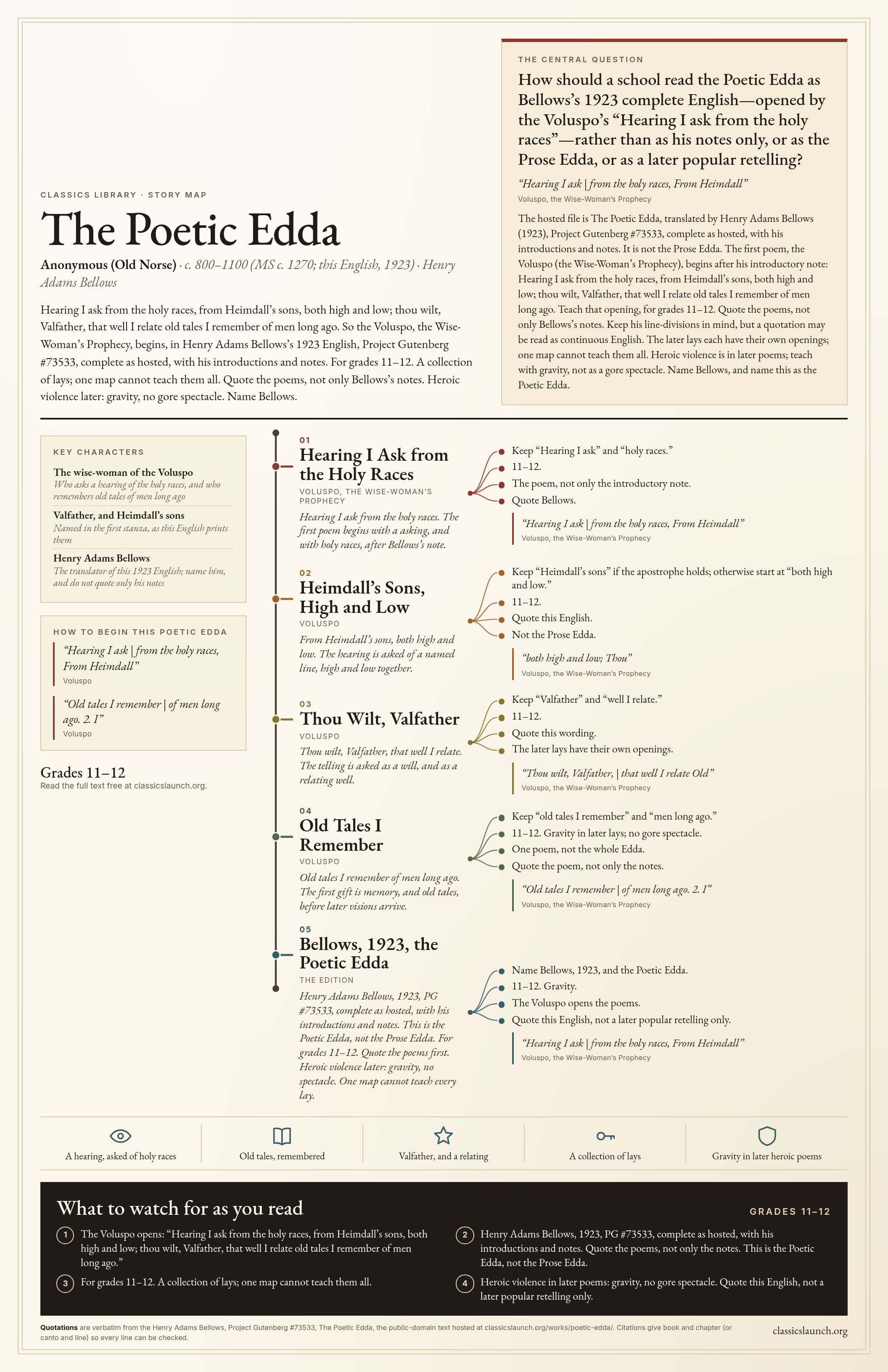
Hearing I ask from the holy races, from Heimdall’s sons, both high and low; thou wilt, Valfather, that well I relate old tales I remember of men long ago. So the Voluspo, the Wise-Woman’s Prophecy, begins, in Henry Adams Bellows’s 1923 English, Project Gutenberg #73533, complete as hosted, with his introductions and notes. For grades 11–12. A collection of lays; one map cannot teach them all. Quote the poems, not only Bellows’s notes. Heroic violence later: gravity, no gore spectacle. Name Bellows.
The central question
How should a school read the Poetic Edda as Bellows’s 1923 complete English—opened by the Voluspo’s “Hearing I ask from the holy races”—rather than as his notes only, or as the Prose Edda, or as a later popular retelling?
“Hearing I ask | from the holy races, From Heimdall”
The hosted file is The Poetic Edda, translated by Henry Adams Bellows (1923), Project Gutenberg #73533, complete as hosted, with his introductions and notes. It is not the Prose Edda. The first poem, the Voluspo (the Wise-Woman’s Prophecy), begins after his introductory note: Hearing I ask from the holy races, from Heimdall’s sons, both high and low; thou wilt, Valfather, that well I relate old tales I remember of men long ago. Teach that opening, for grades 11–12. Quote the poems, not only Bellows’s notes. Keep his line-divisions in mind, but a quotation may be read as continuous English. The later lays each have their own openings; one map cannot teach them all. Heroic violence is in later poems; teach with gravity, not as a gore spectacle. Name Bellows, and name this as the Poetic Edda.
- 01
Hearing I Ask from the Holy Races
Voluspo, the Wise-Woman’s Prophecy
Hearing I ask from the holy races. The first poem begins with a asking, and with holy races, after Bellows’s note.
- Keep “Hearing I ask” and “holy races.”
- 11–12.
- The poem, not only the introductory note.
- Quote Bellows.
“Hearing I ask | from the holy races, From Heimdall”
- 02
Heimdall’s Sons, High and Low
Voluspo
From Heimdall’s sons, both high and low. The hearing is asked of a named line, high and low together.
- Keep “Heimdall’s sons” if the apostrophe holds; otherwise start at “both high and low.”
- 11–12.
- Quote this English.
- Not the Prose Edda.
“both high and low; Thou”
- 03
Thou Wilt, Valfather
Voluspo
Thou wilt, Valfather, that well I relate. The telling is asked as a will, and as a relating well.
- Keep “Valfather” and “well I relate.”
- 11–12.
- Quote this wording.
- The later lays have their own openings.
“Thou wilt, Valfather, | that well I relate Old”
- 04
Old Tales I Remember
Voluspo
Old tales I remember of men long ago. The first gift is memory, and old tales, before later visions arrive.
- Keep “old tales I remember” and “men long ago.”
- 11–12. Gravity in later lays; no gore spectacle.
- One poem, not the whole Edda.
- Quote the poem, not only the notes.
“Old tales I remember | of men long ago. 2. I”
- 05
Bellows, 1923, the Poetic Edda
The edition
Henry Adams Bellows, 1923, PG #73533, complete as hosted, with his introductions and notes. This is the Poetic Edda, not the Prose Edda. For grades 11–12. Quote the poems first. Heroic violence later: gravity, no spectacle. One map cannot teach every lay.
- Name Bellows, 1923, and the Poetic Edda.
- 11–12. Gravity.
- The Voluspo opens the poems.
- Quote this English, not a later popular retelling only.
“Hearing I ask | from the holy races, From Heimdall”
- A hearing, asked of holy races
- Old tales, remembered
- Valfather, and a relating
- A collection of lays
- Gravity in later heroic poems
What to watch for as you read
Grades 11–12- The Voluspo opens: “Hearing I ask from the holy races, from Heimdall’s sons, both high and low; thou wilt, Valfather, that well I relate old tales I remember of men long ago.”
- Henry Adams Bellows, 1923, PG #73533, complete as hosted, with his introductions and notes. Quote the poems, not only the notes. This is the Poetic Edda, not the Prose Edda.
- For grades 11–12. A collection of lays; one map cannot teach them all.
- Heroic violence in later poems: gravity, no gore spectacle. Quote this English, not a later popular retelling only.
Every quotation is word for word from the Henry Adams Bellows hosted in this library and is checked against that text each time the site is built. Citations give book and chapter (or canto and line).