Story maps · Grades 3–5
Pollyanna: A Story Map
The PDF is one tabloid page (11 × 17 in). On letter paper, choose “Fit to page.”
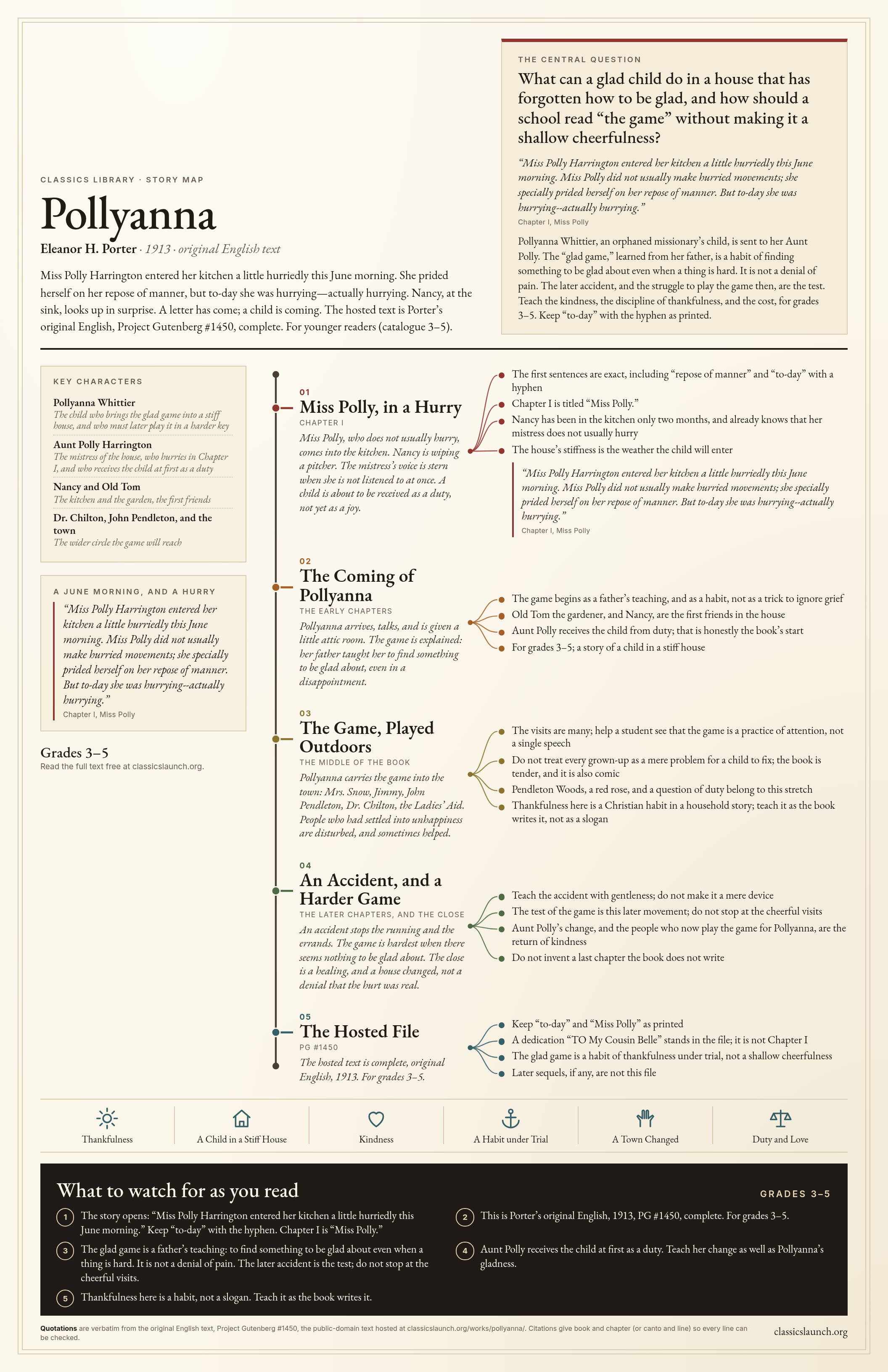
Miss Polly Harrington entered her kitchen a little hurriedly this June morning. She prided herself on her repose of manner, but to-day she was hurrying—actually hurrying. Nancy, at the sink, looks up in surprise. A letter has come; a child is coming. The hosted text is Porter’s original English, Project Gutenberg #1450, complete. For younger readers (catalogue 3–5).
The central question
What can a glad child do in a house that has forgotten how to be glad, and how should a school read “the game” without making it a shallow cheerfulness?
“Miss Polly Harrington entered her kitchen a little hurriedly this June morning. Miss Polly did not usually make hurried movements; she specially prided herself on her repose of manner. But to-day she was hurrying--actually hurrying.”
Pollyanna Whittier, an orphaned missionary’s child, is sent to her Aunt Polly. The “glad game,” learned from her father, is a habit of finding something to be glad about even when a thing is hard. It is not a denial of pain. The later accident, and the struggle to play the game then, are the test. Teach the kindness, the discipline of thankfulness, and the cost, for grades 3–5. Keep “to-day” with the hyphen as printed.
- 01
Miss Polly, in a Hurry
Chapter I
Miss Polly, who does not usually hurry, comes into the kitchen. Nancy is wiping a pitcher. The mistress’s voice is stern when she is not listened to at once. A child is about to be received as a duty, not yet as a joy.
- The first sentences are exact, including “repose of manner” and “to-day” with a hyphen
- Chapter I is titled “Miss Polly.”
- Nancy has been in the kitchen only two months, and already knows that her mistress does not usually hurry
- The house’s stiffness is the weather the child will enter
“Miss Polly Harrington entered her kitchen a little hurriedly this June morning. Miss Polly did not usually make hurried movements; she specially prided herself on her repose of manner. But to-day she was hurrying--actually hurrying.”
- 02
The Coming of Pollyanna
The early chapters
Pollyanna arrives, talks, and is given a little attic room. The game is explained: her father taught her to find something to be glad about, even in a disappointment.
- The game begins as a father’s teaching, and as a habit, not as a trick to ignore grief
- Old Tom the gardener, and Nancy, are the first friends in the house
- Aunt Polly receives the child from duty; that is honestly the book’s start
- For grades 3–5; a story of a child in a stiff house
- 03
The Game, Played Outdoors
The middle of the book
Pollyanna carries the game into the town: Mrs. Snow, Jimmy, John Pendleton, Dr. Chilton, the Ladies’ Aid. People who had settled into unhappiness are disturbed, and sometimes helped.
- The visits are many; help a student see that the game is a practice of attention, not a single speech
- Do not treat every grown-up as a mere problem for a child to fix; the book is tender, and it is also comic
- Pendleton Woods, a red rose, and a question of duty belong to this stretch
- Thankfulness here is a Christian habit in a household story; teach it as the book writes it, not as a slogan
- 04
An Accident, and a Harder Game
The later chapters, and the close
An accident stops the running and the errands. The game is hardest when there seems nothing to be glad about. The close is a healing, and a house changed, not a denial that the hurt was real.
- Teach the accident with gentleness; do not make it a mere device
- The test of the game is this later movement; do not stop at the cheerful visits
- Aunt Polly’s change, and the people who now play the game for Pollyanna, are the return of kindness
- Do not invent a last chapter the book does not write
- 05
The Hosted File
PG #1450
The hosted text is complete, original English, 1913. For grades 3–5.
- Keep “to-day” and “Miss Polly” as printed
- A dedication “TO My Cousin Belle” stands in the file; it is not Chapter I
- The glad game is a habit of thankfulness under trial, not a shallow cheerfulness
- Later sequels, if any, are not this file
- Thankfulness
- A Child in a Stiff House
- Kindness
- A Habit under Trial
- A Town Changed
- Duty and Love
What to watch for as you read
Grades 3–5- The story opens: “Miss Polly Harrington entered her kitchen a little hurriedly this June morning.” Keep “to-day” with the hyphen. Chapter I is “Miss Polly.”
- This is Porter’s original English, 1913, PG #1450, complete. For grades 3–5.
- The glad game is a father’s teaching: to find something to be glad about even when a thing is hard. It is not a denial of pain. The later accident is the test; do not stop at the cheerful visits.
- Aunt Polly receives the child at first as a duty. Teach her change as well as Pollyanna’s gladness.
- Thankfulness here is a habit, not a slogan. Teach it as the book writes it.
Every quotation is word for word from the original English text hosted in this library and is checked against that text each time the site is built. Citations give book and chapter (or canto and line).