Story maps · Grades 10–12
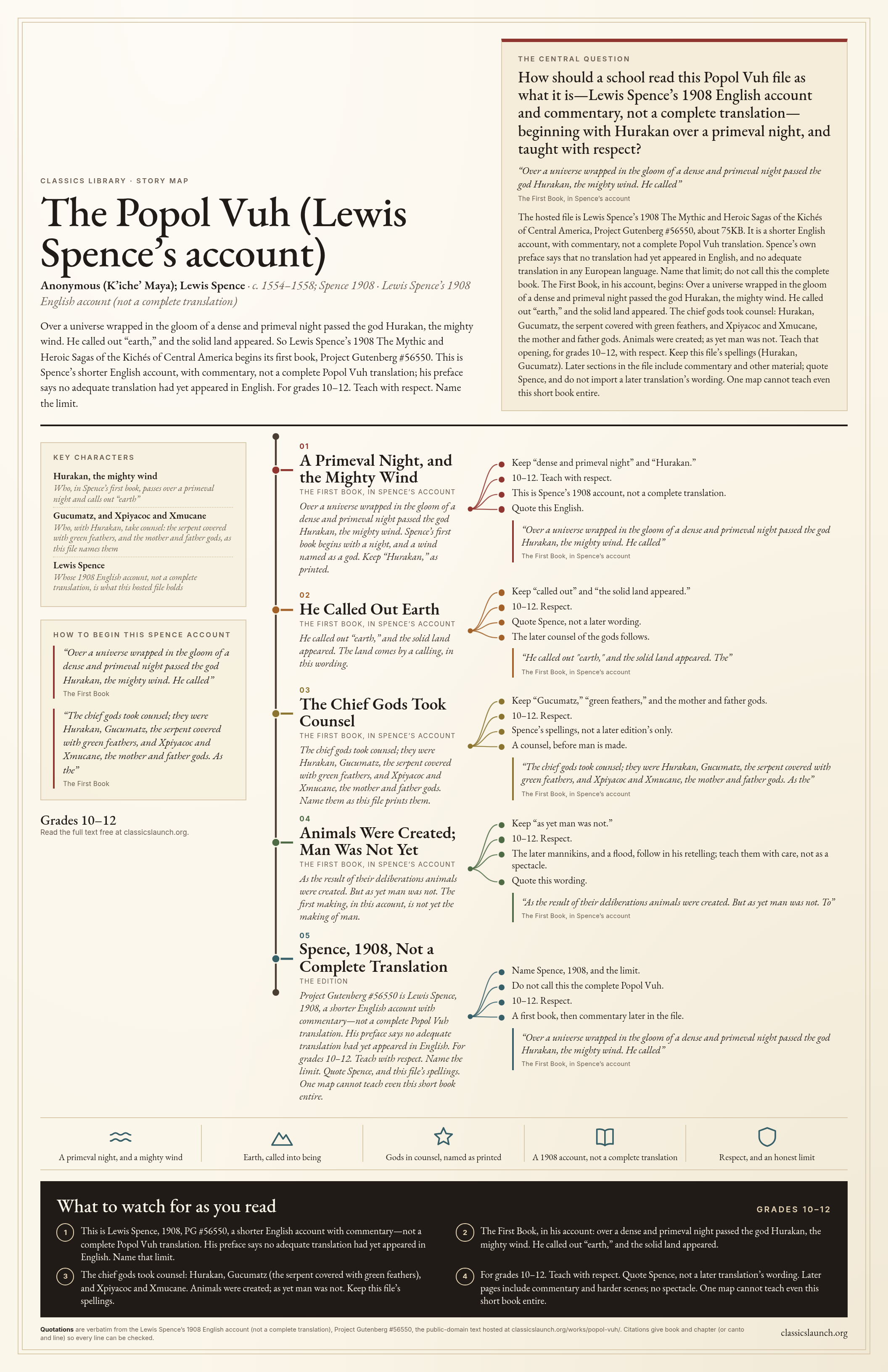
The Popol Vuh (Lewis Spence’s account): A Story Map
The PDF is one tabloid page (11 × 17 in). On letter paper, choose “Fit to page.”
Over a universe wrapped in the gloom of a dense and primeval night passed the god Hurakan, the mighty wind. He called out “earth,” and the solid land appeared. So Lewis Spence’s 1908 The Mythic and Heroic Sagas of the Kichés of Central America begins its first book, Project Gutenberg #56550. This is Spence’s shorter English account, with commentary, not a complete Popol Vuh translation; his preface says no adequate translation had yet appeared in English. For grades 10–12. Teach with respect. Name the limit.
The central question
How should a school read this Popol Vuh file as what it is—Lewis Spence’s 1908 English account and commentary, not a complete translation—beginning with Hurakan over a primeval night, and taught with respect?
“Over a universe wrapped in the gloom of a dense and primeval night passed the god Hurakan, the mighty wind. He called”
The hosted file is Lewis Spence’s 1908 The Mythic and Heroic Sagas of the Kichés of Central America, Project Gutenberg #56550, about 75KB. It is a shorter English account, with commentary, not a complete Popol Vuh translation. Spence’s own preface says that no translation had yet appeared in English, and no adequate translation in any European language. Name that limit; do not call this the complete book. The First Book, in his account, begins: Over a universe wrapped in the gloom of a dense and primeval night passed the god Hurakan, the mighty wind. He called out “earth,” and the solid land appeared. The chief gods took counsel: Hurakan, Gucumatz, the serpent covered with green feathers, and Xpiyacoc and Xmucane, the mother and father gods. Animals were created; as yet man was not. Teach that opening, for grades 10–12, with respect. Keep this file’s spellings (Hurakan, Gucumatz). Later sections in the file include commentary and other material; quote Spence, and do not import a later translation’s wording. One map cannot teach even this short book entire.
- 01
A Primeval Night, and the Mighty Wind
The First Book, in Spence’s account
Over a universe wrapped in the gloom of a dense and primeval night passed the god Hurakan, the mighty wind. Spence’s first book begins with a night, and a wind named as a god. Keep “Hurakan,” as printed.
- Keep “dense and primeval night” and “Hurakan.”
- 10–12. Teach with respect.
- This is Spence’s 1908 account, not a complete translation.
- Quote this English.
“Over a universe wrapped in the gloom of a dense and primeval night passed the god Hurakan, the mighty wind. He called”
- 02
He Called Out Earth
The First Book, in Spence’s account
He called out “earth,” and the solid land appeared. The land comes by a calling, in this wording.
- Keep “called out” and “the solid land appeared.”
- 10–12. Respect.
- Quote Spence, not a later wording.
- The later counsel of the gods follows.
“He called out "earth," and the solid land appeared. The”
- 03
The Chief Gods Took Counsel
The First Book, in Spence’s account
The chief gods took counsel; they were Hurakan, Gucumatz, the serpent covered with green feathers, and Xpiyacoc and Xmucane, the mother and father gods. Name them as this file prints them.
- Keep “Gucumatz,” “green feathers,” and the mother and father gods.
- 10–12. Respect.
- Spence’s spellings, not a later edition’s only.
- A counsel, before man is made.
“The chief gods took counsel; they were Hurakan, Gucumatz, the serpent covered with green feathers, and Xpiyacoc and Xmucane, the mother and father gods. As the”
- 04
Animals Were Created; Man Was Not Yet
The First Book, in Spence’s account
As the result of their deliberations animals were created. But as yet man was not. The first making, in this account, is not yet the making of man.
- Keep “as yet man was not.”
- 10–12. Respect.
- The later mannikins, and a flood, follow in his retelling; teach them with care, not as a spectacle.
- Quote this wording.
“As the result of their deliberations animals were created. But as yet man was not. To”
- 05
Spence, 1908, Not a Complete Translation
The edition
Project Gutenberg #56550 is Lewis Spence, 1908, a shorter English account with commentary—not a complete Popol Vuh translation. His preface says no adequate translation had yet appeared in English. For grades 10–12. Teach with respect. Name the limit. Quote Spence, and this file’s spellings. One map cannot teach even this short book entire.
- Name Spence, 1908, and the limit.
- Do not call this the complete Popol Vuh.
- 10–12. Respect.
- A first book, then commentary later in the file.
“Over a universe wrapped in the gloom of a dense and primeval night passed the god Hurakan, the mighty wind. He called”
- A primeval night, and a mighty wind
- Earth, called into being
- Gods in counsel, named as printed
- A 1908 account, not a complete translation
- Respect, and an honest limit
What to watch for as you read
Grades 10–12- This is Lewis Spence, 1908, PG #56550, a shorter English account with commentary—not a complete Popol Vuh translation. His preface says no adequate translation had yet appeared in English. Name that limit.
- The First Book, in his account: over a dense and primeval night passed the god Hurakan, the mighty wind. He called out “earth,” and the solid land appeared.
- The chief gods took counsel: Hurakan, Gucumatz (the serpent covered with green feathers), and Xpiyacoc and Xmucane. Animals were created; as yet man was not. Keep this file’s spellings.
- For grades 10–12. Teach with respect. Quote Spence, not a later translation’s wording. Later pages include commentary and harder scenes; no spectacle. One map cannot teach even this short book entire.
Every quotation is word for word from the Lewis Spence’s 1908 English account (not a complete translation) hosted in this library and is checked against that text each time the site is built. Citations give book and chapter (or canto and line).