Story maps · Grades 9–12
The Prose Edda: A Story Map
The PDF is one tabloid page (11 × 17 in). On letter paper, choose “Fit to page.”
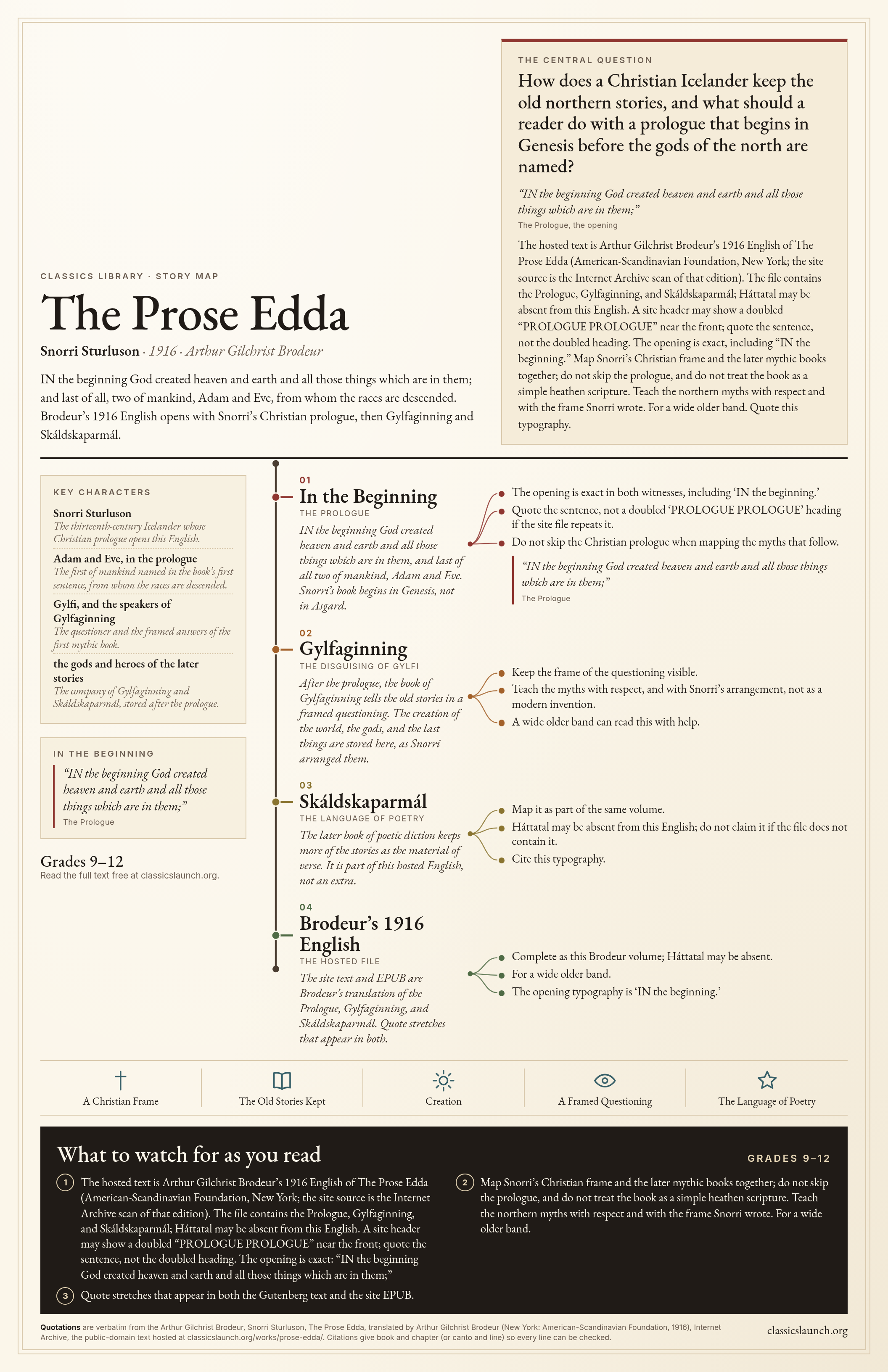
IN the beginning God created heaven and earth and all those things which are in them; and last of all, two of mankind, Adam and Eve, from whom the races are descended. Brodeur’s 1916 English opens with Snorri’s Christian prologue, then Gylfaginning and Skáldskaparmál.
The central question
How does a Christian Icelander keep the old northern stories, and what should a reader do with a prologue that begins in Genesis before the gods of the north are named?
“IN the beginning God created heaven and earth and all those things which are in them;”
The hosted text is Arthur Gilchrist Brodeur’s 1916 English of The Prose Edda (American-Scandinavian Foundation, New York; the site source is the Internet Archive scan of that edition). The file contains the Prologue, Gylfaginning, and Skáldskaparmál; Háttatal may be absent from this English. A site header may show a doubled “PROLOGUE PROLOGUE” near the front; quote the sentence, not the doubled heading. The opening is exact, including “IN the beginning.” Map Snorri’s Christian frame and the later mythic books together; do not skip the prologue, and do not treat the book as a simple heathen scripture. Teach the northern myths with respect and with the frame Snorri wrote. For a wide older band. Quote this typography.
- 01
In the Beginning
The Prologue
IN the beginning God created heaven and earth and all those things which are in them, and last of all two of mankind, Adam and Eve. Snorri’s book begins in Genesis, not in Asgard.
- The opening is exact in both witnesses, including ‘IN the beginning.’
- Quote the sentence, not a doubled ‘PROLOGUE PROLOGUE’ heading if the site file repeats it.
- Do not skip the Christian prologue when mapping the myths that follow.
“IN the beginning God created heaven and earth and all those things which are in them;”
- 02
Gylfaginning
The disguising of Gylfi
After the prologue, the book of Gylfaginning tells the old stories in a framed questioning. The creation of the world, the gods, and the last things are stored here, as Snorri arranged them.
- Keep the frame of the questioning visible.
- Teach the myths with respect, and with Snorri’s arrangement, not as a modern invention.
- A wide older band can read this with help.
- 03
Skáldskaparmál
The language of poetry
The later book of poetic diction keeps more of the stories as the material of verse. It is part of this hosted English, not an extra.
- Map it as part of the same volume.
- Háttatal may be absent from this English; do not claim it if the file does not contain it.
- Cite this typography.
- 04
Brodeur’s 1916 English
The hosted file
The site text and EPUB are Brodeur’s translation of the Prologue, Gylfaginning, and Skáldskaparmál. Quote stretches that appear in both.
- Complete as this Brodeur volume; Háttatal may be absent.
- For a wide older band.
- The opening typography is ‘IN the beginning.’
- A Christian Frame
- The Old Stories Kept
- Creation
- A Framed Questioning
- The Language of Poetry
What to watch for as you read
Grades 9–12- The hosted text is Arthur Gilchrist Brodeur’s 1916 English of The Prose Edda (American-Scandinavian Foundation, New York; the site source is the Internet Archive scan of that edition). The file contains the Prologue, Gylfaginning, and Skáldskaparmál; Háttatal may be absent from this English. A site header may show a doubled “PROLOGUE PROLOGUE” near the front; quote the sentence, not the doubled heading. The opening is exact: “IN the beginning God created heaven and earth and all those things which are in them;”
- Map Snorri’s Christian frame and the later mythic books together; do not skip the prologue, and do not treat the book as a simple heathen scripture. Teach the northern myths with respect and with the frame Snorri wrote. For a wide older band.
- Quote stretches that appear in both the Gutenberg text and the site EPUB.
Every quotation is word for word from the Arthur Gilchrist Brodeur hosted in this library and is checked against that text each time the site is built. Citations give book and chapter (or canto and line).