Work record
The Prose Edda
c. 1220 · Medieval · Collection · Old Norse
Abstract
Background. Written by an Icelandic lawspeaker and historian more than two centuries after his island adopted Christianity, the book preserved the lore that court poets needed when the old gods were no longer worshipped. Brodeur's 1916 version renders the first three of its four parts; the metrical showpiece Háttatal is left out.
Content. A brief Prologue derives Odin's people from Troy and explains pagan worship as a misremembering of human rulers. In Gylfaginning a disguised Swedish king interrogates three mysterious figures, who lead him from the void and the frost-giant Ymir through Yggdrasill, the deities of Asgard, Thor's misadventures and Baldr's killing to the final conflagration and a renewed green world. Skáldskaparmál shifts the frame to a feast where Bragi entertains Ægir with Idunn's abduction, the brewing of the poets' mead, Hrungnir's duel and Andvari's accursed ring, then catalogues the circumlocutions of skaldic verse.
Themes. Doom foreknown yet resisted, the vulnerability of goodness, cunning against strength, and the sacred cost of eloquence run through the tales. The vanishing hall leaves open how much of what Gylfi heard was illusion.
Significance. Without Snorri much of Scandinavian mythology would be lost or unintelligible. Printed from 1665, his handbook fed European antiquarianism, Romantic art and opera, and the invented worlds of Tolkien, while remaining the indispensable key to Old Norse poetry.
Main characters
- Gylfi (Gangleri): Swedish king who questions the gods in disguise
- Hárr, Jafnhárr and Thridi: three enthroned speakers who answer him
- Odin: one-eyed Allfather, winner of the poets' mead
- Thor: giant-slaying thunder god with the hammer Mjollnir
- Loki: trickster who brings about Baldr's death
- Baldr: Odin's radiant son, killed by mistletoe
- Bragi: poet-god who explains the origins of verse
- Ægir: sea-giant who visits Asgard and asks about poetry

Summary
The Prose Edda is a handbook of Norse myth and of the art of skaldic poetry, written in Iceland around 1220 by the chieftain and historian Snorri Sturluson. It was meant to teach young poets the old stories and the poetic names (kennings) that the court verse of Scandinavia depended on, at a time when Iceland had been Christian for more than two centuries. The library text is Arthur Gilchrist Brodeur's English translation (1916) of its first three parts. The Prologue begins with Adam and Eve and the Flood, and explains how men who had lost the name of God still reasoned from the earth and the heavens that some ruler must govern them. It then traces the Æsir to Troy in Asia: Odin and his followers, renowned for their wisdom, travelled north and were taken for gods. Gylfaginning, the Beguiling of Gylfi, tells how King Gylfi of Sweden, disguised as a wanderer named Gangleri, comes to a great hall and questions three enthroned figures called Hárr, Jafnhárr and Thridi. Their answers, studded with stanzas from Voluspa and other poems, give a complete account of the Norse cosmos: the Yawning Void of Ginnungagap between fire and ice, the giant Ymir whose body becomes the world, the first humans Askr and Embla, the ash tree Yggdrasill and its three roots, and the halls of Asgard. One by one the gods are described: Odin, Thor, Baldr, Njordr, Freyr, Tyr, Heimdallr, Hodr, Frigg, Freyja and the others. Then come the stories: the binding of the Fenris-Wolf with the fetter Gleipnir, which costs Tyr his hand; Thor's humbling journey to the hall of Utgarda-Loki, where he loses contests that turn out to be illusions; Thor's fishing for the Midgard Serpent; and the death of Baldr, shot by blind Hodr with a sprig of mistletoe guided by Loki, followed by the refusal of the giantess Thokk to weep him out of Hel. Loki is bound beneath a dripping serpent, and Hárr describes the Weird of the Gods (Ragnarök), the last battle, the burning of the world and a green earth rising again. At the end the hall vanishes and Gylfi finds himself alone on an empty plain. Skáldskaparmál, the Poesy of Skalds, is framed as a conversation between the sea-giant Ægir and Bragi, god of poetry. Bragi tells of Idunn's apples and the giant Thjazi, Skadi's choice of a husband by his feet, and the mead of poetry brewed from the blood of the wise Kvasir and won back by Odin. Long catalogues of kennings and poetic names follow, illustrated by stanzas from named skalds, with further tales: Thor's duel with Hrungnir, Loki's wager with the dwarves that produced Thor's hammer, Andvari's cursed gold and the Volsungs, the mill Grotti and the eternal battle of the Hjadnings.
Virtues in this work
- Fortitude: Tyr alone dares to lay his hand in the Fenris-Wolf's mouth as a pledge, and loses it so that the wolf can be bound.
- Prudence: Odin gives an eye in pledge at Mimir's well for a drink of its wisdom, valuing understanding above his own body.
- Charity: Frigg's love for Baldr moves her to seek an oath from every created thing, and all creation weeps to bring him back from Hel.
- Humility: Thor, mightiest of the gods, is beaten in every contest at Utgarda-Loki's hall and must hear that he wrestled Old Age itself.
Plot or Argument
- Prologue: from the Flood to the Æsir of Troy
Snorri sets the pagan stories inside a Christian history: after the Flood men forgot God's name but reasoned toward a creator from nature. Odin and his people, descended from the kings of Troy, migrate north to Saxony, Denmark, Sweden and Norway and are honoured as gods.
- Gylfaginning I-IX: Gylfi in the hall, and the making of the world
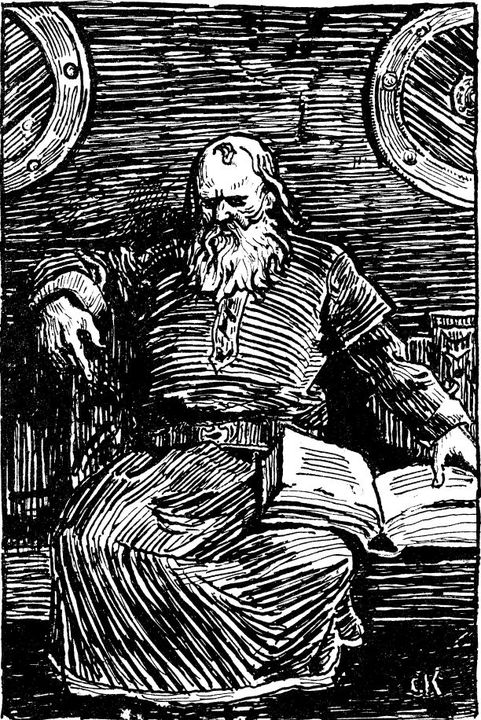
Gylfi, disguised as Gangleri, enters a hall roofed with shields and questions Hárr, Jafnhárr and Thridi. They describe the All-Father, Ginnungagap between Muspellheim and Niflheim, the giant Ymir and the cow Audumla, the slaying of Ymir by Borr's sons, and the making of Askr and Embla from two trees.
- Gylfaginning X-XXXVI: the world-tree, the gods and the goddesses
The answers tour the cosmos: day and night, sun and moon chased by wolves, the bridge Bifrost, the ash Yggdrasill with its wells of Urdr and Mimir, and the halls of the gods. Each god is described in turn, with Tyr's lost hand and the binding of the Fenris-Wolf, and Loki and his children.
- Gylfaginning XXXVII-XLVIII: Valhall and Thor's adventures
Odin's champions feast in Valhall. Thor, travelling with Loki, Thjalfi and Röskva, is outmatched at Utgarda-Loki's hall in eating, running, drinking, lifting a cat and wrestling an old woman, and learns that he contended with fire, thought, the sea, the Midgard Serpent and old age. He later hooks the Midgard Serpent while fishing with the giant Hymir.
- Gylfaginning XLIX-L: the death of Baldr and the binding of Loki
Frigg takes oaths from all things to spare Baldr but passes over the mistletoe; Loki puts it in blind Hodr's hand. Hermodr rides to Hel, who will release Baldr if all things weep, but the giantess Thokk refuses. Loki is caught in salmon shape and bound until the end of the world.
- Gylfaginning LI-LIV: the Weird of the Gods and the vanishing hall
Hárr foretells the Fimbul-Winter, the loosing of the Wolf and the Serpent, Surtr's fire and the deaths of Odin, Thor, Freyr, Tyr and Heimdallr, then a new earth, the surviving gods and the human pair Lif and Lifthrasir. The hall disappears and Gylfi returns home to tell the tale.
- Skáldskaparmál: Bragi's stories for Ægir
At a feast in Asgard, Bragi tells Ægir how Thjazi carried off Idunn and her apples, how Skadi chose Njordr by his feet, and how the mead of poetry came from Kvasir's blood through the dwarves and the giant Suttungr to Odin.
- Skáldskaparmál: kennings, heiti and the heroic tales
Snorri lists the poetic names for gods, men, gold, battle, ships, the sea and much else, quoting skalds for each. Tales explain the kennings: Thor's fight with Hrungnir and the hone lodged in his head, the dwarves' gifts and Thor's hammer, the otter's ransom and Andvari's ring, Sigurdr and the Gjukungs, Frodi's mill Grotti, Hrolfr Kraki's gold and the endless battle of the Hjadnings.
Characters
- Gylfi (Gangleri), questioner in Gylfaginning
A wise king of Sweden who visits Asgard in disguise to learn the secrets of the Æsir and is answered with the whole of the mythology.
- Hárr, Jafnhárr and Thridi, the three enthroned answerers
High, Just-as-High and Third, seated one above another, who answer Gangleri's questions and are later revealed as an illusion.
- Odin (Allfather), chief of the gods
The one-eyed lord of Asgard who pledged an eye at Mimir's well and won the mead of poetry from the giants.
- Thor, god of thunder
Mighty enemy of the giants, wielder of the hammer Mjollnir, humbled at Utgarda-Loki's hall but victorious over Hrungnir.
- Loki, trickster among the Æsir
Fair-faced and cunning, father of the Wolf, the Serpent and Hel; he contrives Baldr's death and is bound until the end of the world.
- Baldr, the best of the gods
Odin's bright and beloved son, slain by mistletoe, whose death foreshadows the doom of the gods.
- Hodr, blind god
Baldr's brother, who unknowingly kills him with the mistletoe that Loki puts in his hand.
- Frigg, Odin's wife
Baldr's mother, who takes oaths from every created thing to spare him but overlooks the mistletoe.
- Tyr, god of battle-courage
The boldest of the Æsir, who lays his hand in the Fenris-Wolf's mouth as a pledge and loses it.
- Fenris-Wolf, monstrous son of Loki
Raised by the gods and bound with the silken fetter Gleipnir; he will break loose and swallow Odin at the end.
- Utgarda-Loki, giant king
Master of an enormous hall who defeats Thor and his companions through illusions and then explains the tricks.
- Bragi, god of poetry
Teller of the stories in Skáldskaparmál, explaining to Ægir the origin of poetry and its kennings.
- Ægir, sea-giant and guest
Visits Asgard and asks Bragi how the art of poetry began and how the poets name things.
- Idunn, keeper of the apples
Bragi's wife, whose apples keep the gods young; Loki lures her out of Asgard to the giant Thjazi.
- Kvasir, wisest of beings
Made from the spittle of the Æsir and Vanir at their peace; his blood becomes the mead of poetry.
Lessons
A Christian scholar keeps the pagan stories
Snorri was a Christian writing two centuries after Iceland's conversion, and his Prologue explains the old gods as famous men of Troy whom later people honoured. That framing let him preserve the myths for poets without asking readers to worship Odin. The book shows how a believing culture can study and save the stories of its ancestors.
- Why does Snorri begin with Adam, Eve and the Flood before he ever mentions Odin?
- What does the Prologue say people could still know about God after they had lost his name?
- Is it honest to treat ancestral gods as great men who were misremembered? What are the gains and losses of that approach?
Baldr and the overlooked mistletoe
Frigg gathers oaths from fire, water, iron, stones, trees, beasts and sicknesses, yet passes over one young sprout as too small to matter. Loki finds the gap, and blind Hodr becomes the instrument of the greatest grief among gods and men. The tale makes vivid how a single neglected thing can undo the most careful protection, and how evil works through others' hands.
- Why does Frigg think the mistletoe is too young to need an oath?
- How much is Hodr to blame for Baldr's death, and how much is Loki?
- Why does the whole of creation agree to weep for Baldr except one giantess?
Thor at Utgarda-Loki's hall
Thor fails to drain a horn, lift a cat or throw an old woman, only to learn that the horn reached the sea, the cat was the Midgard Serpent and the woman was Old Age. The story teaches that appearances can be measured wrongly, and that even the strongest must lose some contests. Utgarda-Loki admits that Thor's apparent failures had terrified him.
- Which of Thor's three trials seems most humiliating at first, and how does the explanation change it?
- Why can no one defeat the old woman Elli?
- Why does Utgarda-Loki tell Thor the truth only as they part?
Tyr's pledge to the Wolf
The gods can bind the Fenris-Wolf only if someone lays a hand in its mouth as surety that the fetter is harmless. Tyr alone dares, and he loses his hand when the gods do not release the beast. The story honours courage that pays a real cost for the common good, and it also asks what a pledge given in bad faith is worth.
- Why does the Wolf demand a hand as a pledge?
- Was Tyr simply brave, or did he also share in a broken promise?
- Can a community be kept safe by a deception? What does it cost the one who makes the pledge?
Where poetry comes from
Bragi's account of Kvasir's blood, the dwarves' kettle and Odin's theft of the mead treats poetry as a costly, almost holy gift that passes through crime, bargaining and cunning. Skáldskaparmál then shows the craft in detail: each kenning hides a story, so that to name gold as Sif's hair or poetry as Odin's mead is to remember a myth.
- How do Fjalar and Galarr explain Kvasir's disappearance, and what do they make from his blood?
- Why would a poet call poetry the mead of Suttungr or Odin's booty?
- Make up a kenning for something in your own life. What story would a listener need to know to understand it?
Context
Iceland was settled from Norway in the late ninth century and accepted Christianity by decision of the Althing around the year 1000. The old court poetry of the skalds, full of allusions to Odin, Thor and the giants, remained prized, especially at the Norwegian court, but its references were becoming obscure to a Christian audience. Snorri Sturluson, one of the most powerful and learned men in thirteenth-century Iceland, set out to explain both the myths and the poetic diction that depended on them.
Composition
Snorri probably wrote the Edda in the years around and after his visit to Norway in 1218-1220; its fourth part, Háttatal, is a poem of 102 stanzas in praise of King Hákon and Earl Skúli, demonstrating the verse forms. The work survives in four main medieval manuscripts, among them the Codex Regius and the Codex Upsaliensis, whose heading names Snorri as compiler. The meaning of the word Edda is uncertain. Brodeur's translation of the Prologue, Gylfaginning and Skáldskaparmál was published in New York by the American-Scandinavian Foundation in 1916; Háttatal is not included.
Reception
The Edda became the main source for Norse mythology once it was rediscovered and printed in the seventeenth century, beginning with Peder Resen's Copenhagen edition of 1665. Eighteenth-century antiquaries spread its stories across Europe, and nineteenth-century poets, painters and composers, Richard Wagner among them, drew on it and on the Poetic Edda. J. R. R. Tolkien lectured on Old Norse at Oxford and took the names of his dwarves and of Gandalf from the dwarf-list that Snorri and Voluspa share; C. S. Lewis described the stirring of Northernness he found in these myths as a boy.
Comparisons
- poetic-edda
Snorri quotes Voluspa, Grimnismal and other Eddic poems throughout Gylfaginning; the Poetic Edda gives those poems whole, so the two books can be read side by side.
- beowulf
Beowulf is an Old English poem from a Christian author looking back on pagan Scandinavian heroes, much as Snorri does; both mention the Danish Scyldings and a world under the shadow of doom.
- apollodorus-library
Apollodorus's Library is the Greek counterpart of Snorri's handbook: a prose compendium that organises a whole mythology from the beginning of the cosmos onward for readers who needed the stories explained.
- bulfinch-age-of-fable
Bulfinch retells the Norse myths of Thor's visit to Jotunheim, the death of Baldur and the twilight of the gods for nineteenth-century American readers, drawing ultimately on the Edda.
- the-hobbit
Tolkien took Thorin, Oakenshield, Gandalf and other dwarf names from the dwarf-list in Gylfaginning and Voluspa and gave them new life in Middle-earth.
- metamorphoses
Ovid also begins with chaos and the shaping of the world before passing to the loves and quarrels of the gods; his cosmos ends in Roman glory, Snorri's in the fire of the last battle and a renewed earth.
Quotes
Frequently cited
“Erst was the age when nothing was: Nor sand nor sea, nor chilling stream-waves; Earth was not found, nor Ether-Heaven, — A Yawning Gap, but grass was none.”
Frequently cited
“the shaft flew through Baldr, and he fell dead to the earth; and that was the greatest mischance that has ever befallen among gods and men.”
“The greatest of all is this: that he made man, and gave him the spirit, which shall live and never perish, though the flesh-frame rot to mould, or burn to ashes”
“It is a proverb, that he is Tyr-valiant, who surpasses other men and does not waver.”
“There grows a tree-sprout alone westward of Valhall: it is called Mistletoe; I thought it too young to ask the oath of.”
“lo, he stood out of doors on a level plain, and saw no hall there and no castle.”
“This man is called Kvasir, and he was so wise that none could question him concerning anything but that he knew the solution.”
For Students
A reading companion for classical Christian high school students. See the student guide.
Reading Guide
Watch for
- The Prologue's account of how people who had lost God's name still reasoned about a ruler of the world, and how it changes the way you read the gods that follow.
- Gangleri's questions in Gylfaginning: notice how each answer leads to the next question, and how often Hárr cites Voluspa as his authority.
- The contests at Utgarda-Loki's hall and the explanation Thor receives when he leaves.
- Every detail of Frigg's oath-taking and the one exception, and who notices it.
- In Skáldskaparmál, how each kenning (Sif's hair, Odin's mead, Ymir's skull) points back to a story.
Key terms and names
- Æsir
- The family of gods led by Odin who dwell in Asgard; the Prologue explains them as men from Asia and Troy.
- Ginnungagap
- The Yawning Void between icy Niflheim and fiery Muspellheim, where the first living being, Ymir, took shape.
- Yggdrasill
- The ash tree at the centre of the worlds, with three roots and a well beneath each, where the gods hold their court.
- Ragnarök (the Weird of the Gods)
- The foretold last battle in which gods and giants destroy each other, followed by the rising of a new earth.
- Kenning
- A poetic name built on a hidden comparison or story, such as calling poetry the mead of Suttungr; Skáldskaparmál explains hundreds of them.
- Skald
- A court poet of Norway or Iceland whose praise poems used elaborate metres and kennings; Snorri quotes many by name.
- Gimle
- The hall brighter than the sun that will stand after heaven and earth pass away, home of the righteous.
- Valhall
- Odin's hall, where warriors who die in battle feast and fight until the last battle.
Seminar Questions
- Comprehension Who are Hárr, Jafnhárr and Thridi, and what happens to their hall at the end of Gylfaginning?
- Comprehension What three contests does Thor lose at Utgarda-Loki's hall, and what did he really contend against in each?
- Comprehension According to Bragi, how was the mead of poetry made, and how did Odin bring it to Asgard?
- Interpretation Snorri begins with Adam and the Flood and ends Gylfaginning with a vanishing hall. How do these frames shape the authority of the pagan stories in between?
- Interpretation Why does the death of Baldr matter so much more to the gods than any other loss in the book? What does it reveal about the world they live in?
- Interpretation The gods bind the Fenris-Wolf by breaking a pledge, and Loki is bound for murder. Are the gods of the Edda just? Use specific episodes.
- Big Question Ragnarök is foreseen and cannot be prevented, yet the gods prepare and fight. Is it noble or foolish to fight a battle you know you will lose?
- Big Question Can a Christian rightly preserve, study and enjoy the myths of gods he does not believe in? What did Snorri think, and what do you think?
Faith Connections
- Romans 1:19-23 (Scripture)
Paul says that God's eternal power is clearly seen through the things that are made, yet men turned to images and false gods. Snorri's Prologue tells almost the same story: people lost God's name but still reasoned from the heavens and the earth toward a ruler, and then honoured men as gods.
- Revelation 21:1-4 (Scripture)
After the fire of Ragnarök a green earth rises from the sea and the righteous dwell in Gimle. Students can set this against John's vision of a new heaven and a new earth where there is no more death, noting both the likeness and the difference that Baldr's return from Hel is not a resurrection won by anyone's sacrifice.
- Augustine, City of God, Books VI-VII (Church Fathers)
Augustine discusses the Roman scholar Varro's division of pagan religion into the myths of the poets, the theology of the philosophers and the civil cult. Snorri's Edda is very nearly a poets' theology, preserved by a Christian for the sake of literature rather than worship.
- C. S. Lewis, Surprised by Joy (1955) (Great Conversation)
Lewis describes how, as a boy, the words of a poem about the dead Balder and later the stories of the Norse gods gave him a piercing longing he called Northernness, which he came to see as one of the pointers that led him toward Christ.
Logic and Rhetoric
Central argument: Poets must know the old stories to understand and use the kennings of skaldic verse; the stories can be told without being believed, because (as the Prologue argues) the gods were men of Troy whom later people misunderstood; therefore a Christian Icelander may learn and keep the whole mythology as part of the craft of poetry.
Rhetorical device: Frame dialogue (question and answer). Gylfaginning is told entirely as Gangleri's questions and the three speakers' answers, from the question of what was before the beginning (Gylfaginning IV) to the vanishing hall (LIV); Skáldskaparmál repeats the device with Ægir questioning Bragi.
Debate: Resolved: Tyr's sacrifice of his hand was an act of true courage, whatever the gods intended by their pledge.
Memory Work
Erst was the age when nothing was: Nor sand nor sea, nor chilling stream-waves; Earth was not found, nor Ether-Heaven, — A Yawning Gap, but grass was none.
It is a proverb, that he is Tyr-valiant, who surpasses other men and does not waver.
Writing Prompts
Essay: Compare the three answerers' account of creation from Ymir's body in Gylfaginning IV-IX with the account of Thridi's highest god who gave man an undying spirit (Gylfaginning III). Does Snorri present one consistent theology, or two traditions side by side?
Comparison with The Poetic Edda: Read the death of Baldr in Gylfaginning XLIX alongside Voluspa and Baldrs Draumar in the Poetic Edda. What does Snorri's prose add to the poems, and what does the poetry keep that his prose leaves out?
Medical Lens
Medicine appears through myth rather than practice, but several episodes record medieval Scandinavian assumptions about healing, aging and inspiration. Groa sings charms over Thor to loosen a hone lodged in his skull, and Snorri calls this her leech-craft, a picture of healing by incantation of a kind also found in Old English charm literature. Idunn's apples keep the gods from aging, and in Utgarda-Loki's hall Thor is brought to one knee by Elli, Old Age, whom no one can overcome. Tyr's severed hand, Odin's pledged eye and blind Hodr show the gods themselves maimed. The mead of poetry ties intoxicating drink to inspiration, a link a historian of altered states may notice. Readings of these myths as reflecting specific diseases or practices are speculative.
- Skáldskaparmál, Thor and Hrungnir
Fragments of Hrungnir's hone stick in Thor's head; the wise woman Groa chants spells over him until it loosens, and he distracts her with news of her husband so that the spell is left unfinished.
- Gylfaginning XLVI-XLVII
Thor wrestles the old woman Elli and is forced to one knee; Utgarda-Loki explains that she was Old Age, who brings every man down.
- Gylfaginning XXVI; Skáldskaparmál, Idunn and Thjazi
Idunn's apples restore youth to the gods; when she is carried off they grow grey and old until Loki brings her back.
- Gylfaginning XXV and XXXIV
Tyr loses his hand in the Fenris-Wolf's jaws when the gods bind the wolf with Gleipnir.
- Skáldskaparmál, the mead of poetry
Kvasir's blood mixed with honey becomes a mead that makes whoever drinks it a poet or scholar; Odin wins it by seduction and shape-changing.
Creative Prompts
- Poetry
Invent six kennings in Snorri's manner for things in your own world (a phone, a library, rain, a bicycle) and write a short stanza that uses three of them, with a note explaining the story behind each.
- Dialogue
Write the scene in which Hermodr arrives at Hel's hall and pleads for Baldr's return, keeping to the conditions Hel sets in Gylfaginning XLIX.
- Essay
Gylfi's hall vanishes at the end of Gylfaginning. Argue whether the vanishing makes the whole account an illusion, a lesson or simply a storyteller's frame, using the Prologue's explanation of the Æsir as evidence.
- Classroom
Draw Yggdrasill as a class diagram: its three roots, the wells beneath them, the creatures in its branches and the worlds around it, labelling each part with the chapter where it appears.
Further Reading
- The Poetic Edda, Anonymous; trans. Henry Adams Bellows
The Eddic poems Snorri quotes, in the 1923 translation held in this library.
- Heimskringla, Snorri Sturluson
Snorri's history of the kings of Norway, which opens with the Ynglinga saga and its own account of Odin.
- The Saga of the Volsungs, Anonymous; trans. Jesse L. Byock
The prose saga of Sigurdr and the Niflungs, summarised in Skáldskaparmál.
- Gods and Myths of Northern Europe, H. R. Ellis Davidson
- D'Aulaires' Book of Norse Myths, Ingri and Edgar Parin d'Aulaire
A picture-book retelling of the Norse myths for younger readers.
Verification notes
All quotations were checked by exact search against the stored OCR text of Brodeur's 1916 translation (Internet Archive proseedda00snor). The OCR text runs as a single block with page headers (THE BEGUILING OF GYLFI, THE POESY OF SKALDS) and footnote fragments embedded in it; quotes were chosen from clean passages. Gylfaginning chapter numbers follow Brodeur's roman numerals as they appear in the text; Skáldskaparmál locators name the episode because the text's numbering there is broken by OCR. Biographical facts about Snorri are standard (lawspeaker, Norwegian visit 1218-1220, death at Reykholt 1241).
- The stored OCR text ends with fragments of Brodeur's index even though the source note says the index is omitted; check before quoting from the end of the file.
- Dating of the Edda's composition (c. 1220-1225) is conventional and not precisely known.