Story maps · Grades 10–12
The Ramayana: A Story Map
The PDF is one tabloid page (11 × 17 in). On letter paper, choose “Fit to page.”
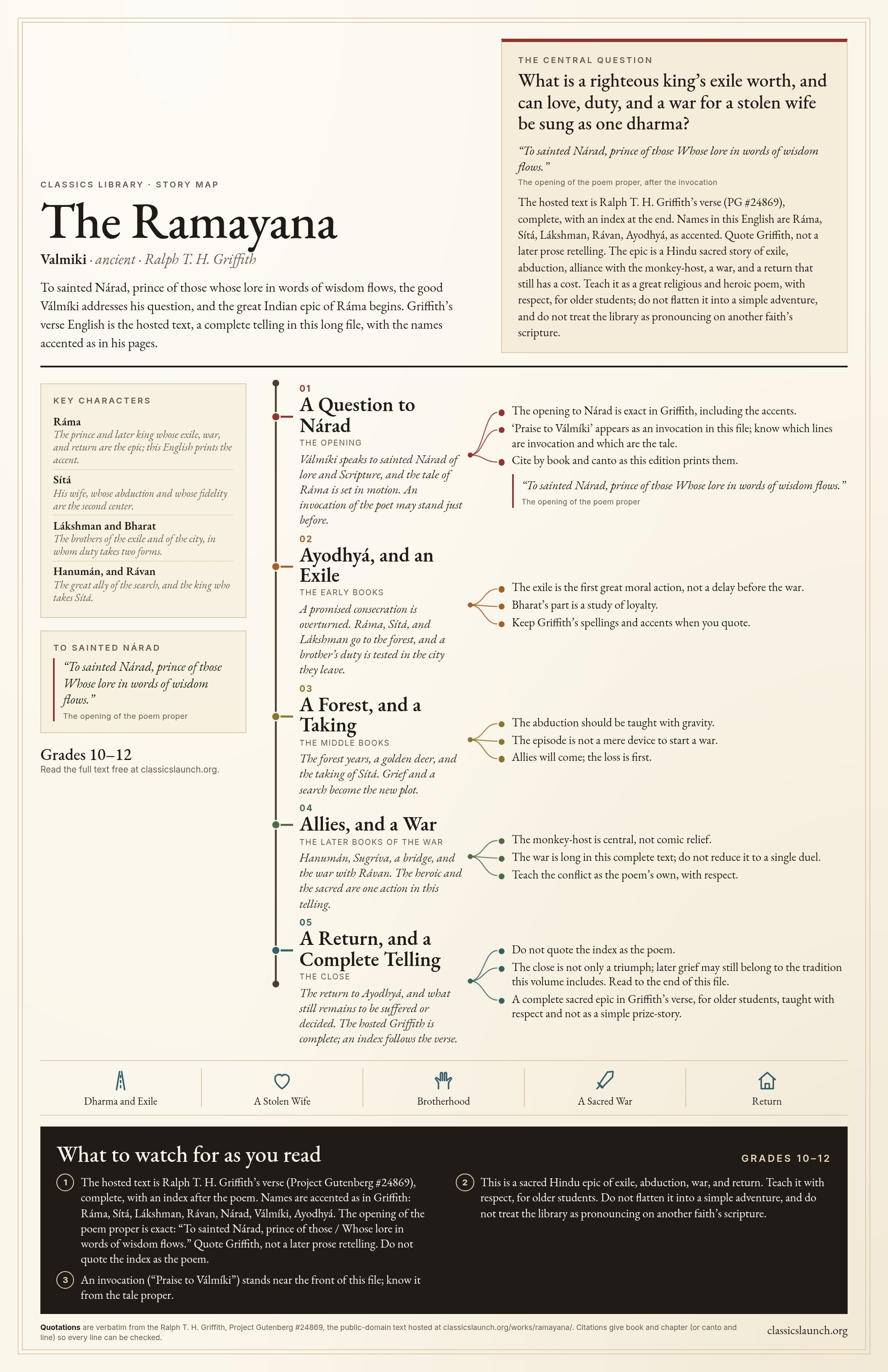
To sainted Nárad, prince of those whose lore in words of wisdom flows, the good Válmíki addresses his question, and the great Indian epic of Ráma begins. Griffith’s verse English is the hosted text, a complete telling in this long file, with the names accented as in his pages.
The central question
What is a righteous king’s exile worth, and can love, duty, and a war for a stolen wife be sung as one dharma?
“To sainted Nárad, prince of those Whose lore in words of wisdom flows.”
The hosted text is Ralph T. H. Griffith’s verse (PG #24869), complete, with an index at the end. Names in this English are Ráma, Sítá, Lákshman, Rávan, Ayodhyá, as accented. Quote Griffith, not a later prose retelling. The epic is a Hindu sacred story of exile, abduction, alliance with the monkey-host, a war, and a return that still has a cost. Teach it as a great religious and heroic poem, with respect, for older students; do not flatten it into a simple adventure, and do not treat the library as pronouncing on another faith’s scripture.
- 01
A Question to Nárad
The opening
Válmíki speaks to sainted Nárad of lore and Scripture, and the tale of Ráma is set in motion. An invocation of the poet may stand just before.
- The opening to Nárad is exact in Griffith, including the accents.
- ‘Praise to Válmíki’ appears as an invocation in this file; know which lines are invocation and which are the tale.
- Cite by book and canto as this edition prints them.
“To sainted Nárad, prince of those Whose lore in words of wisdom flows.”
- 02
Ayodhyá, and an Exile
The early books
A promised consecration is overturned. Ráma, Sítá, and Lákshman go to the forest, and a brother’s duty is tested in the city they leave.
- The exile is the first great moral action, not a delay before the war.
- Bharat’s part is a study of loyalty.
- Keep Griffith’s spellings and accents when you quote.
- 03
A Forest, and a Taking
The middle books
The forest years, a golden deer, and the taking of Sítá. Grief and a search become the new plot.
- The abduction should be taught with gravity.
- The episode is not a mere device to start a war.
- Allies will come; the loss is first.
- 04
Allies, and a War
The later books of the war
Hanumán, Sugríva, a bridge, and the war with Rávan. The heroic and the sacred are one action in this telling.
- The monkey-host is central, not comic relief.
- The war is long in this complete text; do not reduce it to a single duel.
- Teach the conflict as the poem’s own, with respect.
- 05
A Return, and a Complete Telling
The close
The return to Ayodhyá, and what still remains to be suffered or decided. The hosted Griffith is complete; an index follows the verse.
- Do not quote the index as the poem.
- The close is not only a triumph; later grief may still belong to the tradition this volume includes. Read to the end of this file.
- A complete sacred epic in Griffith’s verse, for older students, taught with respect and not as a simple prize-story.
- Dharma and Exile
- A Stolen Wife
- Brotherhood
- A Sacred War
- Return
What to watch for as you read
Grades 10–12- The hosted text is Ralph T. H. Griffith’s verse (Project Gutenberg #24869), complete, with an index after the poem. Names are accented as in Griffith: Ráma, Sítá, Lákshman, Rávan, Nárad, Válmíki, Ayodhyá. The opening of the poem proper is exact: “To sainted Nárad, prince of those / Whose lore in words of wisdom flows.” Quote Griffith, not a later prose retelling. Do not quote the index as the poem.
- This is a sacred Hindu epic of exile, abduction, war, and return. Teach it with respect, for older students. Do not flatten it into a simple adventure, and do not treat the library as pronouncing on another faith’s scripture.
- An invocation (“Praise to Válmíki”) stands near the front of this file; know it from the tale proper.
Every quotation is word for word from the Ralph T. H. Griffith hosted in this library and is checked against that text each time the site is built. Citations give book and chapter (or canto and line).