Story maps · Grades 9–12
Richard III: A Story Map
The PDF is one tabloid page (11 × 17 in). On letter paper, choose “Fit to page.”
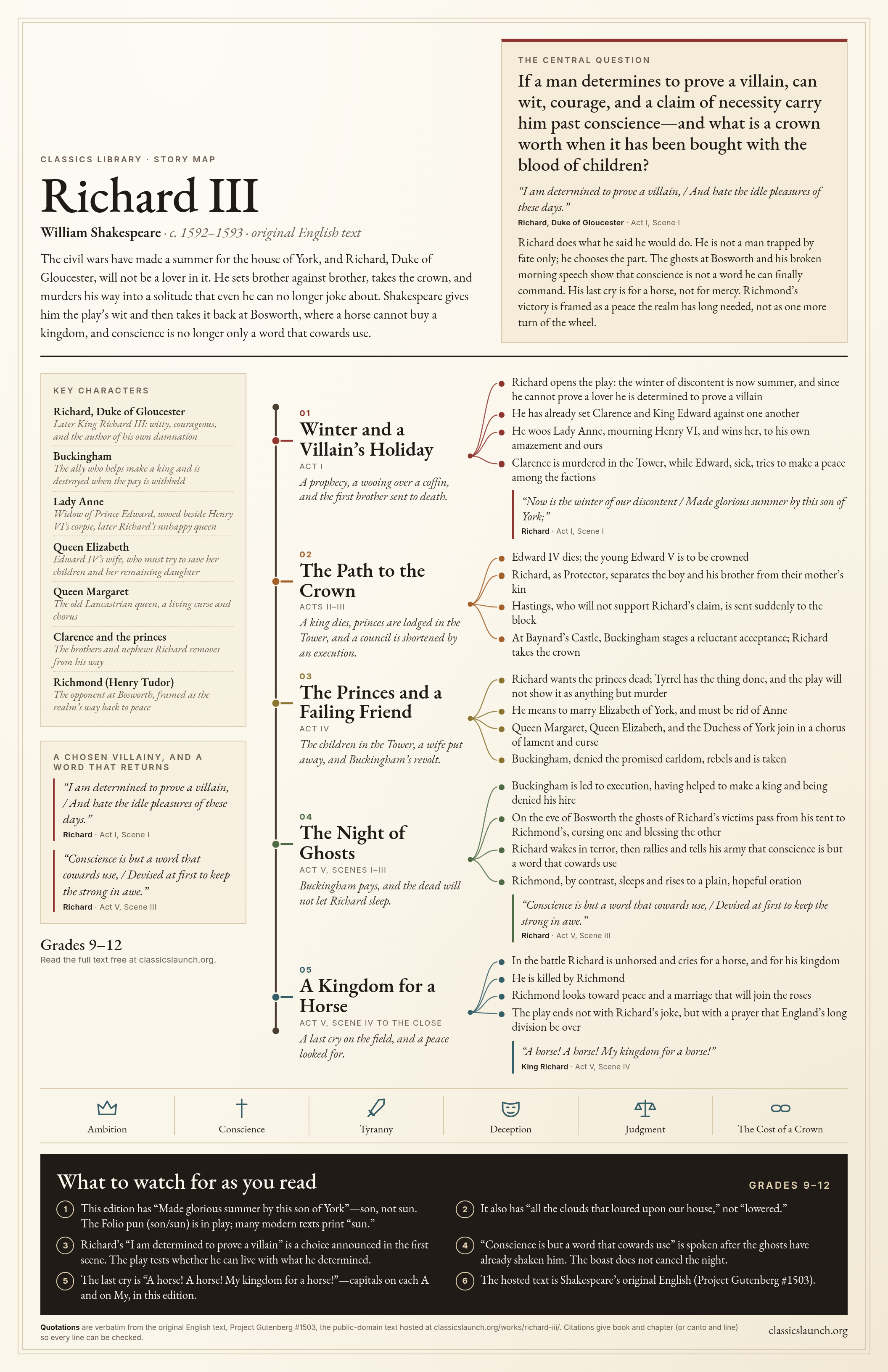
The civil wars have made a summer for the house of York, and Richard, Duke of Gloucester, will not be a lover in it. He sets brother against brother, takes the crown, and murders his way into a solitude that even he can no longer joke about. Shakespeare gives him the play’s wit and then takes it back at Bosworth, where a horse cannot buy a kingdom, and conscience is no longer only a word that cowards use.
The central question
If a man determines to prove a villain, can wit, courage, and a claim of necessity carry him past conscience—and what is a crown worth when it has been bought with the blood of children?
“I am determined to prove a villain, / And hate the idle pleasures of these days.”
Richard does what he said he would do. He is not a man trapped by fate only; he chooses the part. The ghosts at Bosworth and his broken morning speech show that conscience is not a word he can finally command. His last cry is for a horse, not for mercy. Richmond’s victory is framed as a peace the realm has long needed, not as one more turn of the wheel.
- 01
Winter and a Villain’s Holiday
Act I
A prophecy, a wooing over a coffin, and the first brother sent to death.
- Richard opens the play: the winter of discontent is now summer, and since he cannot prove a lover he is determined to prove a villain
- He has already set Clarence and King Edward against one another
- He woos Lady Anne, mourning Henry VI, and wins her, to his own amazement and ours
- Clarence is murdered in the Tower, while Edward, sick, tries to make a peace among the factions
“Now is the winter of our discontent / Made glorious summer by this son of York;”
- 02
The Path to the Crown
Acts II–III
A king dies, princes are lodged in the Tower, and a council is shortened by an execution.
- Edward IV dies; the young Edward V is to be crowned
- Richard, as Protector, separates the boy and his brother from their mother’s kin
- Hastings, who will not support Richard’s claim, is sent suddenly to the block
- At Baynard’s Castle, Buckingham stages a reluctant acceptance; Richard takes the crown
- 03
The Princes and a Failing Friend
Act IV
The children in the Tower, a wife put away, and Buckingham’s revolt.
- Richard wants the princes dead; Tyrrel has the thing done, and the play will not show it as anything but murder
- He means to marry Elizabeth of York, and must be rid of Anne
- Queen Margaret, Queen Elizabeth, and the Duchess of York join in a chorus of lament and curse
- Buckingham, denied the promised earldom, rebels and is taken
- 04
The Night of Ghosts
Act V, Scenes I–III
Buckingham pays, and the dead will not let Richard sleep.
- Buckingham is led to execution, having helped to make a king and being denied his hire
- On the eve of Bosworth the ghosts of Richard’s victims pass from his tent to Richmond’s, cursing one and blessing the other
- Richard wakes in terror, then rallies and tells his army that conscience is but a word that cowards use
- Richmond, by contrast, sleeps and rises to a plain, hopeful oration
“Conscience is but a word that cowards use, / Devised at first to keep the strong in awe.”
- 05
A Kingdom for a Horse
Act V, Scene IV to the close
A last cry on the field, and a peace looked for.
- In the battle Richard is unhorsed and cries for a horse, and for his kingdom
- He is killed by Richmond
- Richmond looks toward peace and a marriage that will join the roses
- The play ends not with Richard’s joke, but with a prayer that England’s long division be over
“A horse! A horse! My kingdom for a horse!”
- Ambition
- Conscience
- Tyranny
- Deception
- Judgment
- The Cost of a Crown
What to watch for as you read
Grades 9–12- This edition has “Made glorious summer by this son of York”—son, not sun. The Folio pun (son/sun) is in play; many modern texts print “sun.”
- It also has “all the clouds that loured upon our house,” not “lowered.”
- Richard’s “I am determined to prove a villain” is a choice announced in the first scene. The play tests whether he can live with what he determined.
- “Conscience is but a word that cowards use” is spoken after the ghosts have already shaken him. The boast does not cancel the night.
- The last cry is “A horse! A horse! My kingdom for a horse!”—capitals on each A and on My, in this edition.
- The hosted text is Shakespeare’s original English (Project Gutenberg #1503).
Every quotation is word for word from the original English text hosted in this library and is checked against that text each time the site is built. Citations give book and chapter (or canto and line).