Story maps · Grades 9–12
Pictures of the Socialistic Future: A Story Map
The PDF is one tabloid page (11 × 17 in). On letter paper, choose “Fit to page.”
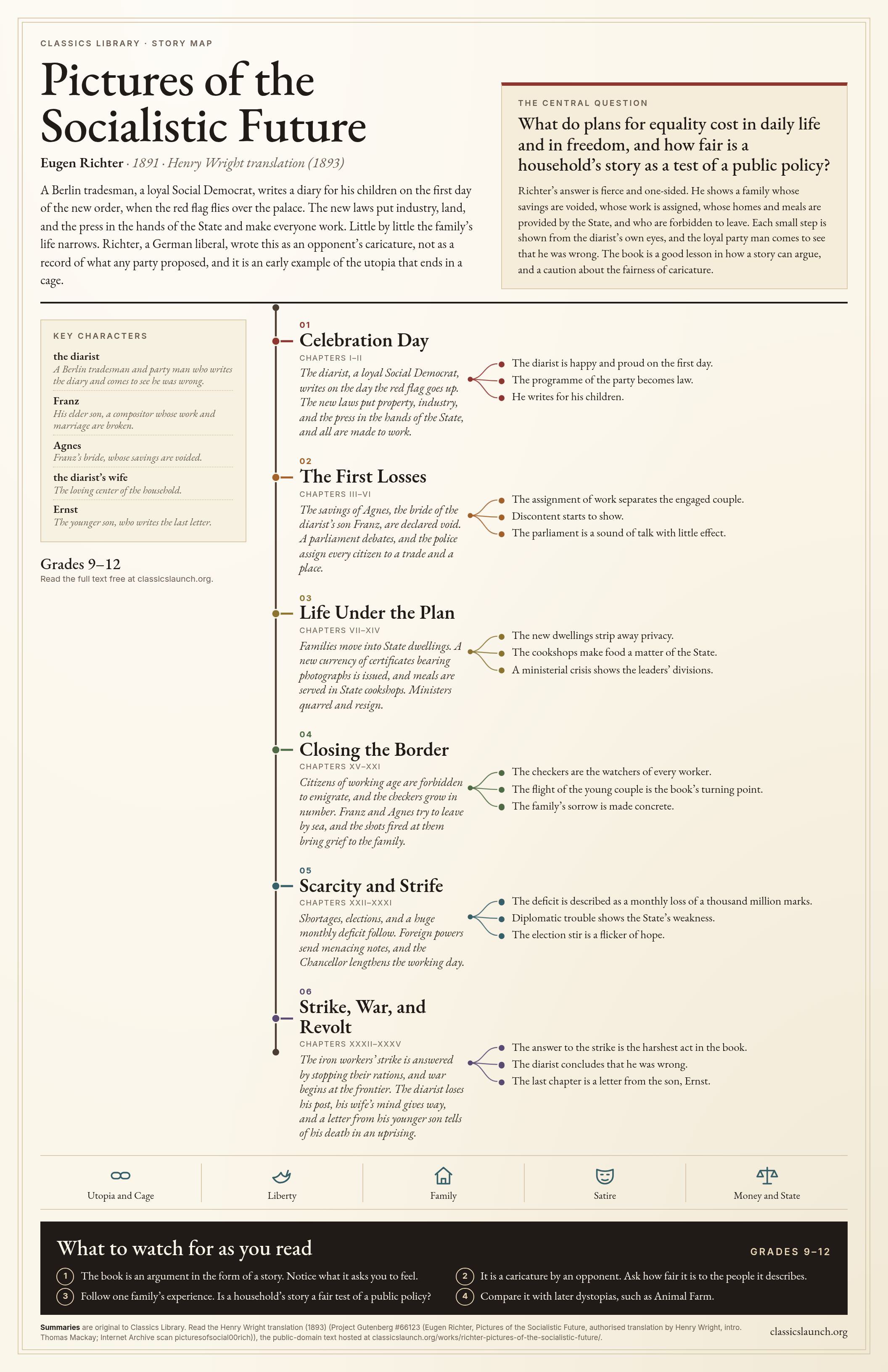
A Berlin tradesman, a loyal Social Democrat, writes a diary for his children on the first day of the new order, when the red flag flies over the palace. The new laws put industry, land, and the press in the hands of the State and make everyone work. Little by little the family’s life narrows. Richter, a German liberal, wrote this as an opponent’s caricature, not as a record of what any party proposed, and it is an early example of the utopia that ends in a cage.
The central question
What do plans for equality cost in daily life and in freedom, and how fair is a household’s story as a test of a public policy?
Richter’s answer is fierce and one-sided. He shows a family whose savings are voided, whose work is assigned, whose homes and meals are provided by the State, and who are forbidden to leave. Each small step is shown from the diarist’s own eyes, and the loyal party man comes to see that he was wrong. The book is a good lesson in how a story can argue, and a caution about the fairness of caricature.
- 01
Celebration Day
Chapters I–II
The diarist, a loyal Social Democrat, writes on the day the red flag goes up. The new laws put property, industry, and the press in the hands of the State, and all are made to work.
- The diarist is happy and proud on the first day.
- The programme of the party becomes law.
- He writes for his children.
- 02
The First Losses
Chapters III–VI
The savings of Agnes, the bride of the diarist’s son Franz, are declared void. A parliament debates, and the police assign every citizen to a trade and a place.
- The assignment of work separates the engaged couple.
- Discontent starts to show.
- The parliament is a sound of talk with little effect.
- 03
Life Under the Plan
Chapters VII–XIV
Families move into State dwellings. A new currency of certificates bearing photographs is issued, and meals are served in State cookshops. Ministers quarrel and resign.
- The new dwellings strip away privacy.
- The cookshops make food a matter of the State.
- A ministerial crisis shows the leaders’ divisions.
- 04
Closing the Border
Chapters XV–XXI
Citizens of working age are forbidden to emigrate, and the checkers grow in number. Franz and Agnes try to leave by sea, and the shots fired at them bring grief to the family.
- The checkers are the watchers of every worker.
- The flight of the young couple is the book’s turning point.
- The family’s sorrow is made concrete.
- 05
Scarcity and Strife
Chapters XXII–XXXI
Shortages, elections, and a huge monthly deficit follow. Foreign powers send menacing notes, and the Chancellor lengthens the working day.
- The deficit is described as a monthly loss of a thousand million marks.
- Diplomatic trouble shows the State’s weakness.
- The election stir is a flicker of hope.
- 06
Strike, War, and Revolt
Chapters XXXII–XXXV
The iron workers’ strike is answered by stopping their rations, and war begins at the frontier. The diarist loses his post, his wife’s mind gives way, and a letter from his younger son tells of his death in an uprising.
- The answer to the strike is the harshest act in the book.
- The diarist concludes that he was wrong.
- The last chapter is a letter from the son, Ernst.
- Utopia and Cage
- Liberty
- Family
- Satire
- Money and State
What to watch for as you read
Grades 9–12- The book is an argument in the form of a story. Notice what it asks you to feel.
- It is a caricature by an opponent. Ask how fair it is to the people it describes.
- Follow one family’s experience. Is a household’s story a fair test of a public policy?
- Compare it with later dystopias, such as Animal Farm.
Every quotation is word for word from the Henry Wright translation (1893) hosted in this library and is checked against that text each time the site is built. Citations give book and chapter (or canto and line).