Work record
Pictures of the Socialistic Future
Eugen RichterSozialdemokratische Zukunftsbilder; Pictures of the Socialistic Future (Freely Adapted from Bebel); Social Democratic Pictures of the Future; Richter's Pictures of the Socialistic FuturePictures of the Socialistic Future by Eugen Richter (1891)Pictures of the Socialistic Future is a short satirical novel by the German liberal Eugen Richter, first published in 1891 and offered by its author as a picture freely adapted from the writings of the Social Democratic leader August Bebel.Also known as: Sozialdemokratische Zukunftsbilder · Pictures of the Socialistic Future (Freely Adapted from Bebel) · Social Democratic Pictures of the Future · Richter's Pictures of the Socialistic Future
1891 · 19th Century · Satire · German
Read this when you want to see how a promise of equality could fail in daily life.
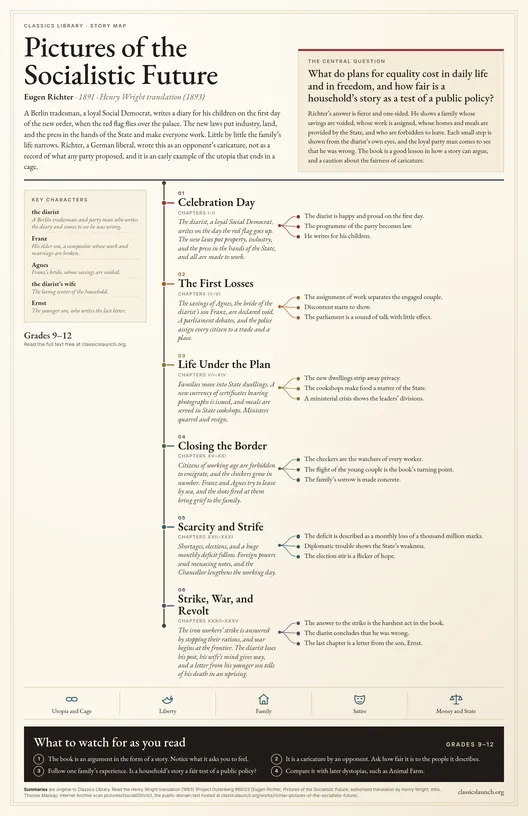 Story mapSee the story mapThe whole book on one page: the story in movements, the characters, and what to watch for. Free to print.
Abstract
Background. A German liberal politician and opponent of the party, writing in 1891 when the Social Democrats had adopted their Erfurt programme, imagines what would follow if that programme became law in Berlin.
Plot. A loyal party man records the first day of the new order with delight. The State takes property and assigns work, serves meals by coupon, forbids emigration and fires on fugitives. Scarcity, war and revolt follow, and the diarist loses his daughter, his wife's reason and his own life.
Ideas. The book is an argument in the form of a story: it asks what plans for equality cost in daily life and in freedom. It is also a caricature by an opponent, so students should ask how fair it is, and how far a household's experience may serve as a fair test of a public policy.
Text. The text is Henry Wright's authorised translation of 1893, in the cheap edition with Thomas Mackay's introduction, and each quotation in the guide was matched to the hosted text. Teachers can pair it with Animal Farm and with the library's study guide, seminar questions and memory work.
Main characters
- The diarist: A Berlin tradesman and party man who writes the diary
- Franz: His elder son, a compositor
- Agnes: Franz's bride
- Ernst: The younger son who writes the last letter
Summary
Pictures of the Socialistic Future is a short satirical novel by the German liberal Eugen Richter, first published in 1891 and offered by its author as a picture freely adapted from the writings of the Social Democratic leader August Bebel. It is told as the diary of a Berlin tradesman, a loyal party man who has worked for years for the cause and who sits down on the first day of the new order to write an account for his children. On that day the red flag flies from the palace, and the diarist is delighted. The first chapters show the new laws: every industry, the land and the presses pass to the State, all must work, and the Social Democratic programme of Erfurt becomes the law of the land. Then, one by one, the small injuries arrive. His son's bride finds her savings declared void. Work is assigned by the police, and the young man is sent from Berlin to another town. Families are moved to State dwellings, children go to State schools, old people to State homes, and meals are served in State cookshops by coupon. The money is replaced by certificates tied to a photograph. Officials called checkers watch every worker, and the number of checkers grows. Citizens of working age are forbidden to emigrate, and the diarist's son and his bride try to flee and are fired on. Goods grow scarce, the monthly deficit climbs, a strike of iron workers is answered by cutting off their rations, and a war begins at the same moment. The diarist, now suspected, loses his post, his daughter dies and his wife goes mad with grief, and he concludes that he was wrong. The book ends with a letter from his younger son telling of his father's death in a riot. Richter is writing as an opponent, and his book is a caricature, not a record of what any party proposed or what any society did. It is nonetheless a vivid early example of a form that later became familiar, the story of a utopia that ends in a cage.
Virtues in this work
- Prudence: The satire asks the reader to weigh the cost of a promise before accepting it and to foresee what a plan will do to a household.
- Humility: The diarist's last chapters show a man admitting that he was wrong and counting the harm his mistake did.
- Justice: The story asks what a State owes to its citizens, and what it owes to a family whose savings and freedom it has taken.
Plot or Argument
- Celebration day (Chapters I–II)
The diarist, a loyal Social Democrat, writes on the day the red flag goes up over Berlin. The new laws put property, industry and the press in the hands of the State, and all are made to work.
- The first losses (Chapters III–VI)
The savings of Agnes, the bride of the diarist's son Franz, are declared void. A Parliament debates, and the police assign every citizen to a trade and a place, which separates the engaged pair.
- Life under the plan (Chapters VII–XIV)
Families are moved into State dwellings, a new currency of certificates bearing photographs is issued, and meals are served in State cookshops. Ministers quarrel and resign.
- Closing the border (Chapters XV–XXI)
Citizens of working age are forbidden to emigrate, and the checkers grow in number. Franz and Agnes try to leave by sea, and the shots fired at the fugitives bring the family to grief.
- Scarcity and strife (Chapters XXII–XXXI)
Shortages, elections and a monthly deficit of a thousand million marks follow. Foreign powers send menacing notes, and the Chancellor lengthens the working day.
- Strike, war and revolt (Chapters XXXII–XXXIV)
The iron workers' strike is answered by stopping their rations, and war begins on the frontier. The diarist, now under suspicion, loses his place, and his wife's mind gives way.
- The last chapter (Chapter XXXV)
A letter from his younger son tells Franz in New York that their father has been shot in the uprising, and that the diary will follow.
Characters
- The diarist, narrator
A Berlin tradesman and party man, formerly a master of his craft, who tells the story and comes to see that he was wrong.
- Franz, elder son
His elder son, a compositor whose work and marriage are broken by the new orders.
- Agnes, Franz's bride
Franz's bride, whose savings are declared void and who tries to leave the country.
- The diarist's wife, mother of the household
The loving centre of the household, whose strength fails after the family is scattered.
- Ernst, younger son
The younger son, who writes the final letter.
Lessons
A satire is an argument in costume
Richter writes as the opponent of a party and gives the future he fears the face of a household. The student learns to enjoy the story while asking whether the picture is fair, since a satire exaggerates by design and cannot be used as proof of what its target proposed.
- What does Richter gain by telling the story in the voice of a believer?
- Where do you think he exaggerates, and what would a Social Democrat of 1891 have said in reply?
The household is where a political scheme is tested
The diary measures each decree by what it does to a family: a bride's savings, a son's trade, a mother's table and a daughter's life. Christian teaching on the family as a first society, with its own duties and rights, gives students a way to ask what a State may and may not claim.
- Which of the decrees touches the family most deeply, and why?
- What does the Bible say a household owes to its members, and what does a State owe a household?
Good intentions are not a defence
The diarist's last words are neither bitter nor proud but a plain admission: he believed, and he was wrong. The lesson is for the reader to see that sincerity does not make a policy wise, and that humility means learning from the cost.
- How does the diarist's confession in Chapter XXXIV change your view of him?
- Why is it harder to admit an error that has cost others than one that has cost only yourself?
Read the other side fairly
The Social Democrats of the time held a range of views, and many supported peaceful reform by vote. Honest readers give Richter's warnings a hearing while keeping the difference between his imagined Germany and the parties he opposed.
- How could you check whether Richter's picture matches what the Erfurt programme actually said?
- What would a fair reply to Richter look like?
Context
Richter wrote in the German Empire in 1891, the year in which the Social Democratic party, freed from Bismarck's anti-socialist law the year before, met at Erfurt and adopted a programme of common ownership. His own party stood for free trade, limited government and the rights of parliament against both the Chancellor and the socialists.
Composition
The book was published in 1891 as a picture of the party's aims freely adapted from the writings of Bebel, and it sold in very large numbers in Germany. Henry Wright's authorised English translation appeared in London in 1893, and the edition hosted here is the cheap edition with Thomas Mackay's introduction of 1907.
Reception
The book was widely read and quoted by opponents of socialism, and it was read as a polemic in the debates of its day. Later readers have compared it with the utopian and dystopian fiction of the twentieth century, but its direct purpose was to sway voters in the Germany of its day.
Comparisons
Read these together
- Arguments Against Socialism: A Reading Path
Fifteen works that argue, from different sides, against common ownership and the planned economy—from Bastiat's parables to Orwell's farm—with the questions each one answers.
- The Communist Manifesto
The Manifesto sets out the programme of common ownership that Richter's satire imagines carried out, and the two can be read as a claim and a caricature of its results.
- Nineteen Eighty-Four
Orwell's novel shows a State that watches, rations and rewrites; Richter's checkers, coupons and closed frontiers anticipate several of its features, in a lighter and plainer manner.
- Animal Farm
Orwell's fable follows a revolution from joyful beginning to a rule harsher than the old one, the same arc that Richter sketches in a Berlin household.
- The Road to Serfdom
Hayek argues in 1944 that economic planning leads by its own logic to the loss of other freedoms, an argument that Richter dramatises in 1891 as a story.
- Socialism: An Economic and Sociological Analysis
Mises gives a systematic account of the difficulties of a planned economy that Richter's diary shows through the shortages, deficits and coupons of ordinary life.
- Utopia
More's island of Utopia is the ancestor of all imagined commonwealths, and Richter's book is a counter-utopia of the same kind.
Quotes
Frequently cited
“All printing establishments having now become the property of the State, all the other papers have, as a matter of course, ceased to appear.”
Frequently cited
“Meantime, a decree has been issued against all emigration without the permission of the authorities.”
Frequently cited
“My only motive was the sincere belief that Socialism would cause a better order of things for future generations.”
Frequently cited
“But how can my boys ever forgive me for having helped to bring about those events which have deprived them of their mother and their sister, and utterly destroyed our happiness as a family?”
“complained piteously of being cheated, as they said, out of their hard-earned savings”
“Unlike gold and silver, the new currency possesses no intrinsic value, but it consists simply of orders or cheques drawn on the State as the sole possessor of all articles of sale.”
“Each person has the right to dine at the cookshop of the district in which his dwelling is situated.”
“once more a number of emigrants, in seeking to evade pursuit by the frontier guards, had been shot down by the latter”
For Students
A reading companion for classical Christian high school students. See the student guide.
Reading Guide
Watch for
- Each small loss in the diary and the household member who feels it first.
- How the narrator describes every decree in the voice of a believer, and how the tone changes.
- The language of coupons, checkers and certificates, and what it tells you about daily life under the plan.
- What the diarist says at the end, and who is addressed in the last letter.
Key terms and names
- Social Democracy
- The German party founded on the teaching of Marx and Lassalle, which in 1891 adopted the Erfurt programme calling for common ownership of the means of production.
- Erfurt programme
- The party platform of 1891, which Richter's State takes as its fundamental law.
- Checker
- In the book, an official who supervises a number of workers and reports on them.
- Money certificate
- A coupon, tied to the holder by a photograph, that takes the place of coin in the book's State.
- Satire
- A work that holds up a belief or a person to ridicule or alarm by exaggeration.
- Freisinn
- The name of Richter's left-liberal party, which means free-thinking and stood for free trade and the rule of parliament.
Seminar Questions
- Comprehension What are the first laws made by the new government, and which do you think the diarist welcomes most?
- Comprehension What happens to Agnes's savings, and what does the loss show about the plan?
- Interpretation Why does Richter tell the story through a believer's eyes, and how does the diarist's tone change from Chapter I to Chapter XXXIV?
- Interpretation Which scenes seem to you the strongest and which seem exaggerated, and why?
- Interpretation What does the ban on emigration in Chapter XV show about the way the State regards its citizens?
- Big Question How can a person tell whether a promise of equality respects the dignity of each family and each person, and what would Christian teaching add?
- Big Question What is the difference between a fair warning and an unfair caricature, and how should a student read a satire written against a party?
Faith Connections
- Exodus 20:15 and 20:17 (Scripture)
The commandments against stealing and coveting assume that property is real and that a neighbour's goods are not for the taking; the diarist's lost savings put the question of what a community may take.
- Proverbs 14:12 (Scripture)
There is a way which seemeth right unto a man, but the end thereof are the ways of death. The diarist's last chapters are a long commentary on this verse.
- Leo XIII, Rerum Novarum (1891) (Great Conversation)
The Pope wrote in the same year as Richter and warned that the plan of common ownership would harm the very workers it promised to help, while also calling on the owners to deal justly with them.
Logic and Rhetoric
Central argument: If a State took all property and assigned every person a place and a ration, daily life would become poorer, freedom would be lost, and the scheme would be held together by watching, coupons and force.
Rhetorical device: satire. The diarist praises each new decree in the language of progress while the reader sees what it costs his family.
Debate: Resolved: That a story can be a fair argument against a political programme.
Memory Work
Meantime, a decree has been issued against all emigration without the permission of the authorities.
But how can my boys ever forgive me for having helped to bring about those events which have deprived them of their mother and their sister, and utterly destroyed our happiness as a family?
Writing Prompts
Essay: Choose three scenes from the diary and explain how Richter uses them to argue against the plan; then say what a reader should keep in mind about a satire written by an opponent.
Comparison with Animal Farm: Compare the way Orwell and Richter let a revolution turn from hope to a rule that confines its own followers, and say what each uses to show it.
Medical Lens
The diarist's wife loses her reason after the death of her daughter and the flight of her sons, and is sent to a State asylum for the incurable. The scene is a brief literary record of grief as a cause of mental collapse and of institutional care as the book imagined it.
- Chapter XXXIV, Disheartening News
The doctor tells the diarist that the shocks of the last months have deprived his wife of reason and that she will be sent to the Asylum for Incurables.
Creative Prompts
- Essay
Write an essay that decides whether a story told by an opponent can be fair to its target. Use at least two scenes from the diary and say what Richter gains and loses by telling it in the voice of a believer.
- Dialogue
Write a conversation between the diarist and Franz on the night before Franz is sent to Leipzig. Let the father defend the new order and the son question one decree.
- Fiction
Write a diary entry from Agnes on the night she learns that her savings are void, keeping to the voice and the plain detail of Richter's chapters.
- Classroom
Hold a mock Reichstag debate in 1891. One side defends the Erfurt programme and the other reads from Richter's picture; each must quote the text and answer the other's best point.
Further Reading
- Animal Farm, George Orwell
A fable of a revolution that ends in a harsher rule; hosted in this library.
- The Road to Serfdom, Friedrich A. Hayek
A twentieth-century argument on the cost of planning.
- Looking Backward, Edward Bellamy
The American socialist utopia of 1888 that Richter's translator mentions in his postscript.
- The Communist Manifesto, Karl Marx and Friedrich Engels
- German Liberalism in the Nineteenth Century, James J. Sheehan
Verification notes
The text is Henry Wright's authorised translation of 1893 in the cheap edition of 1912, as produced by Project Gutenberg from the Internet Archive scan, with Mackay's introduction of 1907 and the translator's postscript; the spelling is British and left as printed. Every quotation in this file was matched to the hosted text. Richter's life dates and offices follow standard reference works. The book is a satire by an opponent and should not be taken as a record of what the Social Democrats proposed.
- Richter's birth place and dates (1838–1906) and his leadership of the left-liberal Freisinnige party follow standard reference works and have not been checked against primary sources here.
- The statement that the party freed from the anti-socialist law met at Erfurt in 1891 follows standard histories and should be checked.
- The book's sales are given by its translator and Mackay's introduction, not from sales records.