Story maps · Grades 10–12
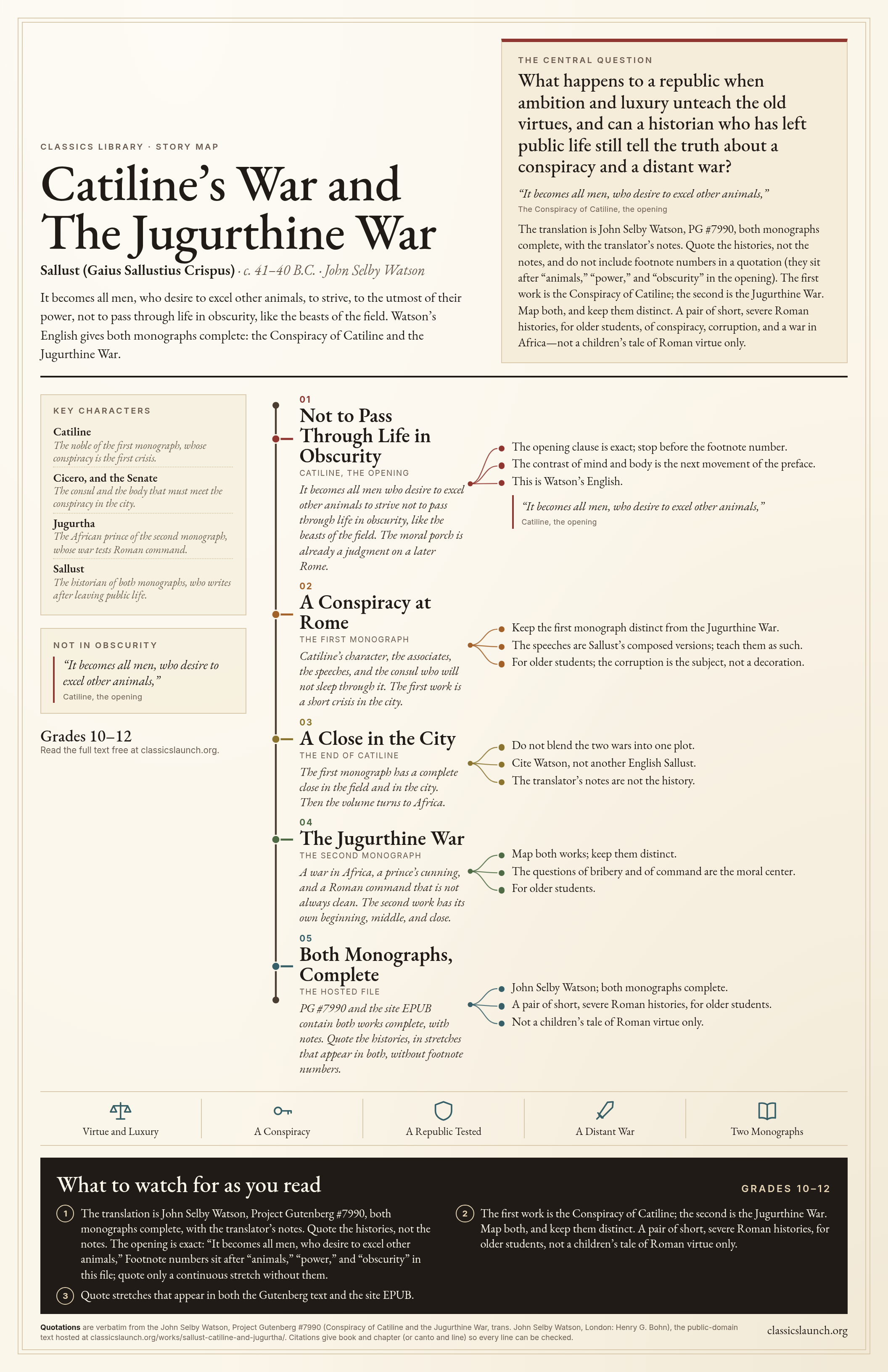
Catiline’s War and The Jugurthine War: A Story Map
The PDF is one tabloid page (11 × 17 in). On letter paper, choose “Fit to page.”
It becomes all men, who desire to excel other animals, to strive, to the utmost of their power, not to pass through life in obscurity, like the beasts of the field. Watson’s English gives both monographs complete: the Conspiracy of Catiline and the Jugurthine War.
The central question
What happens to a republic when ambition and luxury unteach the old virtues, and can a historian who has left public life still tell the truth about a conspiracy and a distant war?
“It becomes all men, who desire to excel other animals,”
The translation is John Selby Watson, PG #7990, both monographs complete, with the translator’s notes. Quote the histories, not the notes, and do not include footnote numbers in a quotation (they sit after “animals,” “power,” and “obscurity” in the opening). The first work is the Conspiracy of Catiline; the second is the Jugurthine War. Map both, and keep them distinct. A pair of short, severe Roman histories, for older students, of conspiracy, corruption, and a war in Africa—not a children’s tale of Roman virtue only.
- 01
Not to Pass Through Life in Obscurity
Catiline, the opening
It becomes all men who desire to excel other animals to strive not to pass through life in obscurity, like the beasts of the field. The moral porch is already a judgment on a later Rome.
- The opening clause is exact; stop before the footnote number.
- The contrast of mind and body is the next movement of the preface.
- This is Watson’s English.
“It becomes all men, who desire to excel other animals,”
- 02
A Conspiracy at Rome
The first monograph
Catiline’s character, the associates, the speeches, and the consul who will not sleep through it. The first work is a short crisis in the city.
- Keep the first monograph distinct from the Jugurthine War.
- The speeches are Sallust’s composed versions; teach them as such.
- For older students; the corruption is the subject, not a decoration.
- 03
A Close in the City
The end of Catiline
The first monograph has a complete close in the field and in the city. Then the volume turns to Africa.
- Do not blend the two wars into one plot.
- Cite Watson, not another English Sallust.
- The translator’s notes are not the history.
- 04
The Jugurthine War
The second monograph
A war in Africa, a prince’s cunning, and a Roman command that is not always clean. The second work has its own beginning, middle, and close.
- Map both works; keep them distinct.
- The questions of bribery and of command are the moral center.
- For older students.
- 05
Both Monographs, Complete
The hosted file
PG #7990 and the site EPUB contain both works complete, with notes. Quote the histories, in stretches that appear in both, without footnote numbers.
- John Selby Watson; both monographs complete.
- A pair of short, severe Roman histories, for older students.
- Not a children’s tale of Roman virtue only.
- Virtue and Luxury
- A Conspiracy
- A Republic Tested
- A Distant War
- Two Monographs
What to watch for as you read
Grades 10–12- The translation is John Selby Watson, Project Gutenberg #7990, both monographs complete, with the translator’s notes. Quote the histories, not the notes. The opening is exact: “It becomes all men, who desire to excel other animals,” Footnote numbers sit after “animals,” “power,” and “obscurity” in this file; quote only a continuous stretch without them.
- The first work is the Conspiracy of Catiline; the second is the Jugurthine War. Map both, and keep them distinct. A pair of short, severe Roman histories, for older students, not a children’s tale of Roman virtue only.
- Quote stretches that appear in both the Gutenberg text and the site EPUB.
Every quotation is word for word from the John Selby Watson hosted in this library and is checked against that text each time the site is built. Citations give book and chapter (or canto and line).