Story maps · Grades 9–12
William Tell: A Story Map
The PDF is one tabloid page (11 × 17 in). On letter paper, choose “Fit to page.”
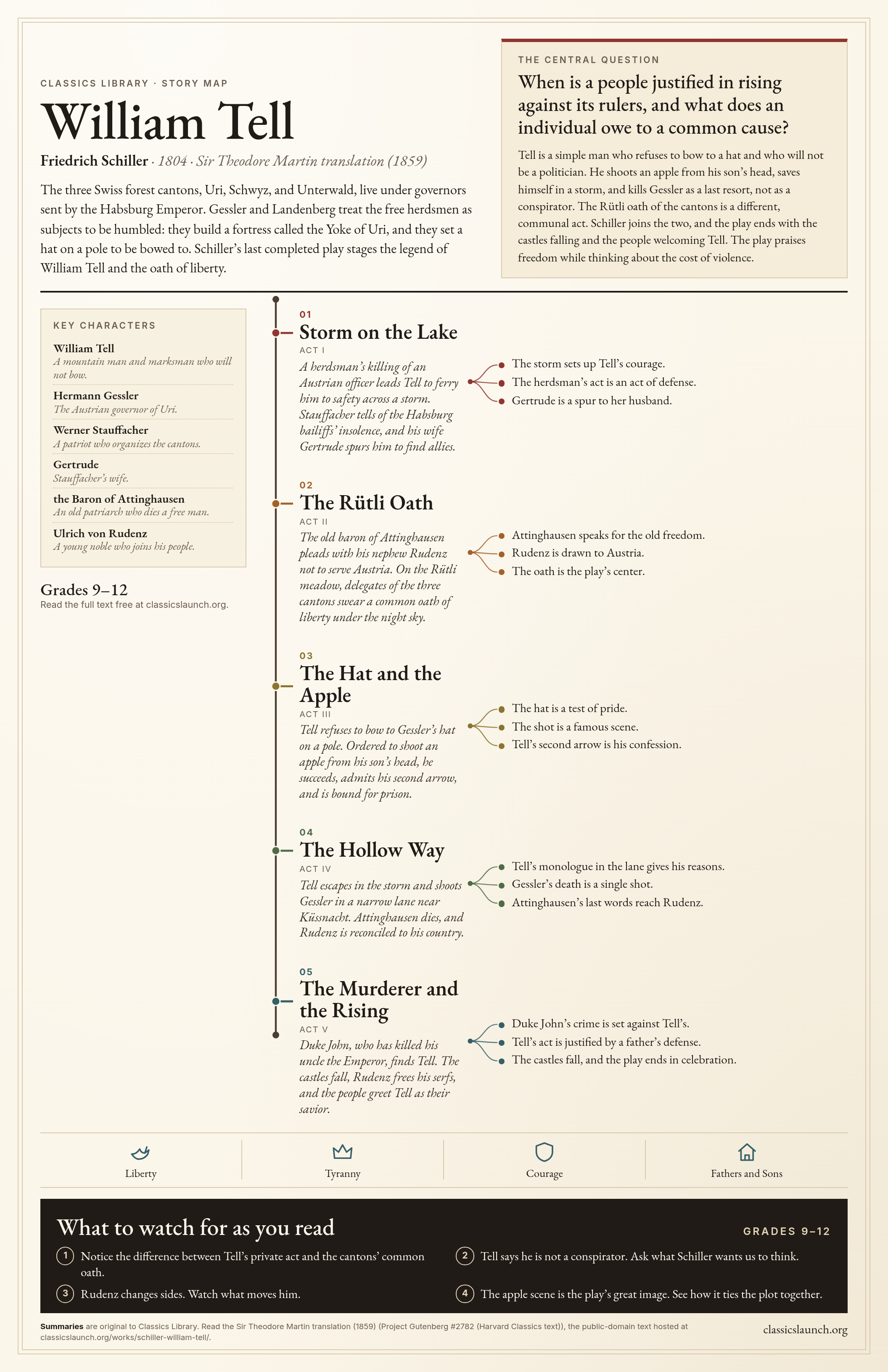
The three Swiss forest cantons, Uri, Schwyz, and Unterwald, live under governors sent by the Habsburg Emperor. Gessler and Landenberg treat the free herdsmen as subjects to be humbled: they build a fortress called the Yoke of Uri, and they set a hat on a pole to be bowed to. Schiller’s last completed play stages the legend of William Tell and the oath of liberty.
The central question
When is a people justified in rising against its rulers, and what does an individual owe to a common cause?
Tell is a simple man who refuses to bow to a hat and who will not be a politician. He shoots an apple from his son’s head, saves himself in a storm, and kills Gessler as a last resort, not as a conspirator. The Rütli oath of the cantons is a different, communal act. Schiller joins the two, and the play ends with the castles falling and the people welcoming Tell. The play praises freedom while thinking about the cost of violence.
- 01
Storm on the Lake
Act I
A herdsman’s killing of an Austrian officer leads Tell to ferry him to safety across a storm. Stauffacher tells of the Habsburg bailiffs’ insolence, and his wife Gertrude spurs him to find allies.
- The storm sets up Tell’s courage.
- The herdsman’s act is an act of defense.
- Gertrude is a spur to her husband.
- 02
The Rütli Oath
Act II
The old baron of Attinghausen pleads with his nephew Rudenz not to serve Austria. On the Rütli meadow, delegates of the three cantons swear a common oath of liberty under the night sky.
- Attinghausen speaks for the old freedom.
- Rudenz is drawn to Austria.
- The oath is the play’s center.
- 03
The Hat and the Apple
Act III
Tell refuses to bow to Gessler’s hat on a pole. Ordered to shoot an apple from his son’s head, he succeeds, admits his second arrow, and is bound for prison.
- The hat is a test of pride.
- The shot is a famous scene.
- Tell’s second arrow is his confession.
- 04
The Hollow Way
Act IV
Tell escapes in the storm and shoots Gessler in a narrow lane near Küssnacht. Attinghausen dies, and Rudenz is reconciled to his country.
- Tell’s monologue in the lane gives his reasons.
- Gessler’s death is a single shot.
- Attinghausen’s last words reach Rudenz.
- 05
The Murderer and the Rising
Act V
Duke John, who has killed his uncle the Emperor, finds Tell. The castles fall, Rudenz frees his serfs, and the people greet Tell as their savior.
- Duke John’s crime is set against Tell’s.
- Tell’s act is justified by a father’s defense.
- The castles fall, and the play ends in celebration.
- Liberty
- Tyranny
- Courage
- Fathers and Sons
What to watch for as you read
Grades 9–12- Notice the difference between Tell’s private act and the cantons’ common oath.
- Tell says he is not a conspirator. Ask what Schiller wants us to think.
- Rudenz changes sides. Watch what moves him.
- The apple scene is the play’s great image. See how it ties the plot together.
Every quotation is word for word from the Sir Theodore Martin translation (1859) hosted in this library and is checked against that text each time the site is built. Citations give book and chapter (or canto and line).