Work record
William Tell
Friedrich SchillerWilhelm Tell; William Tell (Schiller)William Tell by Friedrich Schiller (1804)William Tell is Schiller's last completed play and, for many readers, his most stirring.Also known as: Wilhelm Tell · William Tell (Schiller)
1804 · 19th Century · Drama · German
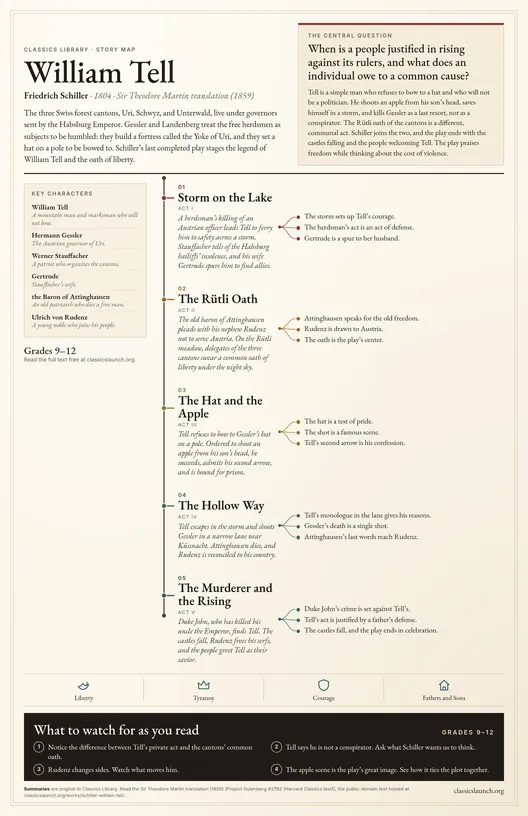 Story mapSee the story mapThe whole book on one page: the story in movements, the characters, and what to watch for. Free to print.
Abstract
Background. Schiller, the great dramatist of German classicism, wrote this last finished play in the last years of his life, drawing on the Swiss legend of the archer and on a Swiss chronicle. It was first staged in Weimar in March 1804, to wide acclaim.
Plot. Three Swiss valleys suffer under cruel Habsburg governors and swear on a meadow to defend their freedom. An archer who wants no part of politics is made to shoot an apple from his son's head, then escapes and kills the governor. The valleys rise as one.
Ideas. The play weighs the right of resistance against its limits, joining oath, law and trust in God to the claim of freedom. It also asks whether private virtue can stand aside from public wrong, and sets a justified killing beside a murder.
Text. This is Sir Theodore Martin's verse translation of 1859 in the Harvard Classics text, with stage directions in brackets. The five acts are of unequal length, and the language is stately and dignified. The hosted text is complete as printed here, with its section headings kept as a guide to the reader, and every quotation on this page is drawn directly from that text. Teachers can pair this work with the library's study guide, seminar questions and memory-work selection to prepare a discussion, a short essay or a recitation.
Main characters
- William Tell: A hunter and master archer of Uri
- Gessler: The Habsburg governor of Schwyz and Uri
- Stauffacher: A prudent householder of Schwyz
- Gertrude: His courageous wife
- Rudenz: A young noble who turns from Austria
- Attinghausen: The dying baron and patriot
Summary
William Tell is Schiller's last completed play and, for many readers, his most stirring. It stages the legend of the three Swiss forest cantons, Uri, Schwyz and Unterwald, whose free herdsmen live under the governors sent by the Habsburg Emperor. Gessler and Landenberg treat the mountain people as subjects to be humbled: they build a fortress called the Yoke of Uri, they set a hat on a pole for all to bow to, and their men commit private outrages that no court will punish. In the first act a peasant, Baumgarten, kills an official who tried to violate his wife and is carried over a storm-whipped lake by Tell, the one man brave enough. Werner Stauffacher, shamed into action by his wife Gertrude, travels to Uri and Unterwald, and the three cantons meet at night on the Rütli meadow, where they swear a solemn oath to be one people, to defend their ancient liberties, and to shed no blood that is not needed. Tell himself is not at first a conspirator. He is a hunter and a father who prefers to mind his own affairs, and he declines to join the council because he trusts only his own arm. His quarrel with the tyrant comes by accident. He will not bow to the hat, and Gessler, learning that he is the best archer in the country, orders him to shoot an apple from his son's head. Tell obeys, strikes the apple, and then confesses that a second arrow was meant for the governor had he hurt the boy. Gessler has him chained for a voyage to the fortress, a storm rises, Tell is unbound to steer, leaps ashore, and waits in a narrow hollow way to kill the tyrant as he rides past. Meanwhile the old Baron of Attinghausen dies urging his nephew Rudenz, who has been drawn toward the Austrian court, to remain with his own people. Rudenz repents and joins the rising. In the last act the Emperor is murdered by his nephew, Duke John, who comes to Tell as a fugitive. Tell, who has killed to save his family, will not let the murderer confuse the two deeds, but he sends him on the road to Rome to seek forgiveness. The cantons rise, the castles fall, and Rudenz frees his serfs. The play is a defence of resistance to tyranny that is also a defence of limits: Schiller's heroes appeal to an order higher than the ruler's will, take the sword only when every other remedy is gone, and ground their freedom in family, oath and trust in God. Teachers should note that the play contains one assassination and a child at risk.
Virtues in this work
- Fortitude: Tell holds his nerve under the most terrible test a father can face, and the cantons keep their resolve in the face of overwhelming force.
- Justice: The Rütli oath binds the cantons to defend their ancient rights and to spare needless bloodshed.
- Faith: The delegates swear to trust in God and not to fear the might of man.
- Magnanimity: Tell sends the murderer John toward Rome and absolution instead of seeking vengeance.
- Friendship: The delegates swear to be brothers who will not part in danger or in death.
Plot or Argument
- Act I: Storm on the lake and the first stirrings
A herdsman's killing of an Austrian officer leads Tell to ferry him to safety across a storm. Stauffacher tells of the Habsburg bailiffs' insolence, and his wife Gertrude spurs him to find allies.
- Act II: Attinghausen, Rudenz and the Rütli oath
The old baron pleads with his nephew Rudenz not to serve Austria. On the Rütli meadow, delegates of the three cantons swear a common oath of liberty under the night sky.
- Act III: The hat and the apple
Tell refuses to bow to Gessler's hat on a pole. Ordered to shoot an apple from his son's head, he succeeds, admits his second arrow, and is bound for prison.
- Act IV: The hollow way and the death of Attinghausen
Tell escapes in the storm and shoots Gessler in a narrow lane near Küssnacht. Attinghausen dies, and Rudenz is reconciled to his country.
- Act V: The murderer and the rising
Duke John, who has killed his uncle the Emperor, finds Tell. The castles fall, Rudenz frees his serfs, and the people greet Tell as their saviour.
Characters
- William Tell, title hero
A mountain hunter and archer, a plain and self-reliant man, who comes to action when his family is threatened.
- Hermann Gessler, antagonist
The Habsburg governor of Schwyz and Uri, who rules by humiliation and sets the hat on the pole.
- Werner Stauffacher, patriot
A Schwyz householder, wise and cautious, who organises the league with the help of his wife.
- Gertrude, wife of Stauffacher
A courageous woman who tells her husband that there is a friend of innocence in heaven.
- Baron of Attinghausen, old patriarch
The aged free noble who dies urging his nephew to stand with his own people.
- Ulrich von Rudenz, young noble
The baron's nephew, torn between Austrian favour and the cause of his country.
Lessons
Resistance to tyranny needs both courage and limits
The Rütli oath binds the cantons to defend their ancient liberties, to spill no blood needlessly, and to trust in God. Schiller lets Reding appeal to rights “indestructible as are the stars”, and he makes the sword the last remedy, not the first.
- What limits do the delegates put on the use of force?
- What does the appeal to an order above the ruler tell us about the source of freedom?
A good man may be forced to act
Tell wants to stay out of politics and says the strong man is strongest alone. It is the hat, the apple and the threat to his child that make him act, and Schiller asks whether private virtue can ever stay neutral when injustice comes near.
- Why does Tell refuse the council at first?
- Is his later deed an act of politics or of fatherhood?
Tell is not a murderer
Tell kills Gessler, and Duke John kills the Emperor. Schiller sets the two killings side by side so that the audience will see the difference between defence of the innocent and the settling of private grievance.
- How does Tell explain his deed to Duke John?
- Why does Tell send John to Rome?
Context
The play is set in the early fourteenth century, when the forest cantons of central Switzerland defended their imperial privileges against the Habsburg dukes of Austria. The Rütli oath of 1291 and the figure of Tell belong to a legend first written down in the fifteenth century and later made the national myth of the Swiss.
Composition
Schiller wrote the play in 1803–04, in Weimar, after Goethe had suggested the subject and sent him notes from Switzerland. It was first staged at Weimar on 17 March 1804, a year before Schiller's death.
Reception
The play was an immediate success and became a staple of German schools and theatres. It was banned or edited in several despotisms, and Rossini's opera of 1829 carried its story across Europe.
Comparisons
- Julius Caesar
Shakespeare's tragedy also asks when killing a ruler is justified, and answers with sorrow, where Schiller answers with a limited yes.
- Hamlet
Both plays set private duty against public disorder, but Tell acts at once where Hamlet delays.
- The Prince
Machiavelli's handbook for rulers is the other side of the argument Schiller's tyrant Gessler illustrates.
- The Life of Friedrich Schiller
Carlyle's life of the poet, hosted in this library, places William Tell among his last works.
- A Tale of Two Cities
Dickens writes of a revolution against tyranny that ends in a new terror, which Schiller's more restrained Swiss oath is meant to avoid.
Quotes
Frequently cited
“But the strong man is strongest when alone.”
Frequently cited
“Yes! there's a limit to the despot's power! When the oppress'd for justice looks in vain, When his sore burden may no more be borne, With fearless heart he makes appeal to Heaven, And thence brings down his everlasting rights, Which there abide, inalienably his, And indestructible as are the stars. Nature's primaeval state returns again, Where man stands hostile to his fellow man; And if all other means shall fail his need, One last resource remains--his own good sword.”
Frequently cited
“A band of brothers true we swear to be, Never to part in danger or in death! [They repeat his words with three fingers raised.] We swear we will be free as were our sires, And sooner die than live in slavery!”
“There is a Friend to innocence in heaven. Send your gaze forward, Werner--not behind.”
“If that my hand had struck my darling child, This second arrow I had aimed at you, And, be assured, I should not then have miss'd.”
“Cling to the land, the dear land of thy sires, Grapple to that with thy whole heart and soul! Thy power is rooted deep and strongly here, But in yon stranger world thou'lt stand alone, A trembling reed beat down by every blast.”
For Students
A reading companion for classical Christian high school students. See the student guide.
Reading Guide
Watch for
- How each of the three cantons enters the story and what each contributes to the oath.
- The difference between Tell's private reasons and the cantons' public reasons for action.
- Every mention of God, heaven or the stars as the court of last appeal.
Key terms and names
- Rütli
- The meadow above Lake Lucerne where, by tradition, the three cantons swore their first oath of alliance.
- Bailiff (Vogt)
- An imperial governor sent to administer justice and collect dues in the name of the Emperor.
- Habsburg
- The Austrian ruling house whose dukes sought to turn the free Swiss valleys into hereditary lands.
- Parricide
- The killing of a near relative, here the murder of the Emperor by his nephew Duke John.
Seminar Questions
- Comprehension What do the three cantons swear on the Rütli, and what do they promise not to do?
- Comprehension What does Gessler order Tell to do, and why does Tell keep a second arrow?
- Interpretation Why does Schiller let Tell refuse the council in Act I and then act alone in Act IV?
- Interpretation How does Schiller make Rudenz's change of heart plausible?
- Interpretation What difference does Tell see between his deed and Duke John's?
- Big Question When, if ever, is armed resistance to a ruler just?
- Big Question Can a man stay neutral in the face of injustice?
Faith Connections
- Romans 13:1–4 (Scripture)
Paul tells believers to be subject to the governing authorities as God's servants for good. Schiller's tyrant has abandoned that office, and the play asks what Christians owe a ruler who does evil.
- Acts 5:29 (Scripture)
'We must obey God rather than men.' The Rütli oath rests on the same priority.
- Thomas Aquinas, Summa Theologiae I-II q. 96 (Great Conversation)
Aquinas holds that a law contrary to the common good is no true law; Schiller's Reding speaks of rights that are indestructible, which no ruler can cancel.
Logic and Rhetoric
Central argument: When a ruler turns authority into humiliation and violence, the people have an inalienable right of last resort, but must use it with an oath, a limit and trust in God.
Rhetorical device: oath as dramatic form. The Rütli scene turns political argument into a shared ritual, so that the audience hears the cause as promise and not mere complaint.
Debate: Resolved: That the Rütli oath justifies armed resistance to a lawful but cruel ruler.
Memory Work
A band of brothers true we swear to be, Never to part in danger or in death! [They repeat his words with three fingers raised.] We swear we will be free as were our sires, And sooner die than live in slavery!
Yes! there's a limit to the despot's power! When the oppress'd for justice looks in vain, When his sore burden may no more be borne, With fearless heart he makes appeal to Heaven, And thence brings down his everlasting rights, Which there abide, inalienably his, And indestructible as are the stars. Nature's primaeval state returns again, Where man stands hostile to his fellow man; And if all other means shall fail his need, One last resource remains--his own good sword.
Writing Prompts
Essay: Tell says that the strong man is strongest alone, yet the play ends with a united people. Which view does Schiller finally endorse?
Comparison with Julius Caesar: Compare Tell's killing of Gessler with the killing of Caesar. How does each play judge the act and its motives?
Creative Prompts
- Essay
Explain how Schiller makes Tell a reluctant hero. Use his refusal of the council and his speech after the apple shot.
- Classroom
Stage the Rütli oath as a class and then discuss why Schiller makes the delegates promise to spare lives and trust God.
- Dialogue
Write a conversation between Tell and Duke John in which Tell explains the difference between his act and the murder of the Emperor.
Further Reading
- The Life of Friedrich Schiller, Thomas Carlyle
Carlyle's early biography, hosted in this library.
- Wallenstein, Friedrich Schiller
Schiller's great historical trilogy, a counterpart on power and loyalty.
- The Revolt of the Netherlands, Friedrich Schiller
Schiller's history of another successful rising against a foreign ruler.
Verification notes
Full text from Project Gutenberg, Sir Theodore Martin's English verse translation of 1859, in public domain. Quotes were checked against the hosted text. Plot details were checked against the same edition; interpretive claims are the library's own reading.
- Exact date of the first edition of Martin's translation as hosted.
- Whether the Harvard Classics text altered any lines of the 1859 translation.