Story maps · Grades 10–12
The Histories: A Story Map
The PDF is one tabloid page (11 × 17 in). On letter paper, choose “Fit to page.”
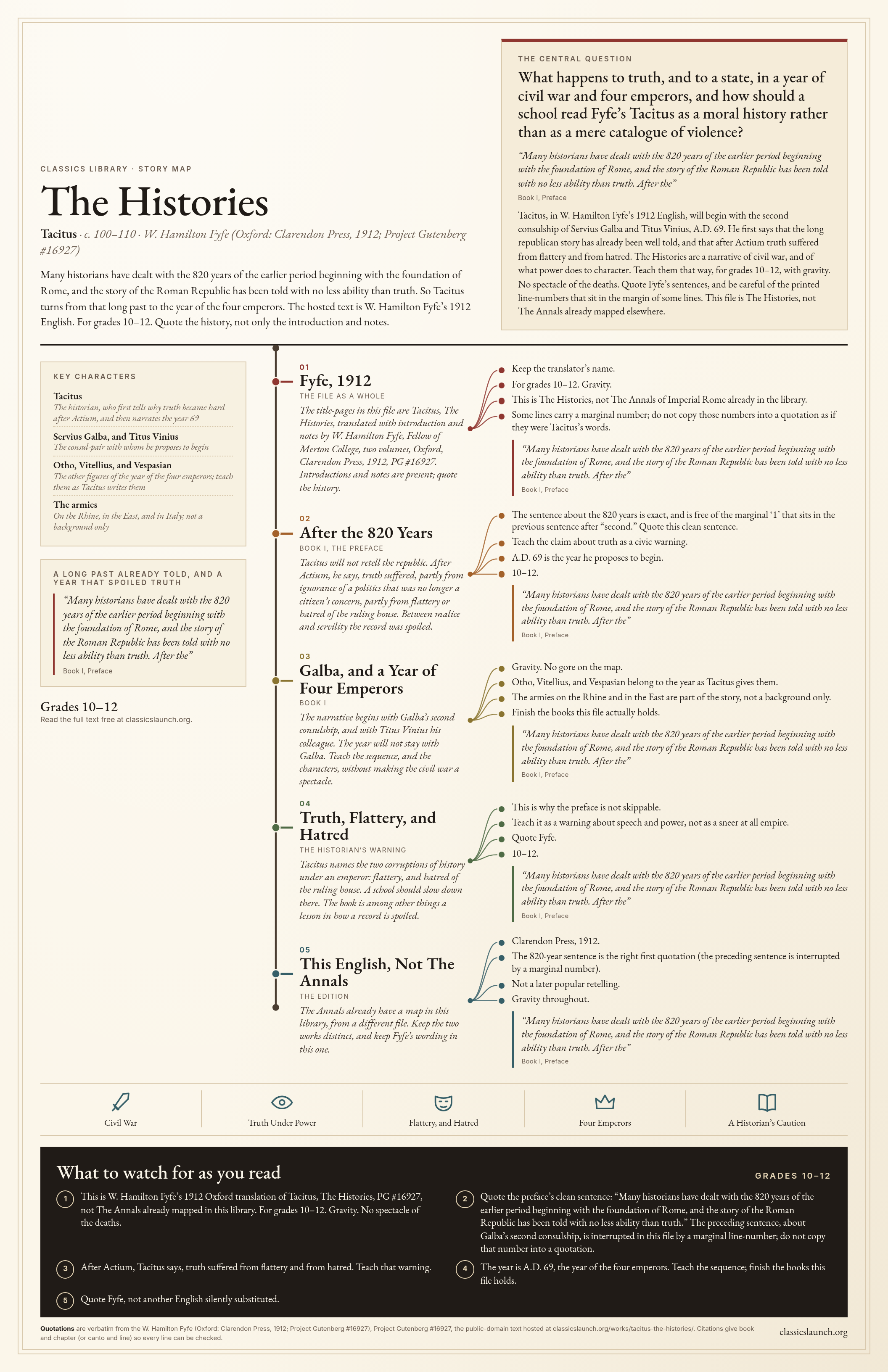
Many historians have dealt with the 820 years of the earlier period beginning with the foundation of Rome, and the story of the Roman Republic has been told with no less ability than truth. So Tacitus turns from that long past to the year of the four emperors. The hosted text is W. Hamilton Fyfe’s 1912 English. For grades 10–12. Quote the history, not only the introduction and notes.
The central question
What happens to truth, and to a state, in a year of civil war and four emperors, and how should a school read Fyfe’s Tacitus as a moral history rather than as a mere catalogue of violence?
“Many historians have dealt with the 820 years of the earlier period beginning with the foundation of Rome, and the story of the Roman Republic has been told with no less ability than truth. After the”
Tacitus, in W. Hamilton Fyfe’s 1912 English, will begin with the second consulship of Servius Galba and Titus Vinius, A.D. 69. He first says that the long republican story has already been well told, and that after Actium truth suffered from flattery and from hatred. The Histories are a narrative of civil war, and of what power does to character. Teach them that way, for grades 10–12, with gravity. No spectacle of the deaths. Quote Fyfe’s sentences, and be careful of the printed line-numbers that sit in the margin of some lines. This file is The Histories, not The Annals already mapped elsewhere.
- 01
Fyfe, 1912
The file as a whole
The title-pages in this file are Tacitus, The Histories, translated with introduction and notes by W. Hamilton Fyfe, Fellow of Merton College, two volumes, Oxford, Clarendon Press, 1912, PG #16927. Introductions and notes are present; quote the history.
- Keep the translator’s name.
- For grades 10–12. Gravity.
- This is The Histories, not The Annals of Imperial Rome already in the library.
- Some lines carry a marginal number; do not copy those numbers into a quotation as if they were Tacitus’s words.
“Many historians have dealt with the 820 years of the earlier period beginning with the foundation of Rome, and the story of the Roman Republic has been told with no less ability than truth. After the”
- 02
After the 820 Years
Book I, the preface
Tacitus will not retell the republic. After Actium, he says, truth suffered, partly from ignorance of a politics that was no longer a citizen’s concern, partly from flattery or hatred of the ruling house. Between malice and servility the record was spoiled.
- The sentence about the 820 years is exact, and is free of the marginal ‘1’ that sits in the previous sentence after “second.” Quote this clean sentence.
- Teach the claim about truth as a civic warning.
- A.D. 69 is the year he proposes to begin.
- 10–12.
“Many historians have dealt with the 820 years of the earlier period beginning with the foundation of Rome, and the story of the Roman Republic has been told with no less ability than truth. After the”
- 03
Galba, and a Year of Four Emperors
Book I
The narrative begins with Galba’s second consulship, and with Titus Vinius his colleague. The year will not stay with Galba. Teach the sequence, and the characters, without making the civil war a spectacle.
- Gravity. No gore on the map.
- Otho, Vitellius, and Vespasian belong to the year as Tacitus gives them.
- The armies on the Rhine and in the East are part of the story, not a background only.
- Finish the books this file actually holds.
“Many historians have dealt with the 820 years of the earlier period beginning with the foundation of Rome, and the story of the Roman Republic has been told with no less ability than truth. After the”
- 04
Truth, Flattery, and Hatred
The historian’s warning
Tacitus names the two corruptions of history under an emperor: flattery, and hatred of the ruling house. A school should slow down there. The book is among other things a lesson in how a record is spoiled.
- This is why the preface is not skippable.
- Teach it as a warning about speech and power, not as a sneer at all empire.
- Quote Fyfe.
- 10–12.
“Many historians have dealt with the 820 years of the earlier period beginning with the foundation of Rome, and the story of the Roman Republic has been told with no less ability than truth. After the”
- 05
This English, Not The Annals
The edition
The Annals already have a map in this library, from a different file. Keep the two works distinct, and keep Fyfe’s wording in this one.
- Clarendon Press, 1912.
- The 820-year sentence is the right first quotation (the preceding sentence is interrupted by a marginal number).
- Not a later popular retelling.
- Gravity throughout.
“Many historians have dealt with the 820 years of the earlier period beginning with the foundation of Rome, and the story of the Roman Republic has been told with no less ability than truth. After the”
- Civil War
- Truth Under Power
- Flattery, and Hatred
- Four Emperors
- A Historian’s Caution
What to watch for as you read
Grades 10–12- This is W. Hamilton Fyfe’s 1912 Oxford translation of Tacitus, The Histories, PG #16927, not The Annals already mapped in this library. For grades 10–12. Gravity. No spectacle of the deaths.
- Quote the preface’s clean sentence: “Many historians have dealt with the 820 years of the earlier period beginning with the foundation of Rome, and the story of the Roman Republic has been told with no less ability than truth.” The preceding sentence, about Galba’s second consulship, is interrupted in this file by a marginal line-number; do not copy that number into a quotation.
- After Actium, Tacitus says, truth suffered from flattery and from hatred. Teach that warning.
- The year is A.D. 69, the year of the four emperors. Teach the sequence; finish the books this file holds.
- Quote Fyfe, not another English silently substituted.
Every quotation is word for word from the W. Hamilton Fyfe (Oxford: Clarendon Press, 1912; Project Gutenberg #16927) hosted in this library and is checked against that text each time the site is built. Citations give book and chapter (or canto and line).