Story maps · Grades 3–5
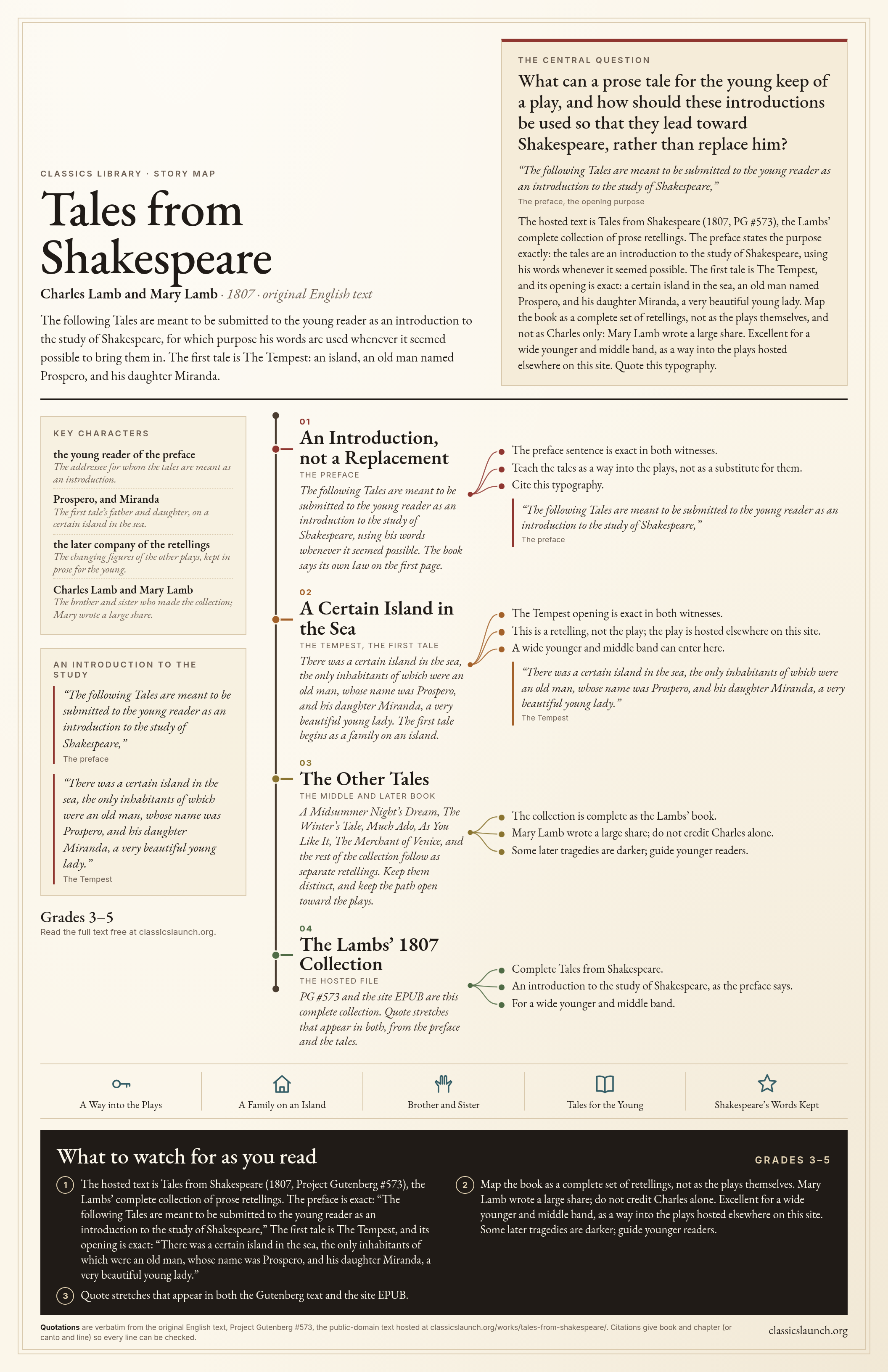
Tales from Shakespeare: A Story Map
The PDF is one tabloid page (11 × 17 in). On letter paper, choose “Fit to page.”
The following Tales are meant to be submitted to the young reader as an introduction to the study of Shakespeare, for which purpose his words are used whenever it seemed possible to bring them in. The first tale is The Tempest: an island, an old man named Prospero, and his daughter Miranda.
The central question
What can a prose tale for the young keep of a play, and how should these introductions be used so that they lead toward Shakespeare, rather than replace him?
“The following Tales are meant to be submitted to the young reader as an introduction to the study of Shakespeare,”
The hosted text is Tales from Shakespeare (1807, PG #573), the Lambs’ complete collection of prose retellings. The preface states the purpose exactly: the tales are an introduction to the study of Shakespeare, using his words whenever it seemed possible. The first tale is The Tempest, and its opening is exact: a certain island in the sea, an old man named Prospero, and his daughter Miranda, a very beautiful young lady. Map the book as a complete set of retellings, not as the plays themselves, and not as Charles only: Mary Lamb wrote a large share. Excellent for a wide younger and middle band, as a way into the plays hosted elsewhere on this site. Quote this typography.
- 01
An Introduction, not a Replacement
The preface
The following Tales are meant to be submitted to the young reader as an introduction to the study of Shakespeare, using his words whenever it seemed possible. The book says its own law on the first page.
- The preface sentence is exact in both witnesses.
- Teach the tales as a way into the plays, not as a substitute for them.
- Cite this typography.
“The following Tales are meant to be submitted to the young reader as an introduction to the study of Shakespeare,”
- 02
A Certain Island in the Sea
The Tempest, the first tale
There was a certain island in the sea, the only inhabitants of which were an old man, whose name was Prospero, and his daughter Miranda, a very beautiful young lady. The first tale begins as a family on an island.
- The Tempest opening is exact in both witnesses.
- This is a retelling, not the play; the play is hosted elsewhere on this site.
- A wide younger and middle band can enter here.
“There was a certain island in the sea, the only inhabitants of which were an old man, whose name was Prospero, and his daughter Miranda, a very beautiful young lady.”
- 03
The Other Tales
The middle and later book
A Midsummer Night’s Dream, The Winter’s Tale, Much Ado, As You Like It, The Merchant of Venice, and the rest of the collection follow as separate retellings. Keep them distinct, and keep the path open toward the plays.
- The collection is complete as the Lambs’ book.
- Mary Lamb wrote a large share; do not credit Charles alone.
- Some later tragedies are darker; guide younger readers.
- 04
The Lambs’ 1807 Collection
The hosted file
PG #573 and the site EPUB are this complete collection. Quote stretches that appear in both, from the preface and the tales.
- Complete Tales from Shakespeare.
- An introduction to the study of Shakespeare, as the preface says.
- For a wide younger and middle band.
- A Way into the Plays
- A Family on an Island
- Brother and Sister
- Tales for the Young
- Shakespeare’s Words Kept
What to watch for as you read
Grades 3–5- The hosted text is Tales from Shakespeare (1807, Project Gutenberg #573), the Lambs’ complete collection of prose retellings. The preface is exact: “The following Tales are meant to be submitted to the young reader as an introduction to the study of Shakespeare,” The first tale is The Tempest, and its opening is exact: “There was a certain island in the sea, the only inhabitants of which were an old man, whose name was Prospero, and his daughter Miranda, a very beautiful young lady.”
- Map the book as a complete set of retellings, not as the plays themselves. Mary Lamb wrote a large share; do not credit Charles alone. Excellent for a wide younger and middle band, as a way into the plays hosted elsewhere on this site. Some later tragedies are darker; guide younger readers.
- Quote stretches that appear in both the Gutenberg text and the site EPUB.
Every quotation is word for word from the original English text hosted in this library and is checked against that text each time the site is built. Citations give book and chapter (or canto and line).