Work record
Tales from Shakespeare
1807 · 19th Century · Short Stories · English
Abstract
Background. Commissioned for the Godwins' Juvenile Library, the book was a household collaboration between an East India House clerk and his elder sister, written at a single table during a calm period in Mary's recurring illness.
Content. Each play becomes a short story told in order of its action, with Shakespeare's phrasing woven in wherever possible. The sequence opens on Prospero's island and closes in Ephesus with Pericles, passing through Arden, Messina, Illyria and Vienna before Charles's half turns to Lear's heath, Inverness, Athens, Verona, Elsinore and Cyprus.
Form. Mary's comedies lean on dialogue because their wit resisted narration; Charles's tragedies run as continuous narrative in which Shakespeare's verse often survives nearly intact. Subplots are pared away: Gloucester's story in Lear shrinks to a few late sentences about his scheming son Edmund, and in the Dream the workmen's rehearsals vanish, leaving Bottom as an unnamed clown whom Titania adores for one night.
Themes. Flattery against honest love, mercy tempering law, guilt that destroys rest, disguise and recognition, and families broken and mended over long years.
Significance. For two centuries it has served as the usual doorway to Shakespeare for young English-speaking readers, and its preface remains a small classic on adapting great literature for the young without condescension.
Main characters
- Prospero and Miranda: Magician-duke and his daughter on the enchanted island
- Leontes and Hermione: Jealous king of Sicily and the wronged queen restored as a statue
- Portia: Belmont heiress who argues Antonio's case in a lawyer's gown
- King Lear and Cordelia: Flattered old king and the plain-spoken daughter who nurses him
- Macbeth: Regicide haunted by a voice that forbids him sleep
- Viola: Shipwrecked twin disguised as a page in Illyria
- Hamlet: Danish prince charged by his father's ghost to avenge him
- Pericles and Thaisa: Storm-parted prince and queen reunited at Diana's temple

Summary
Tales from Shakespeare retells twenty of Shakespeare's plays as prose stories for children. A short preface explains the method: the authors keep Shakespeare's own words wherever they can, avoid words that came into English after his time, and hope the tales will send young readers on to the plays themselves when they are older. Fourteen tales come from the comedies and romances. In The Tempest, Prospero, the exiled duke of Milan, lives on an enchanted island with his daughter Miranda, the spirit Ariel and the monster Caliban; he raises a storm, brings his enemies ashore, matches Miranda with Ferdinand, forgives his brother and gives up his magic. A Midsummer Night's Dream follows Hermia, Lysander, Helena and Demetrius into a wood where Puck's love-juice tangles their affections and Titania dotes on a clown with an ass's head. In The Winter's Tale, the jealous Leontes accuses his queen Hermione, loses his son and casts out his baby daughter Perdita, who grows up among shepherds; years later Paulina's statue of the queen comes to life. The other comedies are Much Ado About Nothing (Beatrice and Benedick, and Hero falsely shamed), As You Like It (Rosalind disguised as Ganymede in the Forest of Arden), The Two Gentlemen of Verona, The Merchant of Venice (Portia's plea for mercy and Shylock's bond defeated), Cymbeline (Imogen's constancy and a sleeping drug mistaken for poison), All's Well That Ends Well (the physician's daughter Helena cures the king of France), The Taming of the Shrew, The Comedy of Errors (two pairs of twins), Measure for Measure (Isabel pleads for her brother Claudio) and Twelfth Night (Viola as Cesario). The book closes with Pericles, Prince of Tyre, in which the physician Cerimon revives Pericles' queen Thaisa from apparent death and the family is reunited at Diana's temple. Six tales come from the tragedies. King Lear divides his kingdom between his flattering daughters Goneril and Regan, disowns the honest Cordelia, goes mad on the heath, and is restored by her physicians before both die. Macbeth murders King Duncan at his wife's urging, hears a voice crying that he has murdered sleep, and falls to Macduff. Timon of Athens gives away his fortune and turns against mankind. Romeo and Juliet ends with the two families burying their feud in their children's graves. Hamlet avenges his father and dies asking Horatio to tell his story. Othello is deceived by Iago into killing the faithful Desdemona. Mary Lamb wrote the comedies and Charles the tragedies. The book was published for William Godwin's Juvenile Library in two volumes dated 1807, with only Charles's name on the title page, and it has stayed in print ever since as the most widely used introduction to Shakespeare for children.
Virtues in this work
- Honor: Cordelia refuses to flatter Lear for a share of his kingdom and tells him only that she loves him as a daughter should.
- Charity: Portia begs Shylock to show mercy before she ever turns the law against him.
- Piety: Cordelia returns from France to nurse her mad father and pays his physicians with her own gold and jewels.
- Prudence: Paulina keeps Hermione hidden for many years until Perdita is found and Leontes has truly repented.
Plot or Argument
- Preface
The authors explain that they have used Shakespeare's words wherever possible, that the comedies needed more dialogue than the tragedies, and that the tales are meant as small coins drawn from a great treasury, to be followed by the plays themselves.
- The Tempest and A Midsummer Night's Dream
Prospero's island, Ariel's tricks and Caliban's labors lead to a storm, a shipwreck that harms no one, Miranda's betrothal to Ferdinand and Prospero's forgiveness of his brother. In the Athenian wood, Oberon and Puck confuse four lovers with a magic flower before setting all right, and the narrator suggests that readers who find the story incredible may treat it as a dream.
- The Winter's Tale and Much Ado About Nothing
Leontes' sudden jealousy costs him his queen, his son Mamillius and his infant daughter, until Perdita returns as a shepherdess and Hermione's statue steps down alive. In Messina, Hero is shamed at the altar by Don John's plot, and Beatrice and Benedick are tricked into confessing their love.
- As You Like It, The Two Gentlemen of Verona and The Merchant of Venice
Rosalind and Celia flee to Arden, where Orlando woos Ganymede; Proteus betrays his friend Valentine and is forgiven; Portia, disguised as the young doctor Balthasar, saves Antonio from Shylock's pound of flesh by holding the bond to its letter.
- Cymbeline and King Lear
Imogen, slandered and banished, survives a sleeping draught meant as poison and is reunited with Posthumus and her lost brothers. Lear's test of love drives out Cordelia and the faithful Kent; cast off by Goneril and Regan, he wanders mad in the storm until Cordelia's physicians calm him with sleep and herbs, before both perish.
- Macbeth, All's Well That Ends Well and The Taming of the Shrew
The witches' prophecy, Duncan's murder and the voice crying sleep no more lead to Macbeth's death at Macduff's hand. Helena cures the king of France with her father's prescription and wins the unwilling Bertram; Petruchio tames Katharine of Padua.
- The Comedy of Errors, Measure for Measure and Twelfth Night
Two sets of twins are mistaken for each other in Ephesus until their parents are reunited; Isabel refuses Angelo's price for her brother's life while the disguised Duke watches over Vienna; Viola, shipwrecked and dressed as Cesario, carries Orsino's suit to Olivia.
- Timon of Athens, Romeo and Juliet, Hamlet and Othello
Charles Lamb's tragedies follow Timon's ruin and misanthropy, the Verona lovers and their families' late reconciliation, Hamlet's revenge and death with Horatio left to tell the story, and Othello's murder of Desdemona under Iago's deceit.
- Pericles, Prince of Tyre
Storms part Pericles from his wife Thaisa and daughter Marina; Cerimon revives Thaisa, Marina keeps her virtue through captivity, and the three meet again at Diana's temple in Ephesus. The closing paragraph draws the moral of virtue tried by calamity.
Characters
- Prospero, The Tempest
Exiled duke and magician who commands Ariel, forgives his enemies and gives up his art.
- Miranda, The Tempest
Prospero's daughter, who pities the shipwrecked sailors and loves Ferdinand.
- Puck, A Midsummer Night's Dream
Oberon's mischievous servant, who puts the love-juice in the wrong eyes.
- Hermione, The Winter's Tale
Falsely accused queen who is hidden for many years and returns as a living statue.
- Portia, The Merchant of Venice
Heiress of Belmont who disguises herself as a young lawyer to save Antonio.
- Shylock, The Merchant of Venice
Moneylender who demands a pound of Antonio's flesh and is defeated by the letter of his own bond.
- King Lear, King Lear
Aged king who mistakes flattery for love, goes mad, and is restored to Cordelia.
- Cordelia, King Lear
Lear's youngest daughter, who will not flatter him and returns to nurse him.
- Macbeth, Macbeth
Scottish general who murders his king and can no longer sleep.
- Helena, All's Well That Ends Well
Daughter of the physician Gerard de Narbon, who cures the king of France.
- Viola, Twelfth Night
Shipwrecked twin who serves Orsino disguised as the page Cesario.
- Hamlet, Hamlet, Prince of Denmark
Danish prince who avenges his father's murder and dies in the attempt.
- Cerimon, Pericles, Prince of Tyre
Skilful physician of Ephesus who revives Thaisa from apparent death.
Lessons
Flattery and true love
Goneril and Regan win their father's kingdom with fine words, while Cordelia, who loves him most, will only say she loves him as a daughter should. The tale shows that loud promises can hide empty hearts, and that plain honesty may cost a great deal before it is proved true.
- Why does Cordelia refuse to make a big speech like her sisters?
- How do Goneril and Regan treat their father once they have his land?
- Who stays loyal to Lear when he has nothing left to give?
Mercy is greater than the letter of the law
Portia tells Shylock that mercy blesses the one who gives it and the one who receives it, and that earthly power is most like God's when mercy softens justice. When Shylock will not show mercy, the same strict law he relied on turns against him.
- Why does Portia ask Shylock for mercy before she says anything about the law?
- How does Portia save Antonio without breaking the bond?
- When have you been shown mercy you did not deserve?
Forgiveness after long sorrow
Several tales end with forgiveness after years of grief: Prospero pardons his brother, Hermione forgives Leontes, and Pericles finds the wife and daughter he thought were lost. Mary Lamb's comedies show that wrongs can be repaired, though often only after patience and repentance.
- What does Leontes do during the many years he believes Hermione is dead?
- Why do you think Prospero chooses to forgive instead of taking revenge?
- Which reunion in the book did you find the most joyful, and why?
Guilt that will not let a person rest
After he kills Duncan, Macbeth hears a voice crying that he has murdered sleep, and his crime only leads to more crimes. Charles Lamb keeps Shakespeare's picture of a conscience that a king's crown cannot quiet.
- What does the voice Macbeth hears say, and why does it frighten him?
- How is Macbeth's life different after he becomes king?
Context
In the early nineteenth century Shakespeare's plays were performed constantly but read mainly by adults, and girls in particular were seldom given free run of their fathers' libraries, as the preface notes. The Lambs wrote for William Godwin's Juvenile Library, a London children's publishing venture run by Godwin and his second wife Mary Jane, which aimed to give children imaginative books rather than only moral tracts.
Composition
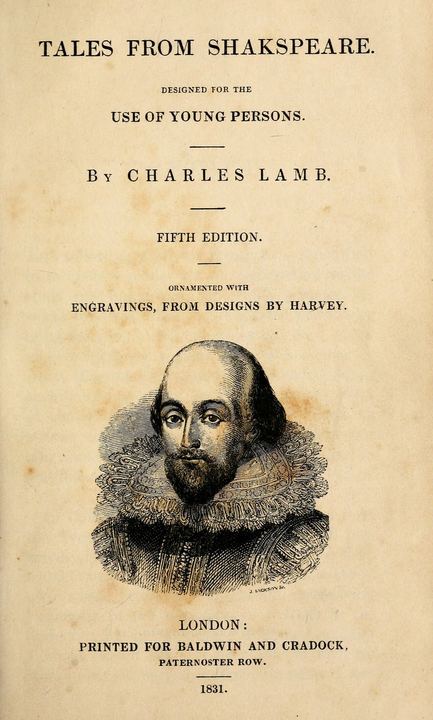
Mary Lamb wrote the fourteen comedies and romances and Charles the six tragedies, working at home in 1806; Mary described the two of them writing at one table. The book appeared in two volumes dated 1807, with engraved plates after designs by William Mulready, and only Charles was named as author on the title page. Mary's name was added in later editions.
Reception
The tales sold well from the start and went through many editions in the nineteenth century, becoming the standard way English-speaking children first met Shakespeare's stories. Their language, close to Shakespeare's own in the tragedies, has kept them in print and in classrooms for more than two hundred years.
Comparisons
- king-lear
Charles Lamb's tale keeps the storm, the madness and Cordelia's death but shrinks the Gloucester subplot to a few late sentences about his son Edmund, so reading the play afterward shows how fully Shakespeare doubled his story of a deceived father.
- a-midsummer-nights-dream
Mary Lamb leaves out the workmen's play of Pyramus and Thisbe almost entirely, keeping only Bottom as a nameless clown, and borrows Puck's closing apology for her own last paragraph.
- the-merchant-of-venice
The tale turns Portia's verse speech on the quality of mercy into reported prose, a clear example of the preface's admission that the comedies were hardest to bring into narrative.
- macbeth
The tale preserves the voice crying sleep no more almost word for word, so it is a natural first step toward reading the play's murder scene in Act 2.
- romeo-and-juliet
Charles Lamb ends with the fathers promising golden statues of each other's children, the same closing image as the play's last scene.
- the-story-of-king-arthur-and-his-knights
Howard Pyle, like the Lambs, retold an older body of English story for young readers in a deliberately antique style, aiming to lead them on to the originals.
Quotes
“There was a certain island in the sea, the only inhabitants of which were an old man, whose name was Prospero, and his daughter Miranda, a very beautiful young lady.”
“they have only to think that they have been asleep and dreaming, and that all these adventures were visions which they saw in their sleep”
“No wonder; for the statue was indeed Hermione herself, the real, the living queen.”
“mercy was a double blessing, it blessed him that gave, and him that received it”
“she loved his majesty according to her duty, neither more nor less.”
“by the help of sleep and medicine, she and her physicians at length succeeded in winding up the untuned and jarring senses which the cruelty of his other daughters had so violently shaken.”
“In the worthy Cerimon, who restored Thaisa to life, we are instructed how goodness directed by knowledge, in bestowing benefits upon mankind, approaches to the nature of the gods.”
“enrichers of the fancy, strengtheners of virtue, a withdrawing from all selfish and mercenary thoughts”
For Students
A reading companion for classical Christian high school students. See the student guide.
Reading Guide
Watch for
- How each tale begins with a plain sentence naming the main people and the place, as in the first line of The Tempest.
- Places where the Lambs slip Shakespeare's own lines into the story, such as the voice crying sleep no more in Macbeth.
- Characters who disguise themselves (Portia, Rosalind, Viola, Imogen), and what each disguise lets them do.
- Long-lost family members found again at the end of The Winter's Tale, The Comedy of Errors, Cymbeline and Pericles.
- The short moral the narrator sometimes gives at the end of a tale, as in the last paragraph of Pericles.
Key terms and names
- Comedy
- A play that ends happily, usually in marriages and reunions. Mary Lamb retold the fourteen comedies and romances in this book.
- Tragedy
- A play that ends in the death or downfall of its hero, like King Lear or Hamlet. Charles Lamb retold the six tragedies.
- The bond
- In The Merchant of Venice, the written agreement that lets Shylock take a pound of Antonio's flesh if a loan is not repaid.
- Love-juice
- The juice of a little purple flower in A Midsummer Night's Dream that makes a sleeper love the first thing seen on waking.
- Disguise
- Several heroines dress as young men, such as Viola as Cesario and Rosalind as Ganymede, to travel safely or to help someone they love.
- Prospero's art
- The magic Prospero learned from his books, which lets him command Ariel and the weather; he gives it up at the end of The Tempest.
Seminar Questions
- Comprehension What do Goneril and Regan say to King Lear, and what does Cordelia say instead?
- Comprehension How does Portia, dressed as a lawyer, keep Shylock from taking a pound of Antonio's flesh?
- Comprehension What happens when Paulina draws back the curtain in front of Hermione's statue?
- Interpretation Prospero could punish his brother for stealing his dukedom. Why do you think he forgives him instead?
- Interpretation Macbeth becomes king but can never sleep peacefully again. What is the story telling us about doing something wicked to get what we want?
- Interpretation Many heroines in the comedies wear disguises. Pick one and explain how her disguise helps the story end happily.
- Big Question Cordelia tells the truth and loses everything at first, while her sisters lie and gain a kingdom. Is it still better to be honest when honesty costs you?
Faith Connections
- Matthew 5:7 (Scripture)
Blessed are the merciful, for they shall obtain mercy. Portia's plea that mercy blesses both giver and receiver, and that we who pray for mercy should show it, follows the Beatitude and the Lord's Prayer closely.
- Proverbs 26:28 and 27:6 (Scripture)
A flattering mouth works ruin, and faithful are the wounds of a friend. Goneril and Regan's flattery and Cordelia's and Kent's plain speaking in King Lear act out these proverbs.
- Luke 15:11-32 (Scripture)
The father who runs to welcome a lost son home is echoed in the joyful reunions of The Winter's Tale and Pericles, where children thought lost are restored to their parents.
- Augustine, Confessions II (Great Conversation)
Augustine shows how a sin chosen for its own sake leaves the soul restless. Macbeth, who can no longer sleep after murdering Duncan, is a vivid picture of that restlessness.
Logic and Rhetoric
Central argument: The preface argues that children cannot yet read Shakespeare's plays with ease, that a story told largely in his own words gives them a foretaste of the plays, and that a foretaste will make them wish to read the plays in full; therefore these tales are a fit first step toward Shakespeare, which in turn can strengthen virtue and teach courtesy and generosity.
Rhetorical device: tricolon and accumulation. In the Preface the Lambs pile up phrases describing what the plays may become for their readers, enrichers of the fancy, strengtheners of virtue, a withdrawing from all selfish and mercenary thoughts, before listing courtesy, benignity, generosity and humanity.
Debate: Resolved: Children should read Shakespeare's stories retold before they read or watch the plays themselves.
Memory Work
mercy was a double blessing, it blessed him that gave, and him that received it
No wonder; for the statue was indeed Hermione herself, the real, the living queen.
Writing Prompts
Essay: Choose two daughters from the book, such as Cordelia and Miranda or Perdita and Marina, and explain what each one's love for her father leads her to do.
Comparison with King Lear: Read Charles Lamb's King Lear and then the first scene of Shakespeare's play. What did Lamb keep, what did he leave out, and how does the play's version of Cordelia's answer feel different from the tale's?
Medical Lens
The book matters to the history of psychiatry chiefly through its co-author. Mary Lamb suffered recurrent episodes of mental illness, killed her mother during one of them in 1796, and was spared a public asylum because Charles undertook to be her guardian; she spent periods in private madhouses for the rest of her life, and the Tales were written in an interval of health. The tales themselves carry Shakespeare's medicine into children's prose: Lear's madness is treated by Cordelia's physicians with sleep and herbs, a picture of the rest-and-soothing approach to mania that predates modern pharmacology; Helena cures the king of France with her dead father's prescription after his own physicians have pronounced him incurable; Cerimon revives Thaisa from apparent death; and both Cymbeline and Romeo and Juliet turn on drugs that counterfeit death. Retrospective labels for Mary Lamb's illness, often given as manic-depressive illness, are readings from letters and should be treated as interpretive.
- King Lear, after the storm
Cordelia's physicians put off her meeting with her father until sleep and herbal medicine restore some composure to his mind.
- King Lear, Kent's banishment
The narrator likens Lear to a frantic patient who kills his physician and loves his mortal disease.
- Macbeth, after Duncan's murder
Macbeth hears a voice crying that he has murdered sleep and shall sleep no more.
- All's Well That Ends Well, opening
Helena, the physician Gerard de Narbon's daughter, offers his prescription to the king whose doctors have called his malady incurable.
- Cymbeline, middle
The queen's physician, distrusting her, gives her a sleeping drug instead of the poison she asked for, and Imogen takes it.
- Pericles, Prince of Tyre
Cerimon, a skilful physician of Ephesus, revives Thaisa, who had been buried at sea in a chest.
Listen to the book
Public-domain audiobook from LibriVox, read by Karen Savage. Recording: Tales from Shakespeare on LibriVox (Internet Archive).
LibriVox recordings are volunteer readings released into the public domain. The reading may follow a different edition from the text in this library.
Creative Prompts
- Classroom
Choose one tale, read the matching scene in the full play, and make a two-column chart of the words the Lambs kept from Shakespeare and the words they changed.
- Fiction
Write Ariel's account of the storm in The Tempest, told to Prospero after every passenger has come safely ashore.
- Dialogue
Write the conversation between Paulina and Hermione during the long years the queen stayed hidden, as they hear news of Leontes' grief.
- Adaptation
Retell one of the twenty plays the Lambs left out, such as Julius Caesar or Henry V, in the style of their tales, keeping Shakespeare's words where you can.
Further Reading
- Shakespeare's Comedies, Histories, and Tragedies (the First Folio), William Shakespeare
The plays the tales are drawn from; any good modern school edition will serve.
- Essays of Elia, Charles Lamb
- Mrs. Leicester's School, Charles and Mary Lamb
The Lambs' other joint book for children, a collection of schoolgirls' stories.
- Mary and Charles Lamb: Their Lives, Writings and Letters, E. V. Lucas
- A Double Life: A Biography of Mary Lamb, Kathy Watson
Verification notes
The division of labor (Mary the fourteen comedies and romances, Charles the six tragedies), the Godwin Juvenile Library publication in two volumes dated 1807, and the absence of Mary's name from the first title page are well established. All quotations were checked as exact substrings of the Project Gutenberg #573 text in content/texts. The Gutenberg text has a few transcription slips (for example quality of merry for mercy in the Merchant tale), so quotations were chosen to avoid them. Mary Lamb's illness and the 1796 death of her mother are documented in Charles's letters and the coroner's verdict; any diagnosis is interpretive.
- Exact publication date: the book is dated 1807 but may have been on sale in December 1806 or January 1807.
- Whether William Blake engraved any of the plates after Mulready's designs, as is sometimes said.
- The first edition in which Mary Lamb's name appeared on the title page (often given as 1838).
- Whether E. V. Lucas's title for the Lambs' combined life and letters matches the edition intended.