Story maps · Grades 9–12
The Brothers (Adelphoe): A Story Map
The PDF is one tabloid page (11 × 17 in). On letter paper, choose “Fit to page.”
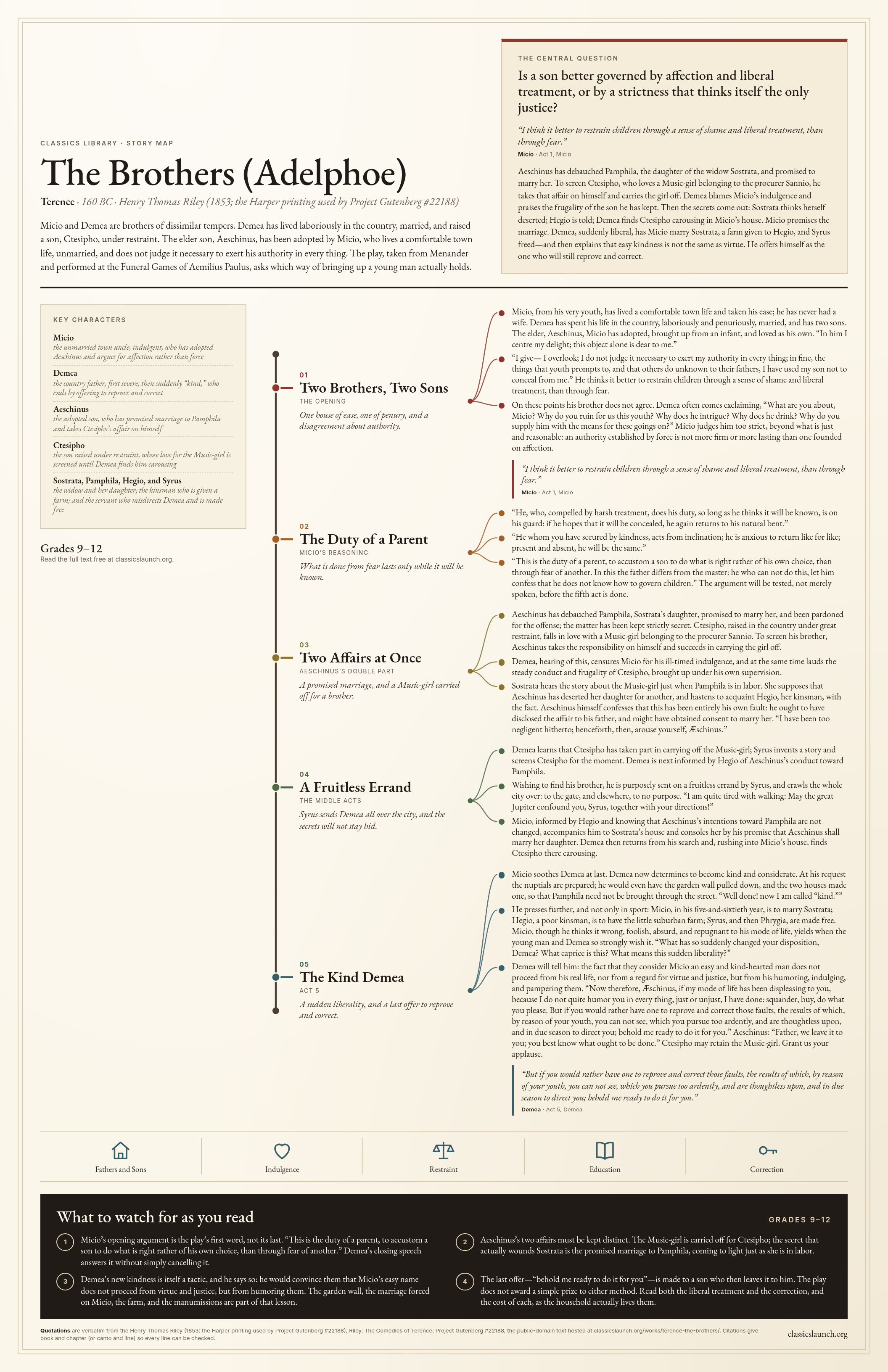
Micio and Demea are brothers of dissimilar tempers. Demea has lived laboriously in the country, married, and raised a son, Ctesipho, under restraint. The elder son, Aeschinus, has been adopted by Micio, who lives a comfortable town life, unmarried, and does not judge it necessary to exert his authority in every thing. The play, taken from Menander and performed at the Funeral Games of Aemilius Paulus, asks which way of bringing up a young man actually holds.
The central question
Is a son better governed by affection and liberal treatment, or by a strictness that thinks itself the only justice?
“I think it better to restrain children through a sense of shame and liberal treatment, than through fear.”
Aeschinus has debauched Pamphila, the daughter of the widow Sostrata, and promised to marry her. To screen Ctesipho, who loves a Music-girl belonging to the procurer Sannio, he takes that affair on himself and carries the girl off. Demea blames Micio’s indulgence and praises the frugality of the son he has kept. Then the secrets come out: Sostrata thinks herself deserted; Hegio is told; Demea finds Ctesipho carousing in Micio’s house. Micio promises the marriage. Demea, suddenly liberal, has Micio marry Sostrata, a farm given to Hegio, and Syrus freed—and then explains that easy kindness is not the same as virtue. He offers himself as the one who will still reprove and correct.
- 01
Two Brothers, Two Sons
The opening
One house of ease, one of penury, and a disagreement about authority.
- Micio, from his very youth, has lived a comfortable town life and taken his ease; he has never had a wife. Demea has spent his life in the country, laboriously and penuriously, married, and has two sons. The elder, Aeschinus, Micio has adopted, brought up from an infant, and loved as his own. “In him I centre my delight; this object alone is dear to me.”
- “I give— I overlook; I do not judge it necessary to exert my authority in every thing; in fine, the things that youth prompts to, and that others do unknown to their fathers, I have used my son not to conceal from me.” He thinks it better to restrain children through a sense of shame and liberal treatment, than through fear.
- On these points his brother does not agree. Demea often comes exclaiming, “What are you about, Micio? Why do you ruin for us this youth? Why does he intrigue? Why does he drink? Why do you supply him with the means for these goings on?” Micio judges him too strict, beyond what is just and reasonable: an authority established by force is not more firm or more lasting than one founded on affection.
“I think it better to restrain children through a sense of shame and liberal treatment, than through fear.”
- 02
The Duty of a Parent
Micio’s reasoning
What is done from fear lasts only while it will be known.
- “He, who, compelled by harsh treatment, does his duty, so long as he thinks it will be known, is on his guard: if he hopes that it will be concealed, he again returns to his natural bent.”
- “He whom you have secured by kindness, acts from inclination; he is anxious to return like for like; present and absent, he will be the same.”
- “This is the duty of a parent, to accustom a son to do what is right rather of his own choice, than through fear of another. In this the father differs from the master: he who can not do this, let him confess that he does not know how to govern children.” The argument will be tested, not merely spoken, before the fifth act is done.
- 03
Two Affairs at Once
Aeschinus’s double part
A promised marriage, and a Music-girl carried off for a brother.
- Aeschinus has debauched Pamphila, Sostrata’s daughter, promised to marry her, and been pardoned for the offense; the matter has been kept strictly secret. Ctesipho, raised in the country under great restraint, falls in love with a Music-girl belonging to the procurer Sannio. To screen his brother, Aeschinus takes the responsibility on himself and succeeds in carrying the girl off.
- Demea, hearing of this, censures Micio for his ill-timed indulgence, and at the same time lauds the steady conduct and frugality of Ctesipho, brought up under his own supervision.
- Sostrata hears the story about the Music-girl just when Pamphila is in labor. She supposes that Aeschinus has deserted her daughter for another, and hastens to acquaint Hegio, her kinsman, with the fact. Aeschinus himself confesses that this has been entirely his own fault: he ought to have disclosed the affair to his father, and might have obtained consent to marry her. “I have been too negligent hitherto; henceforth, then, arouse yourself, Æschinus.”
- 04
A Fruitless Errand
The middle acts
Syrus sends Demea all over the city, and the secrets will not stay hid.
- Demea learns that Ctesipho has taken part in carrying off the Music-girl; Syrus invents a story and screens Ctesipho for the moment. Demea is next informed by Hegio of Aeschinus’s conduct toward Pamphila.
- Wishing to find his brother, he is purposely sent on a fruitless errand by Syrus, and crawls the whole city over: to the gate, and elsewhere, to no purpose. “I am quite tired with walking: May the great Jupiter confound you, Syrus, together with your directions!”
- Micio, informed by Hegio and knowing that Aeschinus’s intentions toward Pamphila are not changed, accompanies him to Sostrata’s house and consoles her by his promise that Aeschinus shall marry her daughter. Demea then returns from his search and, rushing into Micio’s house, finds Ctesipho there carousing.
- 05
The Kind Demea
Act 5
A sudden liberality, and a last offer to reprove and correct.
- Micio soothes Demea at last. Demea now determines to become kind and considerate. At his request the nuptials are prepared; he would even have the garden wall pulled down, and the two houses made one, so that Pamphila need not be brought through the street. “Well done! now I am called “kind.””
- He presses further, and not only in sport: Micio, in his five-and-sixtieth year, is to marry Sostrata; Hegio, a poor kinsman, is to have the little suburban farm; Syrus, and then Phrygia, are made free. Micio, though he thinks it wrong, foolish, absurd, and repugnant to his mode of life, yields when the young man and Demea so strongly wish it. “What has so suddenly changed your disposition, Demea? What caprice is this? What means this sudden liberality?”
- Demea will tell him: the fact that they consider Micio an easy and kind-hearted man does not proceed from his real life, nor from a regard for virtue and justice, but from his humoring, indulging, and pampering them. “Now therefore, Æschinus, if my mode of life has been displeasing to you, because I do not quite humor you in every thing, just or unjust, I have done: squander, buy, do what you please. But if you would rather have one to reprove and correct those faults, the results of which, by reason of your youth, you can not see, which you pursue too ardently, and are thoughtless upon, and in due season to direct you; behold me ready to do it for you.” Aeschinus: “Father, we leave it to you; you best know what ought to be done.” Ctesipho may retain the Music-girl. Grant us your applause.
“But if you would rather have one to reprove and correct those faults, the results of which, by reason of your youth, you can not see, which you pursue too ardently, and are thoughtless upon, and in due season to direct you; behold me ready to do it for you.”
- Fathers and Sons
- Indulgence
- Restraint
- Education
- Correction
What to watch for as you read
Grades 9–12- Micio’s opening argument is the play’s first word, not its last. “This is the duty of a parent, to accustom a son to do what is right rather of his own choice, than through fear of another.” Demea’s closing speech answers it without simply cancelling it.
- Aeschinus’s two affairs must be kept distinct. The Music-girl is carried off for Ctesipho; the secret that actually wounds Sostrata is the promised marriage to Pamphila, coming to light just as she is in labor.
- Demea’s new kindness is itself a tactic, and he says so: he would convince them that Micio’s easy name does not proceed from virtue and justice, but from humoring them. The garden wall, the marriage forced on Micio, the farm, and the manumissions are part of that lesson.
- The last offer—“behold me ready to do it for you”—is made to a son who then leaves it to him. The play does not award a simple prize to either method. Read both the liberal treatment and the correction, and the cost of each, as the household actually lives them.
Every quotation is word for word from the Henry Thomas Riley (1853; the Harper printing used by Project Gutenberg #22188) hosted in this library and is checked against that text each time the site is built. Citations give book and chapter (or canto and line).