Story maps · Grades 3–5
The Adventures of Pinocchio: A Story Map
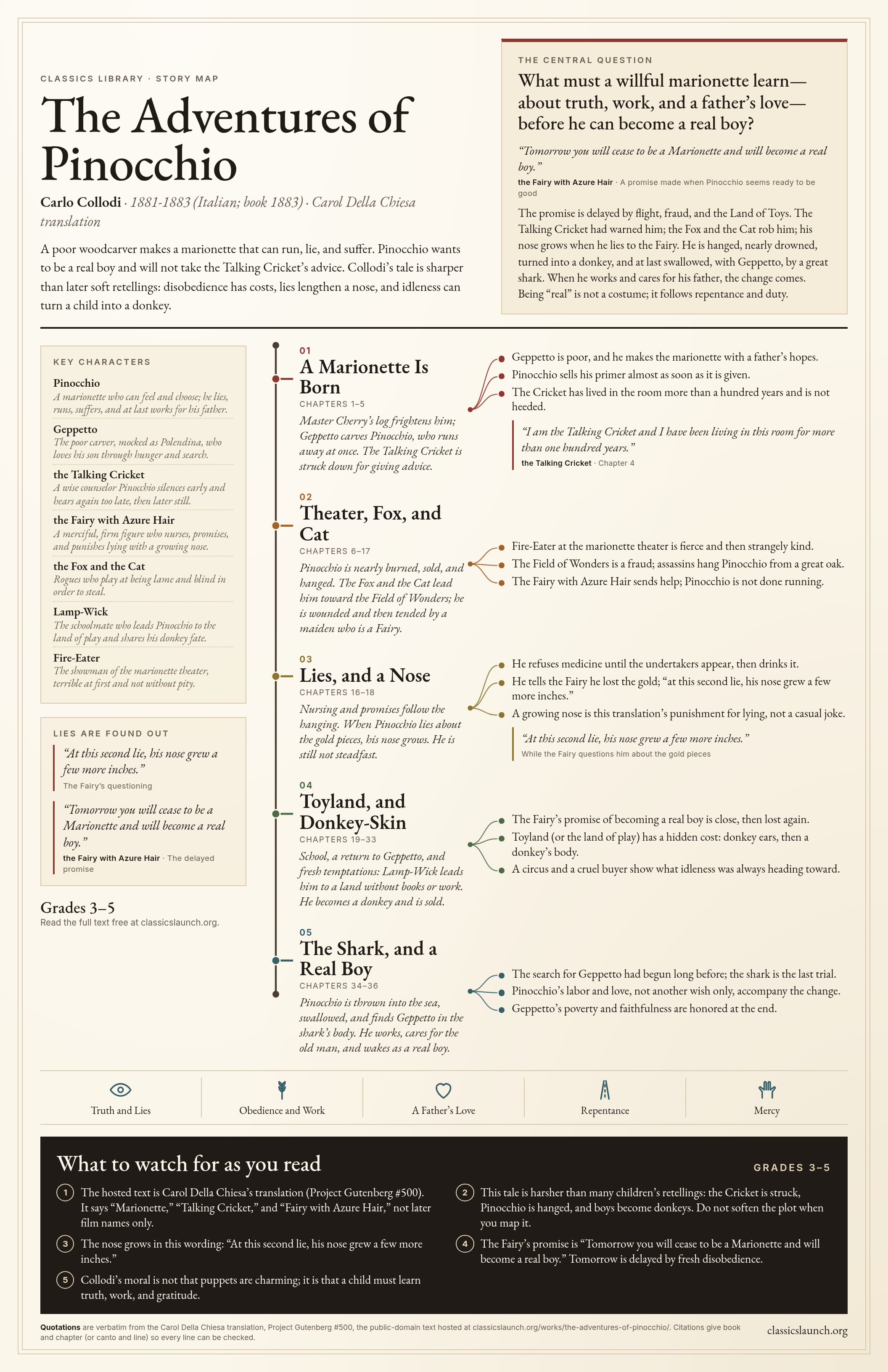
The PDF is one tabloid page (11 × 17 in). On letter paper, choose “Fit to page.”
A poor woodcarver makes a marionette that can run, lie, and suffer. Pinocchio wants to be a real boy and will not take the Talking Cricket’s advice. Collodi’s tale is sharper than later soft retellings: disobedience has costs, lies lengthen a nose, and idleness can turn a child into a donkey.
The central question
What must a willful marionette learn—about truth, work, and a father’s love—before he can become a real boy?
“Tomorrow you will cease to be a Marionette and will become a real boy.”
The promise is delayed by flight, fraud, and the Land of Toys. The Talking Cricket had warned him; the Fox and the Cat rob him; his nose grows when he lies to the Fairy. He is hanged, nearly drowned, turned into a donkey, and at last swallowed, with Geppetto, by a great shark. When he works and cares for his father, the change comes. Being “real” is not a costume; it follows repentance and duty.
- 01
A Marionette Is Born
Chapters 1–5
Master Cherry’s log frightens him; Geppetto carves Pinocchio, who runs away at once. The Talking Cricket is struck down for giving advice.
- Geppetto is poor, and he makes the marionette with a father’s hopes.
- Pinocchio sells his primer almost as soon as it is given.
- The Cricket has lived in the room more than a hundred years and is not heeded.
“I am the Talking Cricket and I have been living in this room for more than one hundred years.”
- 02
Theater, Fox, and Cat
Chapters 6–17
Pinocchio is nearly burned, sold, and hanged. The Fox and the Cat lead him toward the Field of Wonders; he is wounded and then tended by a maiden who is a Fairy.
- Fire-Eater at the marionette theater is fierce and then strangely kind.
- The Field of Wonders is a fraud; assassins hang Pinocchio from a great oak.
- The Fairy with Azure Hair sends help; Pinocchio is not done running.
- 03
Lies, and a Nose
Chapters 16–18
Nursing and promises follow the hanging. When Pinocchio lies about the gold pieces, his nose grows. He is still not steadfast.
- He refuses medicine until the undertakers appear, then drinks it.
- He tells the Fairy he lost the gold; “at this second lie, his nose grew a few more inches.”
- A growing nose is this translation’s punishment for lying, not a casual joke.
“At this second lie, his nose grew a few more inches.”
- 04
Toyland, and Donkey-Skin
Chapters 19–33
School, a return to Geppetto, and fresh temptations: Lamp-Wick leads him to a land without books or work. He becomes a donkey and is sold.
- The Fairy’s promise of becoming a real boy is close, then lost again.
- Toyland (or the land of play) has a hidden cost: donkey ears, then a donkey’s body.
- A circus and a cruel buyer show what idleness was always heading toward.
- 05
The Shark, and a Real Boy
Chapters 34–36
Pinocchio is thrown into the sea, swallowed, and finds Geppetto in the shark’s body. He works, cares for the old man, and wakes as a real boy.
- The search for Geppetto had begun long before; the shark is the last trial.
- Pinocchio’s labor and love, not another wish only, accompany the change.
- Geppetto’s poverty and faithfulness are honored at the end.
- Truth and Lies
- Obedience and Work
- A Father’s Love
- Repentance
- Mercy
What to watch for as you read
Grades 3–5- The hosted text is Carol Della Chiesa’s translation (Project Gutenberg #500). It says “Marionette,” “Talking Cricket,” and “Fairy with Azure Hair,” not later film names only.
- This tale is harsher than many children’s retellings: the Cricket is struck, Pinocchio is hanged, and boys become donkeys. Do not soften the plot when you map it.
- The nose grows in this wording: “At this second lie, his nose grew a few more inches.”
- The Fairy’s promise is “Tomorrow you will cease to be a Marionette and will become a real boy.” Tomorrow is delayed by fresh disobedience.
- Collodi’s moral is not that puppets are charming; it is that a child must learn truth, work, and gratitude.
Every quotation is word for word from the Carol Della Chiesa translation hosted in this library and is checked against that text each time the site is built. Citations give book and chapter (or canto and line).