Story maps · Grades 9–12
The Book of Job: A Story Map
The PDF is one tabloid page (11 × 17 in). On letter paper, choose “Fit to page.”
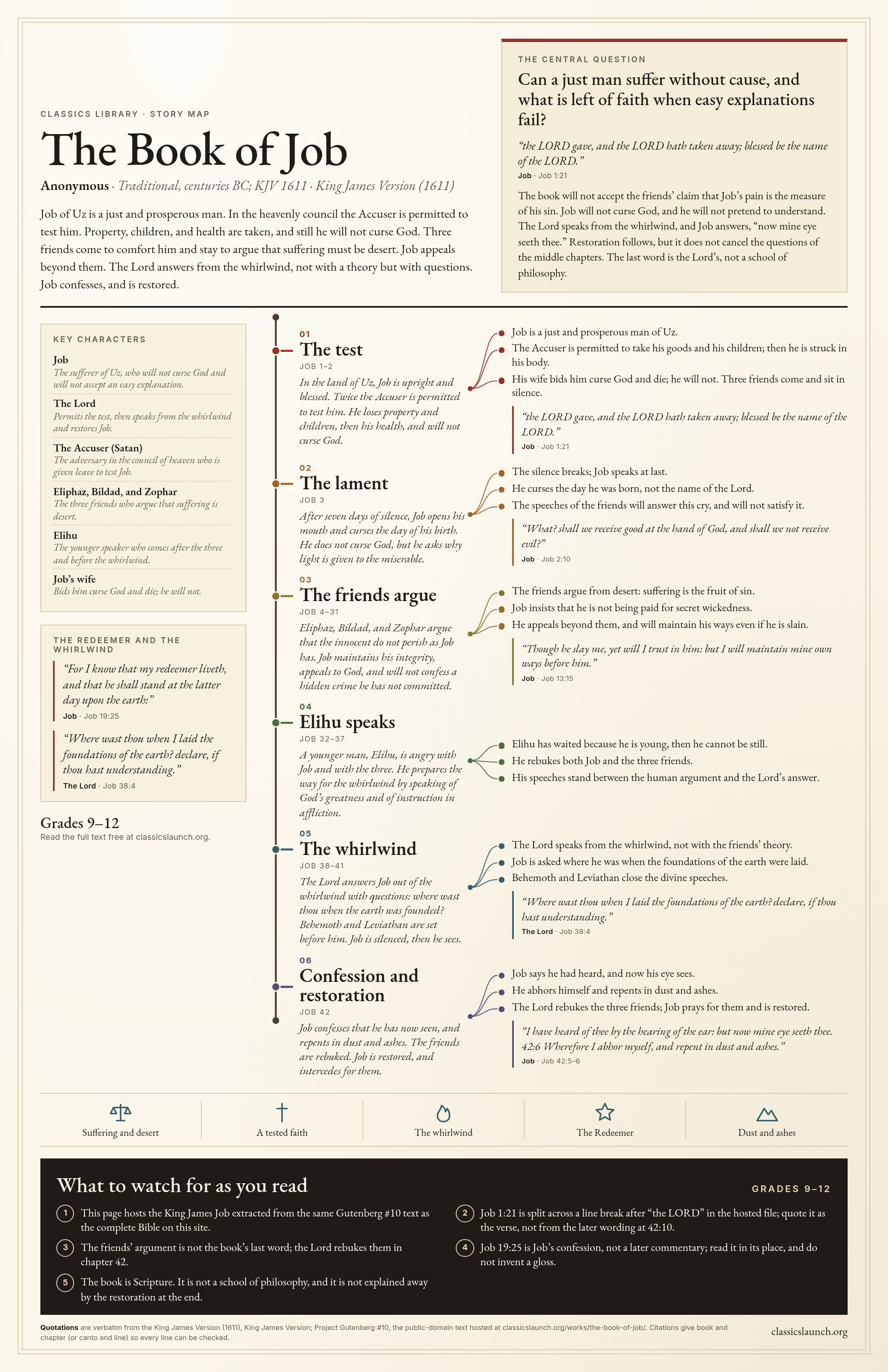
Job of Uz is a just and prosperous man. In the heavenly council the Accuser is permitted to test him. Property, children, and health are taken, and still he will not curse God. Three friends come to comfort him and stay to argue that suffering must be desert. Job appeals beyond them. The Lord answers from the whirlwind, not with a theory but with questions. Job confesses, and is restored.
The central question
Can a just man suffer without cause, and what is left of faith when easy explanations fail?
“the LORD gave, and the LORD hath taken away; blessed be the name of the LORD.”
The book will not accept the friends’ claim that Job’s pain is the measure of his sin. Job will not curse God, and he will not pretend to understand. The Lord speaks from the whirlwind, and Job answers, “now mine eye seeth thee.” Restoration follows, but it does not cancel the questions of the middle chapters. The last word is the Lord’s, not a school of philosophy.
- 01
The test
Job 1–2
In the land of Uz, Job is upright and blessed. Twice the Accuser is permitted to test him. He loses property and children, then his health, and will not curse God.
- Job is a just and prosperous man of Uz.
- The Accuser is permitted to take his goods and his children; then he is struck in his body.
- His wife bids him curse God and die; he will not. Three friends come and sit in silence.
“the LORD gave, and the LORD hath taken away; blessed be the name of the LORD.”
- 02
The lament
Job 3
After seven days of silence, Job opens his mouth and curses the day of his birth. He does not curse God, but he asks why light is given to the miserable.
- The silence breaks; Job speaks at last.
- He curses the day he was born, not the name of the Lord.
- The speeches of the friends will answer this cry, and will not satisfy it.
“What? shall we receive good at the hand of God, and shall we not receive evil?”
- 03
The friends argue
Job 4–31
Eliphaz, Bildad, and Zophar argue that the innocent do not perish as Job has. Job maintains his integrity, appeals to God, and will not confess a hidden crime he has not committed.
- The friends argue from desert: suffering is the fruit of sin.
- Job insists that he is not being paid for secret wickedness.
- He appeals beyond them, and will maintain his ways even if he is slain.
“Though he slay me, yet will I trust in him: but I will maintain mine own ways before him.”
- 04
Elihu speaks
Job 32–37
A younger man, Elihu, is angry with Job and with the three. He prepares the way for the whirlwind by speaking of God’s greatness and of instruction in affliction.
- Elihu has waited because he is young, then he cannot be still.
- He rebukes both Job and the three friends.
- His speeches stand between the human argument and the Lord’s answer.
- 05
The whirlwind
Job 38–41
The Lord answers Job out of the whirlwind with questions: where wast thou when the earth was founded? Behemoth and Leviathan are set before him. Job is silenced, then he sees.
- The Lord speaks from the whirlwind, not with the friends’ theory.
- Job is asked where he was when the foundations of the earth were laid.
- Behemoth and Leviathan close the divine speeches.
“Where wast thou when I laid the foundations of the earth? declare, if thou hast understanding.”
- 06
Confession and restoration
Job 42
Job confesses that he has now seen, and repents in dust and ashes. The friends are rebuked. Job is restored, and intercedes for them.
- Job says he had heard, and now his eye sees.
- He abhors himself and repents in dust and ashes.
- The Lord rebukes the three friends; Job prays for them and is restored.
“I have heard of thee by the hearing of the ear: but now mine eye seeth thee. 42:6 Wherefore I abhor myself, and repent in dust and ashes.”
- Suffering and desert
- A tested faith
- The whirlwind
- The Redeemer
- Dust and ashes
What to watch for as you read
Grades 9–12- This page hosts the King James Job extracted from the same Gutenberg #10 text as the complete Bible on this site.
- Job 1:21 is split across a line break after “the LORD” in the hosted file; quote it as the verse, not from the later wording at 42:10.
- The friends’ argument is not the book’s last word; the Lord rebukes them in chapter 42.
- Job 19:25 is Job’s confession, not a later commentary; read it in its place, and do not invent a gloss.
- The book is Scripture. It is not a school of philosophy, and it is not explained away by the restoration at the end.
Every quotation is word for word from the King James Version (1611) hosted in this library and is checked against that text each time the site is built. Citations give book and chapter (or canto and line).