Work record
The Book of Job
AnonymousJob; The Book of Job (KJV)The Book of Job (Date of composition uncertain)The Book of Job is a work of Hebrew wisdom about a man in the land of Uz who is ‘perfect and upright,’ who fears God and turns from evil, and who is stripped of property, children, and health.Also known as: Job · The Book of Job (KJV)
Date of composition uncertain; the story is set in the age of the patriarchs; KJV 1611. · Ancient · Religious Scripture · Hebrew
Read this when suffering is deep, and easy answers will not do.
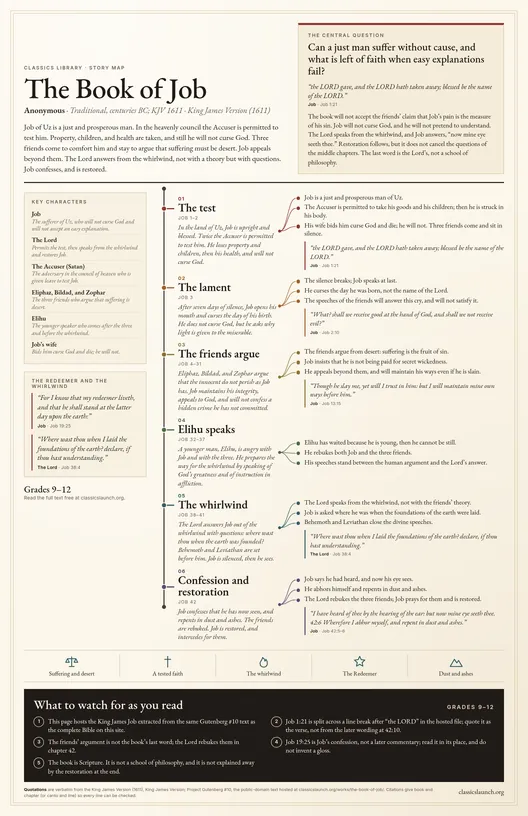 Story mapSee the story mapThe whole book on one page: the story in movements, the characters, and what to watch for. Free to print.
Abstract
Background. The Book of Job is Hebrew wisdom about a man of Uz who is upright and then stripped of goods, children, and health. This page hosts that book alone, in the same King James English already used for The Bible on this site, so a class can read it with a guide.
Plot. Satan is permitted to test Job. Job will not curse God. Three friends argue that such pain must be punishment. Job defends his integrity and asks for a hearing. After Elihu speaks, the Lord answers out of the whirlwind with questions, not a chart of causes. Job repents in dust and ashes, prays for his friends, and is restored.
Ideas. The book refuses a simple arithmetic of guilt and pain, and it also refuses the thought that God is silent forever. A Christian class can honor Job’s patience, named in James, and can read the word about the Redeemer with care, without turning the whirlwind into a slogan or a diagnosis.
Text. The English is the King James Version, extracted from Project Gutenberg #10, the same file as the library’s complete Bible. No later translation is used. Dates of composition are uncertain and are marked as such; the sort year is for catalogue order only.
Key figures
- Job: the sufferer of Uz who will not curse God
- The Lord: who permits the test and later speaks from the whirlwind
- Eliphaz, Bildad, and Zophar: the three friends who argue from desert
Summary
The Book of Job is a work of Hebrew wisdom about a man in the land of Uz who is ‘perfect and upright,’ who fears God and turns from evil, and who is stripped of property, children, and health. In a heavenly scene the Lord points Job out to Satan, and Satan is permitted to test him, first in his goods and family, then in his flesh, short of taking his life. Job does not curse God. He blesses the name of the Lord who gave and who has taken away. His wife urges him to curse God and die; he will not. Three friends come to sit with him in silence, and then to argue. Eliphaz, Bildad, and Zophar hold, in different tones, that such suffering must be punishment for sin, and that Job should repent and be restored. Job defends his integrity, laments the day of his birth, and cries out for a hearing. He will not accept a false confession in order to make the books balance. He says that he knows his Redeemer lives. A younger man, Elihu, speaks after the three have failed, and then the Lord answers Job out of the whirlwind, not with a chart of causes, but with questions about the founding of the earth, the sea, the stars, and the creatures, including behemoth and leviathan. Job answers that he had heard of God by the hearing of the ear, but now his eye sees, and he repents in dust and ashes. The Lord rebukes the three friends for not having spoken of him what is right, as Job has, and Job prays for them. Job is restored: his goods are doubled, he is given children again, and he dies old and full of days. The book does not treat pain as a riddle with a cheap key. It refuses the friends’ simple arithmetic, and it also refuses the thought that God is unconcerned. This page hosts the book by itself, in the same King James English as The Bible on this site, so that a class can read Job with a guide, and then return to the whole canon.
Virtues in this work
Plot or Argument
- The prologue in heaven and on earth (Job 1–2)
Job is introduced as upright. Satan is permitted to test him. Job loses goods and children, then his health, and will not curse God. Three friends arrive and sit with him seven days in silence.
- The debate (Job 3–31)
Job curses the day of his birth. Eliphaz, Bildad, and Zophar argue that suffering of this kind must be punishment. Job answers, defends his integrity, and longs for a hearing before God.
- Elihu (Job 32–37)
A younger speaker, Elihu, waits until the three have finished, then speaks at length before the Lord’s own answer.
- The Lord out of the whirlwind (Job 38–42:6)
The Lord questions Job about the founding of the earth and the life of creatures. Job answers that he now sees, and he repents in dust and ashes.
- The epilogue (Job 42:7–17)
The Lord rebukes the three friends; Job prays for them; Job is restored in goods and family, and dies full of days.
Characters
- Job, sufferer
A man of Uz, blameless and upright, who will not curse God and who at last is answered and restored.
- The Lord, God
Speaks of Job in the prologue, permits the test, and later answers out of the whirlwind.
- Satan, accuser
The adversary who obtains leave to test Job, first in goods and family, then in his flesh.
- Eliphaz the Temanite, friend and counsellor
The first of the three friends; he argues from vision and tradition that the innocent do not perish so.
- Bildad the Shuhite, friend and counsellor
The second friend; he presses tradition and the fate of the wicked, and later grows shorter and harsher.
- Zophar the Naamathite, friend and counsellor
The third friend; he is the most abrupt in charging Job and urging repentance.
- Elihu, younger speaker
A young man who has waited while the three spoke, and who talks before the Lord answers.
- Job’s wife, wife
Urges Job, after the second stroke, to curse God and die; he refuses.
Lessons
Do not explain a friend’s pain too quickly
The three friends come to comfort Job, and then they argue him into a theory. The book lets their theory fail. A class can learn to sit still, as they first did for seven days, before it speaks.
- Where do the friends begin to sound sure?
- What would have been a better first word to Job?
Integrity is not the same as self-justification
Job will not confess a sin he does not know, merely to make the ledgers even. He also, at the end, puts his hand over his mouth before the Lord. The book honors both the refusal of a false confession and the humility of the last answer.
- Where is Job right to stand his ground?
- What changes in him when the Lord has spoken?
God’s answer is not a formula
The Lord does not give Job a list of causes. He asks questions about the world he has made. The Christian reader can receive this without flattening it into a slogan, and can also hear Job’s word about his Redeemer beside later Scripture, with the Hebrew of the passage treated honestly.
- What do the questions out of the whirlwind do that an explanation would not?
- How should a class read Job 19:25 without forcing or emptying it?
Context
The Book of Job belongs to the wisdom writings of the Hebrew Bible. The story is set in the land of Uz, outside Israel’s later royal history, in an early household manner of life, with flocks, children, and a man who offers sacrifice for his family. The date of the book’s composition is not settled. It has long been read in the synagogue and the church as Scripture, and the King James Version of 1611 made its English cadences familiar in the schools and the pulpit.
Composition
The Hebrew is anonymous. The hosted English is the King James Version, taken from the same Gutenberg #10 text already used for The Bible on this site. Nothing here is a new translation.
Reception
Job has been read for comfort, for argument, and for its poetry, from the early church through the Reformation and English letters. James 5:11 names Job’s patience. This page exists so that the book can be assigned by itself, then set back into the whole Bible.
Comparisons
- The Bible
The complete King James Bible on this site includes Job; this page is the book standing alone, with a student guide, so that a class may read it closely and then return to the canon.
- Ecclesiastes
Another Hebrew wisdom book that will not accept easy comfort; Ecclesiastes is more reflective, Job more dramatic and personal.
- The Bhagavad Gita
A very different sacred dialogue on duty and suffering, from the Sanskrit tradition; useful only as a careful comparison, not as a substitute for Job.
- The Consolation of Philosophy
A later consolation in prison, in which Philosophy reasons with a man in grief; Job is Scripture, and its last word is the Lord’s, not a school of philosophy.
Quotes
“the LORD gave, and the LORD hath taken away; blessed be the name of the LORD”
“What? shall we receive good at the hand of God, and shall we not receive evil”
“Though he slay me, yet will I trust in him: but I will maintain mine own ways before him”
“For I know that my redeemer liveth, and that he shall stand at the latter day upon the earth”
“Where wast thou when I laid the foundations of the earth? declare, if thou hast understanding”
“I have heard of thee by the hearing of the ear: but now mine eye seeth thee. 42:6 Wherefore I abhor myself, and repent in dust and ashes”
For Students
A reading companion for classical Christian high school students. See the student guide.
Reading Guide
Watch for
- The difference between the friends’ first silence and their later speeches
- Job’s refusal both to curse God and to confess a sin he does not know
- What the Lord asks, and what he does not explain
- The restoration at the end, which does not erase the children who died
Key terms and names
- Uz
- The land, not precisely identified, in which Job lives at the opening of the book.
- Satan
- The accuser in the prologue, who is permitted to test Job but not to take his life.
- Whirlwind
- The storm out of which the Lord answers Job in the closing chapters.
- Redeemer (Job 19:25)
- Job’s word for the one who lives and will stand; later Christian reading should be named as reading, not smuggled in as if it were the only Hebrew sense.
- King James Version
- The 1611 English hosted here, the same text as The Bible on this site.
Seminar Questions
- Comprehension What is Job permitted to lose in the first test, and what is withheld in the second?
- Comprehension Name the three friends, and state in one sentence the common claim they share.
- Interpretation Why does Job refuse to accept the friends’ explanation, even when they speak in the name of piety?
- Interpretation What kind of answer is the speech from the whirlwind, if it is not a list of reasons?
- Interpretation How should a Christian class read Job 19:25 without either emptying it or forcing it?
- Big Question Is it possible to praise God honestly in the middle of undeserved suffering, and what does this book show about that praise?
- Big Question What is the difference between comforting a sufferer and explaining him?
Faith Connections
- James 5:11 (Scripture)
The epistle names the patience of Job and the end of the Lord, as a word to Christians in trial.
- Romans 8:18–28 (Scripture)
Paul speaks of present suffering and of God’s purpose, a later apostolic word to set beside, not over, the book of Job.
- Gregory the Great, Moralia in Job (Church Fathers)
A great Latin commentary that read Job as a teacher of patience and of the spiritual life; useful as history of reading, not as a replacement for the book itself.
Logic and Rhetoric
Central argument: The Book of Job shows a righteous sufferer who will not curse God, refuses a false confession, and is at last answered by the Lord out of the whirlwind rather than by the friends’ theory of simple desert.
Rhetorical device: dialogue and divine interrogation. The long debate of Job and the friends is closed not by a verdict from them, but by the Lord’s questions about the founding of the earth.
Debate: Resolved: That the friends are wrong to treat Job’s suffering as proof of hidden guilt, and that the Lord’s answer is an answer even though it is not a diagram of causes.
Memory Work
the LORD gave, and the LORD hath taken away; blessed be the name of the LORD
For I know that my redeemer liveth, and that he shall stand at the latter day upon the earth
Writing Prompts
Essay: Trace one friend’s argument through two speeches, and show where it fails to meet Job’s case.
Comparison with The Bible: Compare the standalone Book of Job with its place in the complete Bible: what is gained by reading the book alone, and what is lost if it is never returned to the canon?
Medical Lens
Job’s sores, his wish that he had not been born, and his grief for his children are part of the book’s argument, not a clinical case. A medicine reader can notice the bodily trial and the temptation to despair without turning the whirlwind into a diagnosis.
- Job 2:7–8
Job is struck with sore boils and sits among the ashes, scraping himself.
- Job 3
Job curses the day of his birth and longs for rest in the grave, without taking his own life.
- Job 19
Job describes himself as wasted and abandoned, then speaks of his Redeemer.
Creative Prompts
- Essay
Write an essay on the three friends: where they are trying to defend God, and where their defense becomes a cruelty to Job.
- Dialogue
Write a short original dialogue, not copied from the book, in which two friends visit a sufferer and must choose whether to explain or to be still.
- Classroom
Have the class outline Job 1–2, 3–31, 32–37, 38–42, and 42:7–17 on one page before any debate, so that the shape of the book is visible.
Further Reading
- The Bible (King James Version), Anonymous / traditional
The complete Bible hosted on this site, from which this book is taken.
- The Epistle of James, James
James 5:11 is the New Testament’s explicit naming of Job.
Verification notes
The English is the same Gutenberg #10 King James text already hosted as The Bible; quotations are taken from that extract. The date of composition is uncertain and is marked as such. Job 19:25 is quoted verbatim; later Christian reading of ‘Redeemer’ is described as reading, not as a claim about the only original sense.
- The conventional sort year of 600 BC is for ordering only; the book’s date is not settled.
- The land of Uz is not certainly identified.