Story maps · Grades 3–5
The Burgess Bird Book for Children: A Story Map
The PDF is one tabloid page (11 × 17 in). On letter paper, choose “Fit to page.”
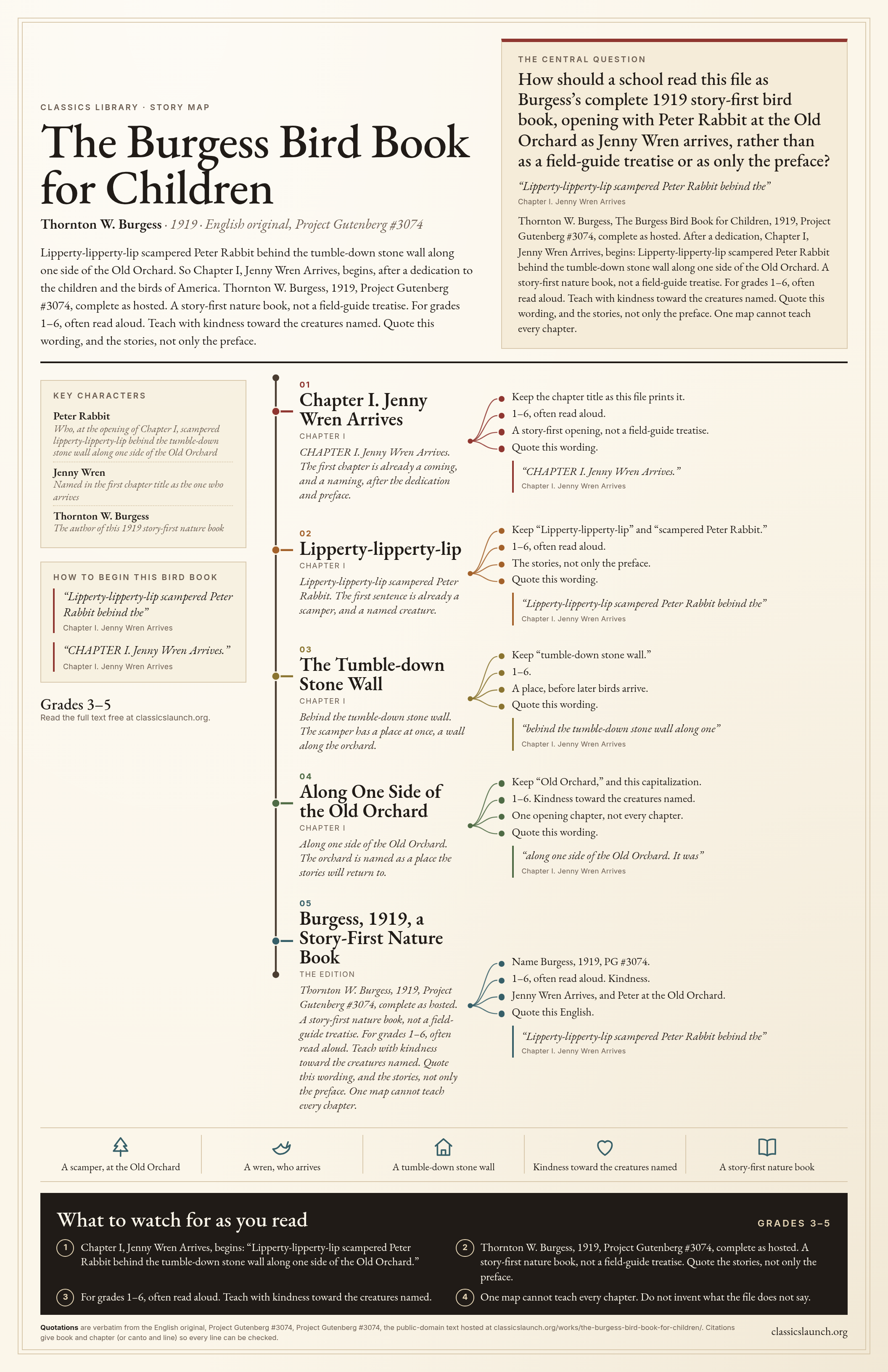
Lipperty-lipperty-lip scampered Peter Rabbit behind the tumble-down stone wall along one side of the Old Orchard. So Chapter I, Jenny Wren Arrives, begins, after a dedication to the children and the birds of America. Thornton W. Burgess, 1919, Project Gutenberg #3074, complete as hosted. A story-first nature book, not a field-guide treatise. For grades 1–6, often read aloud. Teach with kindness toward the creatures named. Quote this wording, and the stories, not only the preface.
The central question
How should a school read this file as Burgess’s complete 1919 story-first bird book, opening with Peter Rabbit at the Old Orchard as Jenny Wren arrives, rather than as a field-guide treatise or as only the preface?
“Lipperty-lipperty-lip scampered Peter Rabbit behind the”
Thornton W. Burgess, The Burgess Bird Book for Children, 1919, Project Gutenberg #3074, complete as hosted. After a dedication, Chapter I, Jenny Wren Arrives, begins: Lipperty-lipperty-lip scampered Peter Rabbit behind the tumble-down stone wall along one side of the Old Orchard. A story-first nature book, not a field-guide treatise. For grades 1–6, often read aloud. Teach with kindness toward the creatures named. Quote this wording, and the stories, not only the preface. One map cannot teach every chapter.
- 01
Chapter I. Jenny Wren Arrives
Chapter I
CHAPTER I. Jenny Wren Arrives. The first chapter is already a coming, and a naming, after the dedication and preface.
- Keep the chapter title as this file prints it.
- 1–6, often read aloud.
- A story-first opening, not a field-guide treatise.
- Quote this wording.
“CHAPTER I. Jenny Wren Arrives.”
- 02
Lipperty-lipperty-lip
Chapter I
Lipperty-lipperty-lip scampered Peter Rabbit. The first sentence is already a scamper, and a named creature.
- Keep “Lipperty-lipperty-lip” and “scampered Peter Rabbit.”
- 1–6, often read aloud.
- The stories, not only the preface.
- Quote this wording.
“Lipperty-lipperty-lip scampered Peter Rabbit behind the”
- 03
The Tumble-down Stone Wall
Chapter I
Behind the tumble-down stone wall. The scamper has a place at once, a wall along the orchard.
- Keep “tumble-down stone wall.”
- 1–6.
- A place, before later birds arrive.
- Quote this wording.
“behind the tumble-down stone wall along one”
- 04
Along One Side of the Old Orchard
Chapter I
Along one side of the Old Orchard. The orchard is named as a place the stories will return to.
- Keep “Old Orchard,” and this capitalization.
- 1–6. Kindness toward the creatures named.
- One opening chapter, not every chapter.
- Quote this wording.
“along one side of the Old Orchard. It was”
- 05
Burgess, 1919, a Story-First Nature Book
The edition
Thornton W. Burgess, 1919, Project Gutenberg #3074, complete as hosted. A story-first nature book, not a field-guide treatise. For grades 1–6, often read aloud. Teach with kindness toward the creatures named. Quote this wording, and the stories, not only the preface. One map cannot teach every chapter.
- Name Burgess, 1919, PG #3074.
- 1–6, often read aloud. Kindness.
- Jenny Wren Arrives, and Peter at the Old Orchard.
- Quote this English.
“Lipperty-lipperty-lip scampered Peter Rabbit behind the”
- A scamper, at the Old Orchard
- A wren, who arrives
- A tumble-down stone wall
- Kindness toward the creatures named
- A story-first nature book
What to watch for as you read
Grades 3–5- Chapter I, Jenny Wren Arrives, begins: “Lipperty-lipperty-lip scampered Peter Rabbit behind the tumble-down stone wall along one side of the Old Orchard.”
- Thornton W. Burgess, 1919, Project Gutenberg #3074, complete as hosted. A story-first nature book, not a field-guide treatise. Quote the stories, not only the preface.
- For grades 1–6, often read aloud. Teach with kindness toward the creatures named.
- One map cannot teach every chapter. Do not invent what the file does not say.
Every quotation is word for word from the English original, Project Gutenberg #3074 hosted in this library and is checked against that text each time the site is built. Citations give book and chapter (or canto and line).