Story maps · Grades 9–12
The Canterbury Tales: A Story Map
The PDF is one tabloid page (11 × 17 in). On letter paper, choose “Fit to page.”
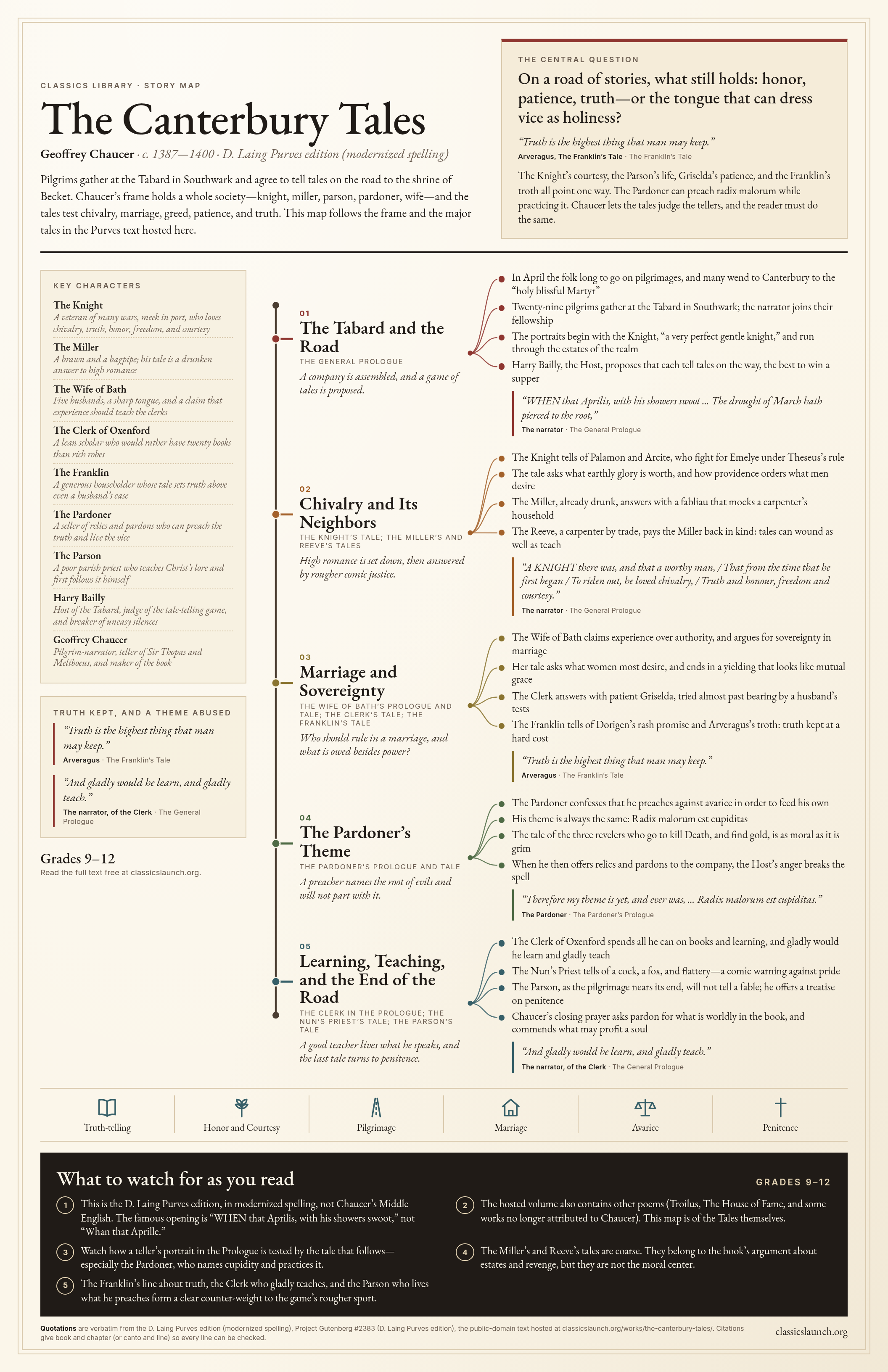
Pilgrims gather at the Tabard in Southwark and agree to tell tales on the road to the shrine of Becket. Chaucer’s frame holds a whole society—knight, miller, parson, pardoner, wife—and the tales test chivalry, marriage, greed, patience, and truth. This map follows the frame and the major tales in the Purves text hosted here.
The central question
On a road of stories, what still holds: honor, patience, truth—or the tongue that can dress vice as holiness?
“Truth is the highest thing that man may keep.”
The Knight’s courtesy, the Parson’s life, Griselda’s patience, and the Franklin’s troth all point one way. The Pardoner can preach radix malorum while practicing it. Chaucer lets the tales judge the tellers, and the reader must do the same.
- 01
The Tabard and the Road
The General Prologue
A company is assembled, and a game of tales is proposed.
- In April the folk long to go on pilgrimages, and many wend to Canterbury to the “holy blissful Martyr”
- Twenty-nine pilgrims gather at the Tabard in Southwark; the narrator joins their fellowship
- The portraits begin with the Knight, “a very perfect gentle knight,” and run through the estates of the realm
- Harry Bailly, the Host, proposes that each tell tales on the way, the best to win a supper
“WHEN that Aprilis, with his showers swoot ... The drought of March hath pierced to the root,”
- 02
Chivalry and Its Neighbors
The Knight’s Tale; the Miller’s and Reeve’s Tales
High romance is set down, then answered by rougher comic justice.
- The Knight tells of Palamon and Arcite, who fight for Emelye under Theseus’s rule
- The tale asks what earthly glory is worth, and how providence orders what men desire
- The Miller, already drunk, answers with a fabliau that mocks a carpenter’s household
- The Reeve, a carpenter by trade, pays the Miller back in kind: tales can wound as well as teach
“A KNIGHT there was, and that a worthy man, / That from the time that he first began / To riden out, he loved chivalry, / Truth and honour, freedom and courtesy.”
- 03
Marriage and Sovereignty
The Wife of Bath’s Prologue and Tale; the Clerk’s Tale; the Franklin’s Tale
Who should rule in a marriage, and what is owed besides power?
- The Wife of Bath claims experience over authority, and argues for sovereignty in marriage
- Her tale asks what women most desire, and ends in a yielding that looks like mutual grace
- The Clerk answers with patient Griselda, tried almost past bearing by a husband’s tests
- The Franklin tells of Dorigen’s rash promise and Arveragus’s troth: truth kept at a hard cost
“Truth is the highest thing that man may keep.”
- 04
The Pardoner’s Theme
The Pardoner’s Prologue and Tale
A preacher names the root of evils and will not part with it.
- The Pardoner confesses that he preaches against avarice in order to feed his own
- His theme is always the same: Radix malorum est cupiditas
- The tale of the three revelers who go to kill Death, and find gold, is as moral as it is grim
- When he then offers relics and pardons to the company, the Host’s anger breaks the spell
“Therefore my theme is yet, and ever was, ... Radix malorum est cupiditas.”
- 05
Learning, Teaching, and the End of the Road
The Clerk in the Prologue; the Nun’s Priest’s Tale; the Parson’s Tale
A good teacher lives what he speaks, and the last tale turns to penitence.
- The Clerk of Oxenford spends all he can on books and learning, and gladly would he learn and gladly teach
- The Nun’s Priest tells of a cock, a fox, and flattery—a comic warning against pride
- The Parson, as the pilgrimage nears its end, will not tell a fable; he offers a treatise on penitence
- Chaucer’s closing prayer asks pardon for what is worldly in the book, and commends what may profit a soul
“And gladly would he learn, and gladly teach.”
- Truth-telling
- Honor and Courtesy
- Pilgrimage
- Marriage
- Avarice
- Penitence
What to watch for as you read
Grades 9–12- This is the D. Laing Purves edition, in modernized spelling, not Chaucer’s Middle English. The famous opening is “WHEN that Aprilis, with his showers swoot,” not “Whan that Aprille.”
- The hosted volume also contains other poems (Troilus, The House of Fame, and some works no longer attributed to Chaucer). This map is of the Tales themselves.
- Watch how a teller’s portrait in the Prologue is tested by the tale that follows—especially the Pardoner, who names cupidity and practices it.
- The Miller’s and Reeve’s tales are coarse. They belong to the book’s argument about estates and revenge, but they are not the moral center.
- The Franklin’s line about truth, the Clerk who gladly teaches, and the Parson who lives what he preaches form a clear counter-weight to the game’s rougher sport.
Every quotation is word for word from the D. Laing Purves edition (modernized spelling) hosted in this library and is checked against that text each time the site is built. Citations give book and chapter (or canto and line).