Story maps · Grades 11–12
The Decameron: A Story Map
The PDF is one tabloid page (11 × 17 in). On letter paper, choose “Fit to page.”
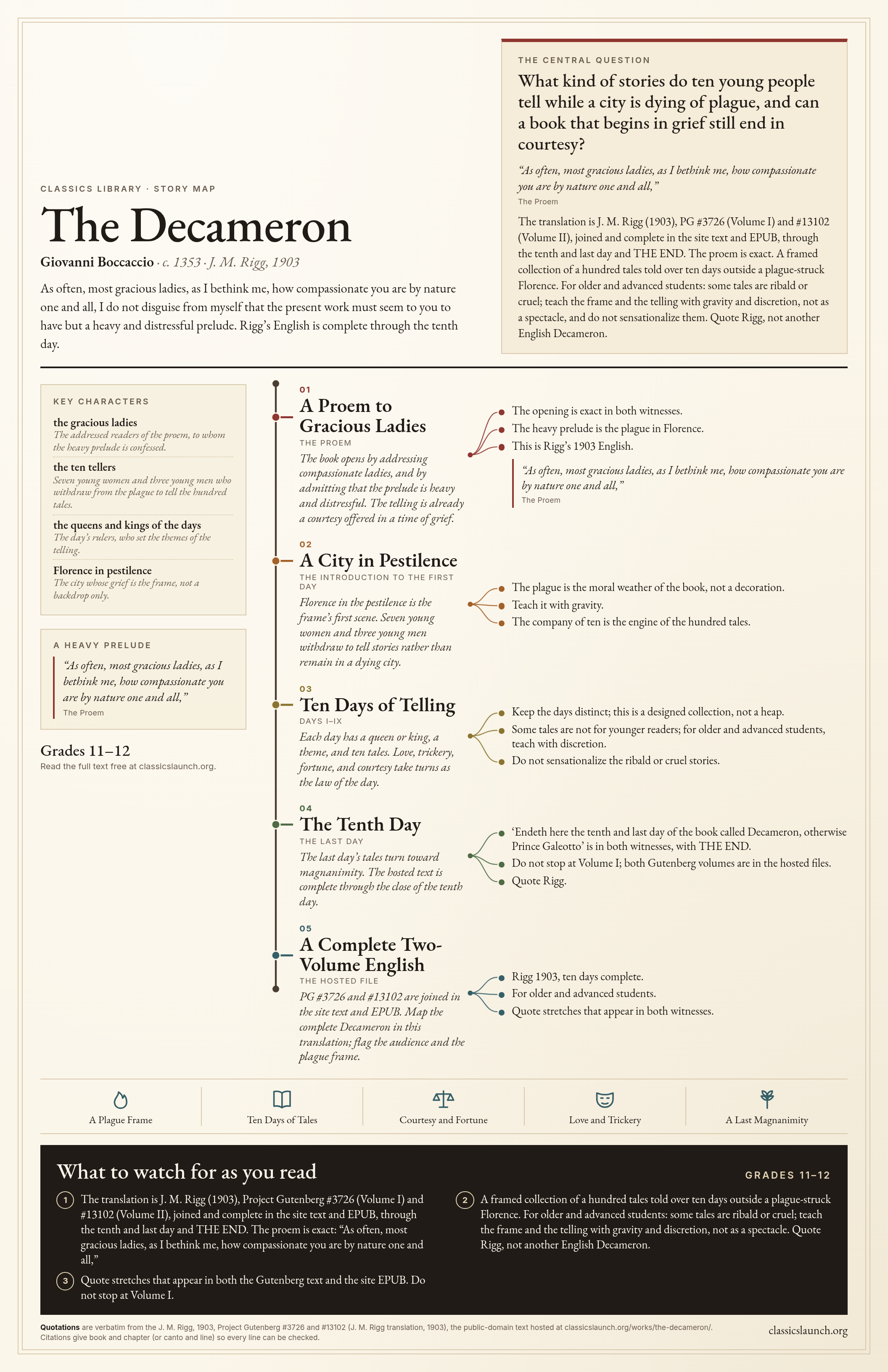
As often, most gracious ladies, as I bethink me, how compassionate you are by nature one and all, I do not disguise from myself that the present work must seem to you to have but a heavy and distressful prelude. Rigg’s English is complete through the tenth day.
The central question
What kind of stories do ten young people tell while a city is dying of plague, and can a book that begins in grief still end in courtesy?
“As often, most gracious ladies, as I bethink me, how compassionate you are by nature one and all,”
The translation is J. M. Rigg (1903), PG #3726 (Volume I) and #13102 (Volume II), joined and complete in the site text and EPUB, through the tenth and last day and THE END. The proem is exact. A framed collection of a hundred tales told over ten days outside a plague-struck Florence. For older and advanced students: some tales are ribald or cruel; teach the frame and the telling with gravity and discretion, not as a spectacle, and do not sensationalize them. Quote Rigg, not another English Decameron.
- 01
A Proem to Gracious Ladies
The Proem
The book opens by addressing compassionate ladies, and by admitting that the prelude is heavy and distressful. The telling is already a courtesy offered in a time of grief.
- The opening is exact in both witnesses.
- The heavy prelude is the plague in Florence.
- This is Rigg’s 1903 English.
“As often, most gracious ladies, as I bethink me, how compassionate you are by nature one and all,”
- 02
A City in Pestilence
The introduction to the First Day
Florence in the pestilence is the frame’s first scene. Seven young women and three young men withdraw to tell stories rather than remain in a dying city.
- The plague is the moral weather of the book, not a decoration.
- Teach it with gravity.
- The company of ten is the engine of the hundred tales.
- 03
Ten Days of Telling
Days I–IX
Each day has a queen or king, a theme, and ten tales. Love, trickery, fortune, and courtesy take turns as the law of the day.
- Keep the days distinct; this is a designed collection, not a heap.
- Some tales are not for younger readers; for older and advanced students, teach with discretion.
- Do not sensationalize the ribald or cruel stories.
- 04
The Tenth Day
The last day
The last day’s tales turn toward magnanimity. The hosted text is complete through the close of the tenth day.
- ‘Endeth here the tenth and last day of the book called Decameron, otherwise Prince Galeotto’ is in both witnesses, with THE END.
- Do not stop at Volume I; both Gutenberg volumes are in the hosted files.
- Quote Rigg.
- 05
A Complete Two-Volume English
The hosted file
PG #3726 and #13102 are joined in the site text and EPUB. Map the complete Decameron in this translation; flag the audience and the plague frame.
- Rigg 1903, ten days complete.
- For older and advanced students.
- Quote stretches that appear in both witnesses.
- A Plague Frame
- Ten Days of Tales
- Courtesy and Fortune
- Love and Trickery
- A Last Magnanimity
What to watch for as you read
Grades 11–12- The translation is J. M. Rigg (1903), Project Gutenberg #3726 (Volume I) and #13102 (Volume II), joined and complete in the site text and EPUB, through the tenth and last day and THE END. The proem is exact: “As often, most gracious ladies, as I bethink me, how compassionate you are by nature one and all,”
- A framed collection of a hundred tales told over ten days outside a plague-struck Florence. For older and advanced students: some tales are ribald or cruel; teach the frame and the telling with gravity and discretion, not as a spectacle. Quote Rigg, not another English Decameron.
- Quote stretches that appear in both the Gutenberg text and the site EPUB. Do not stop at Volume I.
Every quotation is word for word from the J. M. Rigg, 1903 hosted in this library and is checked against that text each time the site is built. Citations give book and chapter (or canto and line).