Story maps · Grades 8–12
The Devil's Pool: A Story Map
The PDF is one tabloid page (11 × 17 in). On letter paper, choose “Fit to page.”
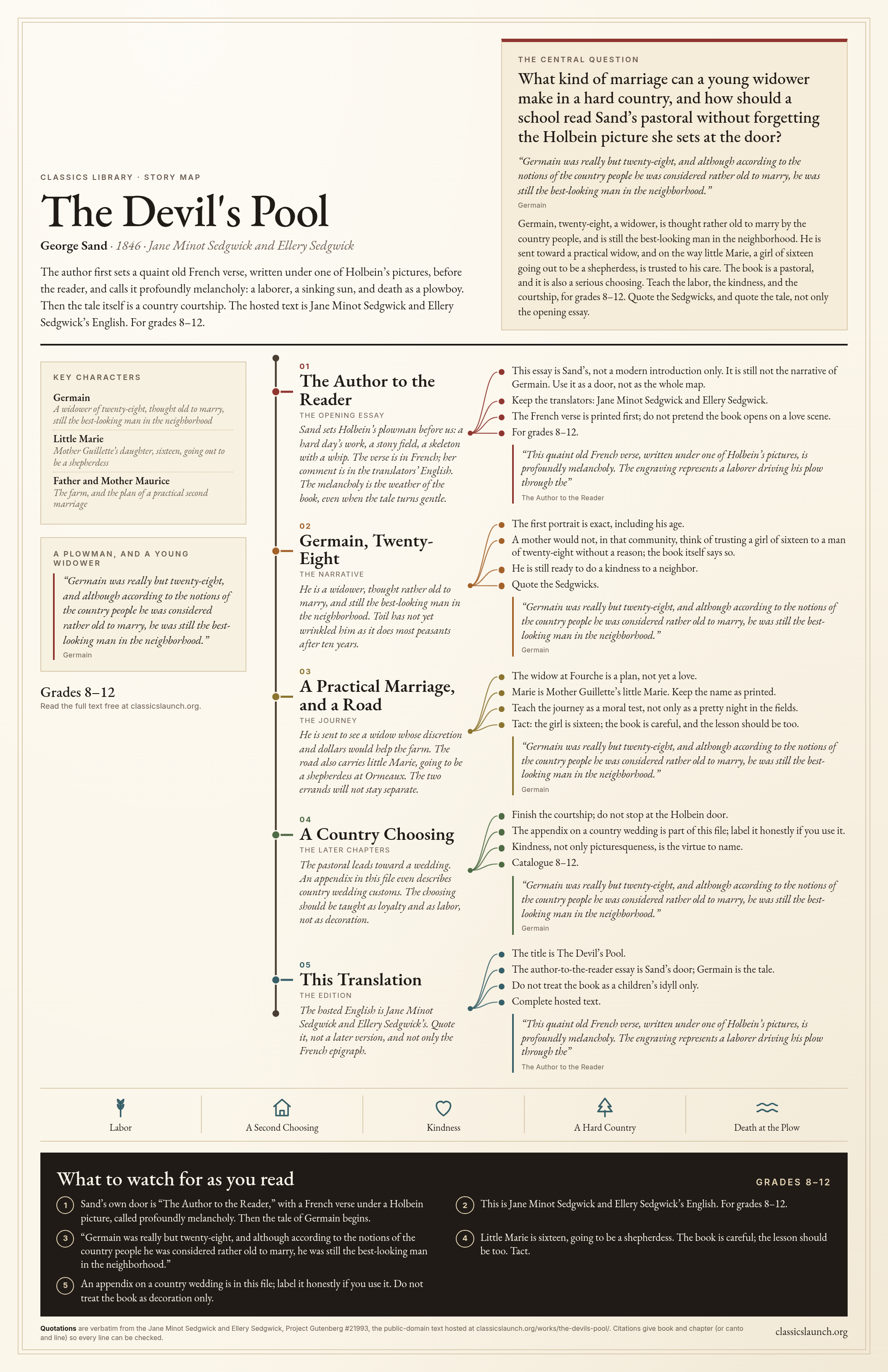
The author first sets a quaint old French verse, written under one of Holbein’s pictures, before the reader, and calls it profoundly melancholy: a laborer, a sinking sun, and death as a plowboy. Then the tale itself is a country courtship. The hosted text is Jane Minot Sedgwick and Ellery Sedgwick’s English. For grades 8–12.
The central question
What kind of marriage can a young widower make in a hard country, and how should a school read Sand’s pastoral without forgetting the Holbein picture she sets at the door?
“Germain was really but twenty-eight, and although according to the notions of the country people he was considered rather old to marry, he was still the best-looking man in the neighborhood.”
Germain, twenty-eight, a widower, is thought rather old to marry by the country people, and is still the best-looking man in the neighborhood. He is sent toward a practical widow, and on the way little Marie, a girl of sixteen going out to be a shepherdess, is trusted to his care. The book is a pastoral, and it is also a serious choosing. Teach the labor, the kindness, and the courtship, for grades 8–12. Quote the Sedgwicks, and quote the tale, not only the opening essay.
- 01
The Author to the Reader
The opening essay
Sand sets Holbein’s plowman before us: a hard day’s work, a stony field, a skeleton with a whip. The verse is in French; her comment is in the translators’ English. The melancholy is the weather of the book, even when the tale turns gentle.
- This essay is Sand’s, not a modern introduction only. It is still not the narrative of Germain. Use it as a door, not as the whole map.
- Keep the translators: Jane Minot Sedgwick and Ellery Sedgwick.
- The French verse is printed first; do not pretend the book opens on a love scene.
- For grades 8–12.
“This quaint old French verse, written under one of Holbein’s pictures, is profoundly melancholy. The engraving represents a laborer driving his plow through the”
- 02
Germain, Twenty-Eight
The narrative
He is a widower, thought rather old to marry, and still the best-looking man in the neighborhood. Toil has not yet wrinkled him as it does most peasants after ten years.
- The first portrait is exact, including his age.
- A mother would not, in that community, think of trusting a girl of sixteen to a man of twenty-eight without a reason; the book itself says so.
- He is still ready to do a kindness to a neighbor.
- Quote the Sedgwicks.
“Germain was really but twenty-eight, and although according to the notions of the country people he was considered rather old to marry, he was still the best-looking man in the neighborhood.”
- 03
A Practical Marriage, and a Road
The journey
He is sent to see a widow whose discretion and dollars would help the farm. The road also carries little Marie, going to be a shepherdess at Ormeaux. The two errands will not stay separate.
- The widow at Fourche is a plan, not yet a love.
- Marie is Mother Guillette’s little Marie. Keep the name as printed.
- Teach the journey as a moral test, not only as a pretty night in the fields.
- Tact: the girl is sixteen; the book is careful, and the lesson should be too.
“Germain was really but twenty-eight, and although according to the notions of the country people he was considered rather old to marry, he was still the best-looking man in the neighborhood.”
- 04
A Country Choosing
The later chapters
The pastoral leads toward a wedding. An appendix in this file even describes country wedding customs. The choosing should be taught as loyalty and as labor, not as decoration.
- Finish the courtship; do not stop at the Holbein door.
- The appendix on a country wedding is part of this file; label it honestly if you use it.
- Kindness, not only picturesqueness, is the virtue to name.
- Catalogue 8–12.
“Germain was really but twenty-eight, and although according to the notions of the country people he was considered rather old to marry, he was still the best-looking man in the neighborhood.”
- 05
This Translation
The edition
The hosted English is Jane Minot Sedgwick and Ellery Sedgwick’s. Quote it, not a later version, and not only the French epigraph.
- The title is The Devil’s Pool.
- The author-to-the-reader essay is Sand’s door; Germain is the tale.
- Do not treat the book as a children’s idyll only.
- Complete hosted text.
“This quaint old French verse, written under one of Holbein’s pictures, is profoundly melancholy. The engraving represents a laborer driving his plow through the”
- Labor
- A Second Choosing
- Kindness
- A Hard Country
- Death at the Plow
What to watch for as you read
Grades 8–12- Sand’s own door is “The Author to the Reader,” with a French verse under a Holbein picture, called profoundly melancholy. Then the tale of Germain begins.
- This is Jane Minot Sedgwick and Ellery Sedgwick’s English. For grades 8–12.
- “Germain was really but twenty-eight, and although according to the notions of the country people he was considered rather old to marry, he was still the best-looking man in the neighborhood.”
- Little Marie is sixteen, going to be a shepherdess. The book is careful; the lesson should be too. Tact.
- An appendix on a country wedding is in this file; label it honestly if you use it. Do not treat the book as decoration only.
Every quotation is word for word from the Jane Minot Sedgwick and Ellery Sedgwick hosted in this library and is checked against that text each time the site is built. Citations give book and chapter (or canto and line).