Story maps · Grades 9–12
The Fall of the Roman Republic: Six Lives: A Story Map
The PDF is one tabloid page (11 × 17 in). On letter paper, choose “Fit to page.”
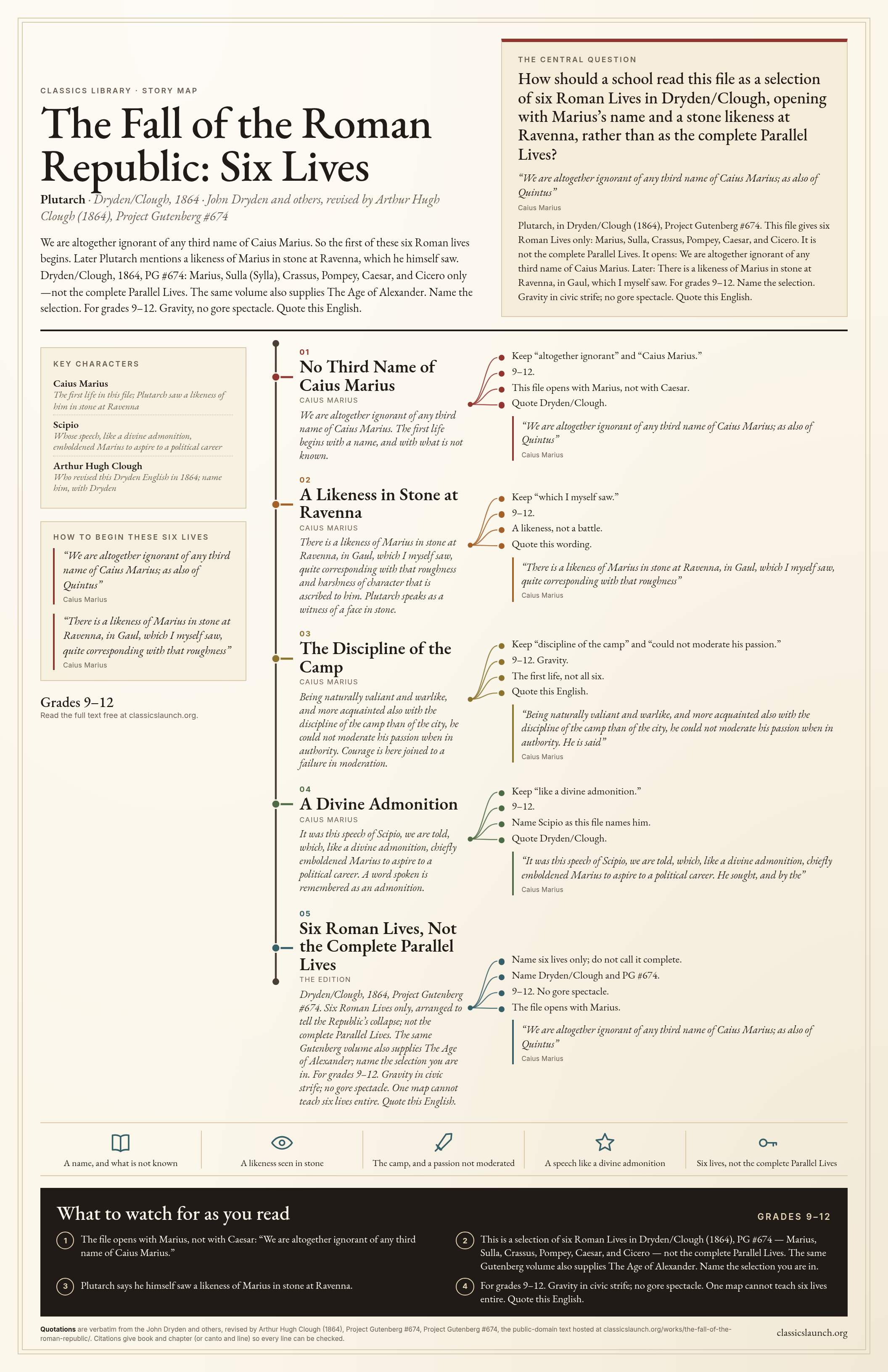
We are altogether ignorant of any third name of Caius Marius. So the first of these six Roman lives begins. Later Plutarch mentions a likeness of Marius in stone at Ravenna, which he himself saw. Dryden/Clough, 1864, PG #674: Marius, Sulla (Sylla), Crassus, Pompey, Caesar, and Cicero only—not the complete Parallel Lives. The same volume also supplies The Age of Alexander. Name the selection. For grades 9–12. Gravity, no gore spectacle. Quote this English.
The central question
How should a school read this file as a selection of six Roman Lives in Dryden/Clough, opening with Marius’s name and a stone likeness at Ravenna, rather than as the complete Parallel Lives?
“We are altogether ignorant of any third name of Caius Marius; as also of Quintus”
Plutarch, in Dryden/Clough (1864), Project Gutenberg #674. This file gives six Roman Lives only: Marius, Sulla, Crassus, Pompey, Caesar, and Cicero. It is not the complete Parallel Lives. It opens: We are altogether ignorant of any third name of Caius Marius. Later: There is a likeness of Marius in stone at Ravenna, in Gaul, which I myself saw. For grades 9–12. Name the selection. Gravity in civic strife; no gore spectacle. Quote this English.
- 01
No Third Name of Caius Marius
Caius Marius
We are altogether ignorant of any third name of Caius Marius. The first life begins with a name, and with what is not known.
- Keep “altogether ignorant” and “Caius Marius.”
- 9–12.
- This file opens with Marius, not with Caesar.
- Quote Dryden/Clough.
“We are altogether ignorant of any third name of Caius Marius; as also of Quintus”
- 02
A Likeness in Stone at Ravenna
Caius Marius
There is a likeness of Marius in stone at Ravenna, in Gaul, which I myself saw, quite corresponding with that roughness and harshness of character that is ascribed to him. Plutarch speaks as a witness of a face in stone.
- Keep “which I myself saw.”
- 9–12.
- A likeness, not a battle.
- Quote this wording.
“There is a likeness of Marius in stone at Ravenna, in Gaul, which I myself saw, quite corresponding with that roughness”
- 03
The Discipline of the Camp
Caius Marius
Being naturally valiant and warlike, and more acquainted also with the discipline of the camp than of the city, he could not moderate his passion when in authority. Courage is here joined to a failure in moderation.
- Keep “discipline of the camp” and “could not moderate his passion.”
- 9–12. Gravity.
- The first life, not all six.
- Quote this English.
“Being naturally valiant and warlike, and more acquainted also with the discipline of the camp than of the city, he could not moderate his passion when in authority. He is said”
- 04
A Divine Admonition
Caius Marius
It was this speech of Scipio, we are told, which, like a divine admonition, chiefly emboldened Marius to aspire to a political career. A word spoken is remembered as an admonition.
- Keep “like a divine admonition.”
- 9–12.
- Name Scipio as this file names him.
- Quote Dryden/Clough.
“It was this speech of Scipio, we are told, which, like a divine admonition, chiefly emboldened Marius to aspire to a political career. He sought, and by the”
- 05
Six Roman Lives, Not the Complete Parallel Lives
The edition
Dryden/Clough, 1864, Project Gutenberg #674. Six Roman Lives only, arranged to tell the Republic’s collapse; not the complete Parallel Lives. The same Gutenberg volume also supplies The Age of Alexander; name the selection you are in. For grades 9–12. Gravity in civic strife; no gore spectacle. One map cannot teach six lives entire. Quote this English.
- Name six lives only; do not call it complete.
- Name Dryden/Clough and PG #674.
- 9–12. No gore spectacle.
- The file opens with Marius.
“We are altogether ignorant of any third name of Caius Marius; as also of Quintus”
- A name, and what is not known
- A likeness seen in stone
- The camp, and a passion not moderated
- A speech like a divine admonition
- Six lives, not the complete Parallel Lives
What to watch for as you read
Grades 9–12- The file opens with Marius, not with Caesar: “We are altogether ignorant of any third name of Caius Marius.”
- This is a selection of six Roman Lives in Dryden/Clough (1864), PG #674 — Marius, Sulla, Crassus, Pompey, Caesar, and Cicero — not the complete Parallel Lives. The same Gutenberg volume also supplies The Age of Alexander. Name the selection you are in.
- Plutarch says he himself saw a likeness of Marius in stone at Ravenna.
- For grades 9–12. Gravity in civic strife; no gore spectacle. One map cannot teach six lives entire. Quote this English.
Every quotation is word for word from the John Dryden and others, revised by Arthur Hugh Clough (1864), Project Gutenberg #674 hosted in this library and is checked against that text each time the site is built. Citations give book and chapter (or canto and line).