Story maps · Grades 9–12
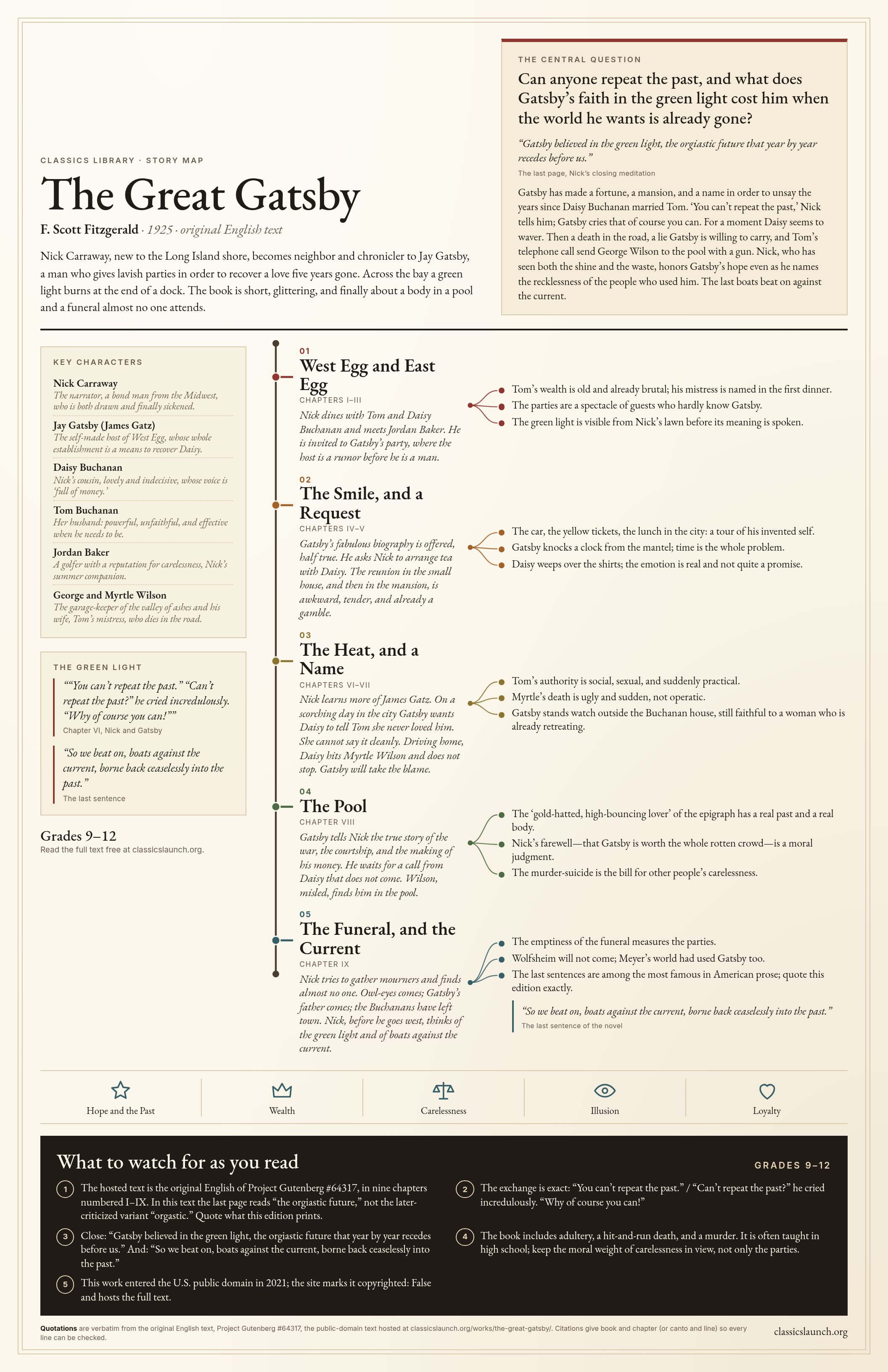
The Great Gatsby: A Story Map
The PDF is one tabloid page (11 × 17 in). On letter paper, choose “Fit to page.”
Nick Carraway, new to the Long Island shore, becomes neighbor and chronicler to Jay Gatsby, a man who gives lavish parties in order to recover a love five years gone. Across the bay a green light burns at the end of a dock. The book is short, glittering, and finally about a body in a pool and a funeral almost no one attends.
The central question
Can anyone repeat the past, and what does Gatsby’s faith in the green light cost him when the world he wants is already gone?
“Gatsby believed in the green light, the orgiastic future that year by year recedes before us.”
Gatsby has made a fortune, a mansion, and a name in order to unsay the years since Daisy Buchanan married Tom. ‘You can’t repeat the past,’ Nick tells him; Gatsby cries that of course you can. For a moment Daisy seems to waver. Then a death in the road, a lie Gatsby is willing to carry, and Tom’s telephone call send George Wilson to the pool with a gun. Nick, who has seen both the shine and the waste, honors Gatsby’s hope even as he names the recklessness of the people who used him. The last boats beat on against the current.
- 01
West Egg and East Egg
Chapters I–III
Nick dines with Tom and Daisy Buchanan and meets Jordan Baker. He is invited to Gatsby’s party, where the host is a rumor before he is a man.
- Tom’s wealth is old and already brutal; his mistress is named in the first dinner.
- The parties are a spectacle of guests who hardly know Gatsby.
- The green light is visible from Nick’s lawn before its meaning is spoken.
- 02
The Smile, and a Request
Chapters IV–V
Gatsby’s fabulous biography is offered, half true. He asks Nick to arrange tea with Daisy. The reunion in the small house, and then in the mansion, is awkward, tender, and already a gamble.
- The car, the yellow tickets, the lunch in the city: a tour of his invented self.
- Gatsby knocks a clock from the mantel; time is the whole problem.
- Daisy weeps over the shirts; the emotion is real and not quite a promise.
- 03
The Heat, and a Name
Chapters VI–VII
Nick learns more of James Gatz. On a scorching day in the city Gatsby wants Daisy to tell Tom she never loved him. She cannot say it cleanly. Driving home, Daisy hits Myrtle Wilson and does not stop. Gatsby will take the blame.
- Tom’s authority is social, sexual, and suddenly practical.
- Myrtle’s death is ugly and sudden, not operatic.
- Gatsby stands watch outside the Buchanan house, still faithful to a woman who is already retreating.
- 04
The Pool
Chapter VIII
Gatsby tells Nick the true story of the war, the courtship, and the making of his money. He waits for a call from Daisy that does not come. Wilson, misled, finds him in the pool.
- The ‘gold-hatted, high-bouncing lover’ of the epigraph has a real past and a real body.
- Nick’s farewell—that Gatsby is worth the whole rotten crowd—is a moral judgment.
- The murder-suicide is the bill for other people’s carelessness.
- 05
The Funeral, and the Current
Chapter IX
Nick tries to gather mourners and finds almost no one. Owl-eyes comes; Gatsby’s father comes; the Buchanans have left town. Nick, before he goes west, thinks of the green light and of boats against the current.
- The emptiness of the funeral measures the parties.
- Wolfsheim will not come; Meyer’s world had used Gatsby too.
- The last sentences are among the most famous in American prose; quote this edition exactly.
“So we beat on, boats against the current, borne back ceaselessly into the past.”
- Hope and the Past
- Wealth
- Carelessness
- Illusion
- Loyalty
What to watch for as you read
Grades 9–12- The hosted text is the original English of Project Gutenberg #64317, in nine chapters numbered I–IX. In this text the last page reads “the orgiastic future,” not the later-criticized variant “orgastic.” Quote what this edition prints.
- The exchange is exact: “You can’t repeat the past.” / “Can’t repeat the past?” he cried incredulously. “Why of course you can!”
- Close: “Gatsby believed in the green light, the orgiastic future that year by year recedes before us.” And: “So we beat on, boats against the current, borne back ceaselessly into the past.”
- The book includes adultery, a hit-and-run death, and a murder. It is often taught in high school; keep the moral weight of carelessness in view, not only the parties.
- This work entered the U.S. public domain in 2021; the site marks it copyrighted: False and hosts the full text.
Every quotation is word for word from the original English text hosted in this library and is checked against that text each time the site is built. Citations give book and chapter (or canto and line).