Story maps · Grades 11–12
The House of the Dead: A Story Map
The PDF is one tabloid page (11 × 17 in). On letter paper, choose “Fit to page.”
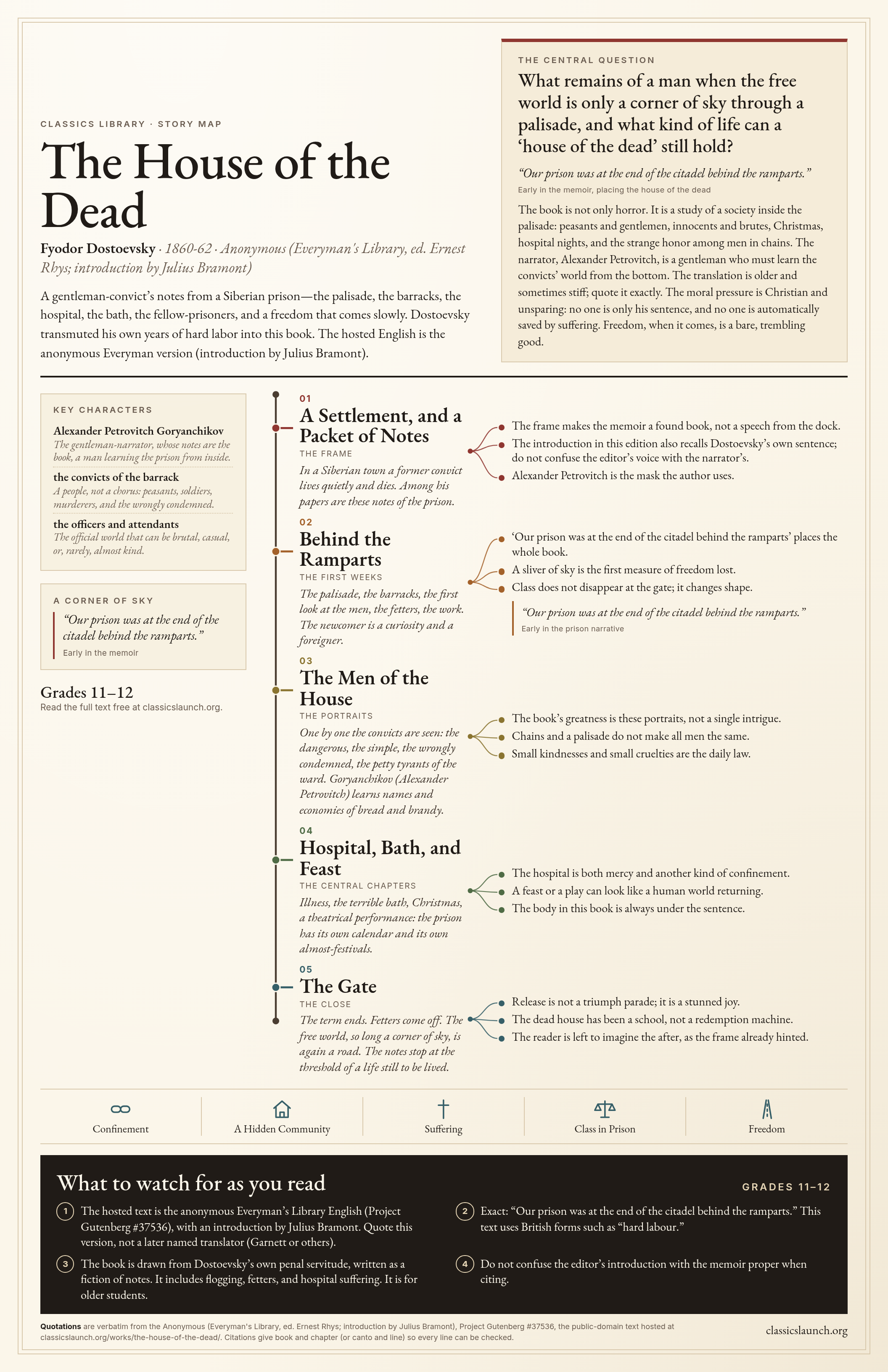
A gentleman-convict’s notes from a Siberian prison—the palisade, the barracks, the hospital, the bath, the fellow-prisoners, and a freedom that comes slowly. Dostoevsky transmuted his own years of hard labor into this book. The hosted English is the anonymous Everyman version (introduction by Julius Bramont).
The central question
What remains of a man when the free world is only a corner of sky through a palisade, and what kind of life can a ‘house of the dead’ still hold?
“Our prison was at the end of the citadel behind the ramparts.”
The book is not only horror. It is a study of a society inside the palisade: peasants and gentlemen, innocents and brutes, Christmas, hospital nights, and the strange honor among men in chains. The narrator, Alexander Petrovitch, is a gentleman who must learn the convicts’ world from the bottom. The translation is older and sometimes stiff; quote it exactly. The moral pressure is Christian and unsparing: no one is only his sentence, and no one is automatically saved by suffering. Freedom, when it comes, is a bare, trembling good.
- 01
A Settlement, and a Packet of Notes
The frame
In a Siberian town a former convict lives quietly and dies. Among his papers are these notes of the prison.
- The frame makes the memoir a found book, not a speech from the dock.
- The introduction in this edition also recalls Dostoevsky’s own sentence; do not confuse the editor’s voice with the narrator’s.
- Alexander Petrovitch is the mask the author uses.
- 02
Behind the Ramparts
The first weeks
The palisade, the barracks, the first look at the men, the fetters, the work. The newcomer is a curiosity and a foreigner.
- ‘Our prison was at the end of the citadel behind the ramparts’ places the whole book.
- A sliver of sky is the first measure of freedom lost.
- Class does not disappear at the gate; it changes shape.
“Our prison was at the end of the citadel behind the ramparts.”
- 03
The Men of the House
The portraits
One by one the convicts are seen: the dangerous, the simple, the wrongly condemned, the petty tyrants of the ward. Goryanchikov (Alexander Petrovitch) learns names and economies of bread and brandy.
- The book’s greatness is these portraits, not a single intrigue.
- Chains and a palisade do not make all men the same.
- Small kindnesses and small cruelties are the daily law.
- 04
Hospital, Bath, and Feast
The central chapters
Illness, the terrible bath, Christmas, a theatrical performance: the prison has its own calendar and its own almost-festivals.
- The hospital is both mercy and another kind of confinement.
- A feast or a play can look like a human world returning.
- The body in this book is always under the sentence.
- 05
The Gate
The close
The term ends. Fetters come off. The free world, so long a corner of sky, is again a road. The notes stop at the threshold of a life still to be lived.
- Release is not a triumph parade; it is a stunned joy.
- The dead house has been a school, not a redemption machine.
- The reader is left to imagine the after, as the frame already hinted.
- Confinement
- A Hidden Community
- Suffering
- Class in Prison
- Freedom
What to watch for as you read
Grades 11–12- The hosted text is the anonymous Everyman’s Library English (Project Gutenberg #37536), with an introduction by Julius Bramont. Quote this version, not a later named translator (Garnett or others).
- Exact: “Our prison was at the end of the citadel behind the ramparts.” This text uses British forms such as “hard labour.”
- The book is drawn from Dostoevsky’s own penal servitude, written as a fiction of notes. It includes flogging, fetters, and hospital suffering. It is for older students.
- Do not confuse the editor’s introduction with the memoir proper when citing.
Every quotation is word for word from the Anonymous (Everyman's Library, ed. Ernest Rhys; introduction by Julius Bramont) hosted in this library and is checked against that text each time the site is built. Citations give book and chapter (or canto and line).